Collagen Supplements for Your Face - What Actually Works
The global collagen supplement market surpassed $7.5 billion in 2025 and is projected to reach $16.7 billion by 2030. Influencer claims range from "erased my wrinkles in two weeks" to "better than Botox." The reality is more nuanced. Oral collagen peptides do have legitimate clinical evidence behind them - multiple randomized controlled trials show measurable improvements in skin elasticity, hydration, and collagen density. But the timelines, dosages, and limitations are nothing like the marketing suggests. Here is what the peer-reviewed research actually shows.
Key Takeaway
Hydrolyzed collagen peptides (2.5-10g/day) have the strongest evidence for skin improvements, with measurable results in skin elasticity (+15-20%) and hydration appearing after 8-12 weeks of consistent use. They support ongoing collagen synthesis but cannot reverse deep structural loss or replace clinical treatments.
What Is Collagen and Why Does Your Face Lose It?
Collagen is the most abundant protein in the human body, making up approximately 75-80% of the dry weight of skin. It provides the structural scaffold that keeps skin firm, plump, and resilient. Three types matter most for facial appearance:
Type I
80% of skin collagen
The primary structural collagen in skin, bones, and tendons. Provides tensile strength and firmness. This is what declines most visibly with age.
Type III
15% of skin collagen
Found alongside Type I in skin and blood vessels. Provides elasticity and suppleness. More abundant in youthful skin and gradually replaced by Type I with age.
Type II
Cartilage collagen
Primarily found in cartilage and joints, not in skin. Relevant for joint supplements but not directly responsible for facial skin quality.
Starting around age 25, your body's collagen production drops by approximately 1-1.5% per year. By age 50, you have lost roughly 25-35% of your total skin collagen. But age is only one factor - four forces drive facial collagen decline:
1
Chronological aging
After age 25, fibroblast activity slows and collagen production drops 1-1.5% annually. Post-menopause, women lose up to 30% of skin collagen in the first 5 years due to estrogen decline.
2
UV exposure (photoaging)
Accounts for approximately 80% of visible skin aging. UVA rays penetrate the dermis and activate matrix metalloproteinases (MMPs) that directly break down existing collagen fibers and suppress new collagen synthesis.
3
Diet and nutrition
Insufficient protein intake limits amino acid availability (glycine, proline, hydroxyproline) for collagen synthesis. Vitamin C deficiency impairs the hydroxylation step essential for stable collagen triple-helix formation.
4
Lifestyle factors
Smoking reduces collagen synthesis by up to 40% and increases MMP activity. High sugar intake causes glycation - glucose molecules cross-link collagen fibers, making them stiff and brittle. Chronic stress elevates cortisol, which degrades collagen.
By Age 50
25-35%
Total skin collagen lost - with UV exposure accounting for ~80% of visible aging
Types of Collagen Supplements Compared
Not all collagen supplements are equal. The form, source, and molecular weight dramatically affect absorption and efficacy. Here is how they compare:
Supplement Types and Bioavailability
| Type | Molecular Weight | Collagen Types | Absorption | Best For |
|---|---|---|---|---|
| Hydrolyzed collagen peptides | 2-5 kDa | I, III (varies by source) | High~90% absorbed | Skin elasticity, hydration, wrinkle reduction - the form used in most clinical trials |
| Gelatin | 50-100 kDa | I, III | Moderaterequires digestion | Cooking and gut health - not ideal for targeted skin benefits due to larger molecular size |
| Undenatured Type II | Intact (not hydrolyzed) | II only | Lowimmune modulation | Joint health only - works via oral tolerance (immune mechanism), not skin collagen synthesis |
| Marine collagen | 2-5 kDa (hydrolyzed) | Primarily Type I | Highsmaller peptides | Skin-focused - primarily Type I matches skin composition, sourced from fish scales/skin |
| Bovine collagen | 2-5 kDa (hydrolyzed) | Types I and III | Highwell-studied | Skin + joints - Types I and III support both skin and connective tissue, most cost-effective option |
| Porcine collagen | 2-5 kDa (hydrolyzed) | Types I and III | Highsimilar to human | Skin - amino acid profile closest to human collagen, less common in consumer supplements |
Molecular weight is the critical factor. Hydrolyzed peptides (2-5 kDa) are absorbed up to 90% in the small intestine and reach the dermis within hours. Gelatin (50-100 kDa) must be broken down further during digestion, reducing bioavailability.
What Does the Research Actually Show?
Unlike many supplement categories, oral collagen peptides have a growing body of randomized controlled trials with measurable outcomes. Here are the key findings:
Systematic Review - 2019
Journal of Drugs in Dermatology
Analyzed 11 randomized controlled trials with a total of 805 patients. Oral collagen supplementation at 2.5-10g per day significantly improved skin elasticity, hydration, and dermal collagen density compared to placebo across all studies. The review concluded that collagen peptides are a "promising alternative" for short and long-term skin health improvement.
Proksch et al. - 2014
Skin Pharmacology and Physiology
69 women aged 35-55 received either 2.5g or 5g of collagen peptides daily for 8 weeks. Skin elasticity improved by 15% in the 2.5g group and 20% in the 5g group compared to placebo. Effects were most pronounced in women over 50. The improvements persisted for at least 4 weeks after supplementation stopped, suggesting lasting changes in dermal collagen synthesis.
Asserin et al. - 2015
Journal of Cosmetic Dermatology
Participants taking 10g of collagen peptides daily for 8 weeks experienced a 28% increase in skin hydration compared to placebo. Collagen density in the dermis increased significantly, measured via high-resolution ultrasound. Wrinkle depth also decreased, with effects continuing to improve at the 4-week follow-up after supplementation ended.
Inoue et al. - 2016
Bioscience, Biotechnology, and Biochemistry
Collagen-derived dipeptides (Pro-Hyp and Hyp-Gly) stimulated hyaluronic acid production in dermal fibroblasts by up to 10x. Hyaluronic acid is the molecule responsible for skin hydration and plumpness, holding up to 1,000 times its weight in water. This provides a mechanistic explanation for why oral collagen improves skin hydration - it does not just add collagen but stimulates the skin's own hyaluronic acid production.
Evidence Strength by Claim
How strong is the clinical evidence for each purported benefit of oral collagen supplements?
Skin hydration
STRONGMultiple RCTs show 12-28% increases in skin hydration at 2.5-10g/day after 8 weeks
Skin elasticity
STRONGProksch et al. showed 15-20% improvement; confirmed across systematic review of 11 trials
Wrinkle reduction
MODERATESeveral trials show reduced wrinkle depth at 12+ weeks, but effect sizes vary and are modest
Wound healing
MODERATEAnimal and small human studies show faster wound repair and increased collagen deposition
Hair and nail growth
LIMITEDSome evidence for nail brittleness reduction; hair studies are mostly anecdotal or industry-funded
Cellulite reduction
LIMITEDOne industry-funded study showed mild improvement; independent replication is lacking
Dosing: How Much Do You Actually Need?
Dosing matters - the clinical trials that showed results used specific amounts. Too little may be ineffective; more is not always better. Here is what the evidence supports:
Evidence-Based Dosing
| Goal | Dose | Min. Duration | Evidence | Notes |
|---|---|---|---|---|
| General skin health | 2.5-5g/day | 8 weeks | Strong | 2.5g showed 15% elasticity gain in Proksch trial; effective and cost-efficient for maintenance |
| Anti-aging / wrinkle reduction | 5-10g/day | 12 weeks | Strong | 5g = 20% elasticity gain; 10g = 28% hydration increase; higher dose = stronger effects in trials |
| Joint support (secondary) | 10g/day | 12 weeks | Moderate | Benefits joint pain in athletes and osteoarthritis patients; bonus benefit at higher skin doses |
Timing
Most clinical studies administered collagen in the morning on an empty stomach, but there is no evidence that timing significantly affects absorption or efficacy. Consistency matters far more than timing - take it whenever you will actually remember to take it daily.
Vitamin C Cofactor
Vitamin C is required for the hydroxylation of proline and lysine - a critical step in stable collagen synthesis. Without it, your body cannot properly assemble new collagen. Minimum intake: 75mg/day (women) or 90mg/day (men). Many researchers suggest 200-500mg for optimal support.
Minimum Duration
Do not expect visible results before 8 weeks. Most improvements become measurable between weeks 8-12, with continued gains through week 24. The collagen renewal cycle in adult skin takes 2-3 months, which is why shorter supplementation periods rarely show results in clinical measurements.
Shop well-reviewed collagen supplements
Affiliate links - we may earn a commission at no extra cost to you.
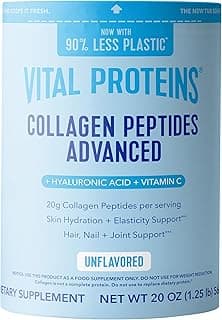
Collagen Peptides
Vital Proteins Collagen Peptides Powder Advanced with Hyaluronic Acid & Vitamin C, 20oz Collagen Protein, Unflavored, 27 Servings
Shop on Amazon →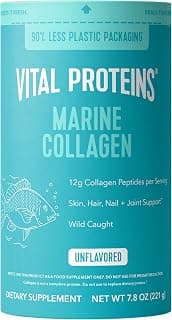
Marine Collagen
Vital Proteins Marine Collagen Peptides Powder Supplement for Skin Hair Nail Joint - Hydrolyzed Collagen - 12g per Serving - 7.8 oz Canister
Shop on Amazon →What Collagen Supplements Cannot Do
The evidence for oral collagen is real - but so are the limitations. Being honest about what supplements cannot achieve is essential for setting realistic expectations:
Cannot reverse deep structural collagen loss
LIMITATIONDecades of photoaging and chronological aging cause irreversible changes to the dermal extracellular matrix. Supplements support new collagen synthesis but cannot rebuild the dense, organized collagen network that existed in youth. The 25-35% loss by age 50 is permanent - supplements slow further decline and modestly improve current quality.
Cannot replace dermal fillers for volume restoration
LIMITATIONFillers physically inject volume (hyaluronic acid, calcium hydroxylapatite) directly beneath the skin for immediate, targeted results. Oral collagen works systemically over months, producing subtle improvements in skin quality - not the volumetric restoration that fillers provide. These are complementary approaches, not substitutes.
Cannot target specific facial areas
LIMITATIONOnce digested and absorbed, collagen peptides are distributed systemically via the bloodstream. You cannot direct them to your nasolabial folds, under-eyes, or forehead specifically. Benefits are distributed across the entire body - skin, joints, bones, and gut lining all compete for the same peptide supply.
Will not produce dramatic before-and-after transformations
LIMITATIONMarketing photos showing dramatic transformations from collagen supplements alone are misleading. The 15-20% elasticity improvement and 28% hydration increase from clinical trials are measurable by instruments but translate to subtle, gradual visible improvements - not the overnight transformations shown in advertisements.
Honest framing: collagen supplements are a maintenance tool that supports your skin's ongoing repair processes. They are most effective when combined with sun protection, adequate nutrition, and healthy lifestyle habits. Think of them as one layer in a comprehensive skin health strategy - not a standalone solution.
How to Maximize Results from Collagen Supplements
Collagen supplements work best when combined with lifestyle factors that support collagen synthesis and prevent degradation. These are ranked by impact based on the available evidence:
1
Daily SPF 30+ sunscreen
UV exposure is the single largest driver of collagen degradation, accounting for ~80% of visible skin aging. Daily broad-spectrum SPF 30+ prevents further damage from UVA-induced matrix metalloproteinases (MMPs) that break down collagen. Without sun protection, supplementation is fighting a losing battle.
2
Adequate vitamin C intake (75-500mg/day)
Vitamin C is the essential cofactor for prolyl hydroxylase and lysyl hydroxylase - the enzymes that stabilize collagen's triple-helix structure. Without sufficient vitamin C, collagen synthesis stalls regardless of peptide availability. Sources: citrus fruits, bell peppers, broccoli, kiwi, or a 200-500mg supplement.
3
Adequate protein intake (0.8-1.2g per kg bodyweight)
Collagen synthesis requires amino acids - particularly glycine (33% of collagen), proline (13%), and hydroxyproline. If total protein intake is insufficient, your body prioritizes essential functions over skin collagen production. A 70kg adult needs at least 56-84g of total daily protein.
4
Quality sleep (7-9 hours)
Human growth hormone (HGH) peaks during deep slow-wave sleep and is a key driver of tissue repair, including collagen synthesis. Sleep deprivation reduces HGH secretion by up to 70%. Chronic poor sleep also elevates cortisol, which directly degrades collagen through increased MMP expression.
5
Limit sugar and alcohol consumption
Excess sugar causes glycation - glucose molecules bond to collagen fibers, forming Advanced Glycation End-products (AGEs) that make collagen stiff, brittle, and dysfunctional. Alcohol dehydrates skin, impairs nutrient absorption, increases inflammation, and depletes vitamin A needed for cell turnover. Both accelerate collagen aging.
See how your skin scores
Upload a photo to get an AI-powered analysis of your facial proportions, skin quality, and symmetry - with personalized recommendations for improvement based on your unique facial structure. Understand your starting point before optimizing your skincare routine.
Try it on your own face
Stop reading. Start seeing - these tools turn this guide into a result.
Time Machine
2 tokensSee yourself 10 years younger - what collagen aspirations actually look like.
Procedure Preview
1 tokenIf you want collagen-style results faster, see what mild filler or volumising treatments could do.
Glow-Up Pack
5 tokensPolished skin + optimised grooming - the visible part of what collagen claims to deliver.
Face Age Test
FreeBaseline AI-estimated perceived age. Track if your supplement routine actually moves the needle.
Related Guides
How to Get Better Cheekbones
Face yoga, fillers, and lifestyle changes
How to Improve Your Jawline
Exercises, body fat, and clinical treatments
How to Improve Facial Symmetry
Exercises, habits, and clinical treatments
Glow-Up Tips That Actually Work
Evidence-based strategies for facial improvement
Nasolabial Fold Reduction
Where collagen meets clinical fold treatment
Check Your Facial Harmony Score →
Free AI analysis of symmetry, proportions, and golden ratio