Measure FWHR, midface ratio, eye spacing, and 9 other photo-based facial ratios. 478 landmarks, processed in your browser.
fWHR (facial width-to-height ratio) divides face width at the cheekbones by upper-face height. Published studies use different vertical anchors and report values mostly between about 1.6 and 2.2, with no single "good" number - research links to behavior and perception are small and contested. This calculator measures an fWHR-style photo ratio plus your midface ratio and 12 ratios total, and shows exactly which anchors it uses.
For a reliable result: keep the lens at eye level, your chin neutral, and both sides of your face equally visible.
Upload a photo
Drag and drop or choose a file
or
JPG, PNG or HEIC, up to 30MB
Your photo never leaves your device
Example
Every measurement drawn where it was taken, then placed among 14,000+ faces. Built on your device in about a second.
What Are Facial Ratios?
Facial ratios are mathematical relationships between distances on a face. This calculator estimates 12 of them from selected MediaPipe landmarks in one front-facing photo. Some names overlap with artistic canons, psychology research, or clinical anthropometry, but published methods do not always use the same anchors. The formulas below describe exactly what this tool computes.
The comparison bands are internal calculator references selected for this landmark geometry and historical score continuity. They are not universal ideals, population norms, or treatment thresholds. Use the result to describe this photo and compare consistently taken photos, not as a beauty or health test. For vertical proportions, the facial thirds test on our golden ratio calculator measures your three visible face bands and shows where each sits among faces measured on this site.
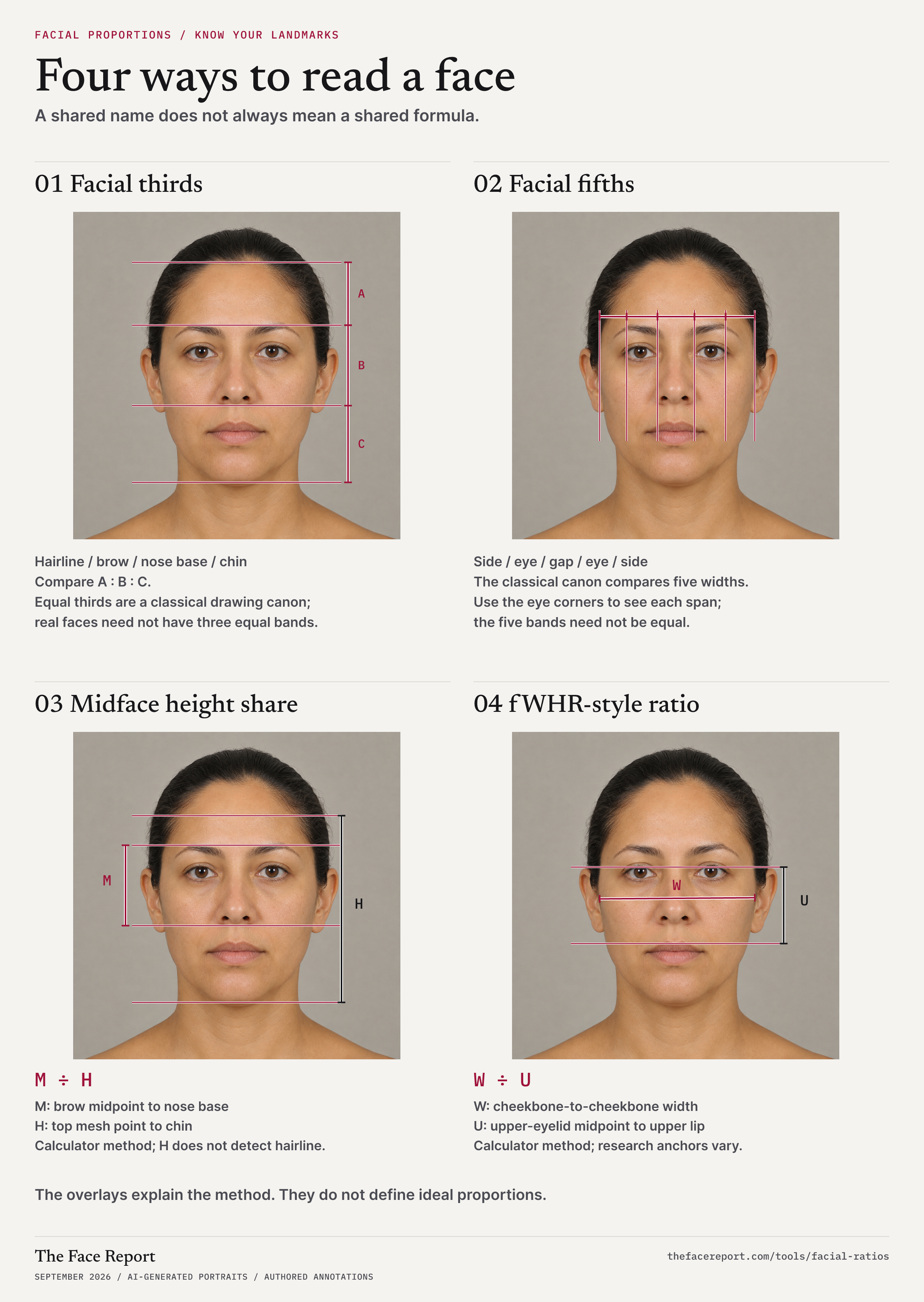
The top row explains the classical thirds and fifths. The bottom row shows this calculator’s midface and fWHR-style formulas. Published methods and other calculators can use different anchors, so similarly named ratios are not always comparable.
Open the image above to inspect the details at full size.
Four ways to read a face. The Face Report (2026). https://thefacereport.com/tools/facial-ratios#facial-ratios-atlas
How this was made & reuse permission
One AI-generated adult portrait analyzed with MediaPipe Face Landmarker. Calculator overlays use the same landmark indices as our ratio engine. The classical hairline is separately annotated; a mesh boundary does not detect the hairline. The diagram explains measurement definitions without claiming ideal proportions or reporting a clinical assessment.
You may reproduce this reference graphic in articles, teaching materials and social posts. A credit to The Face Report and a link to this source page are appreciated. If you adapt it, identify your changes and keep its illustrative context clear. This permission applies to this graphic.
Tap a free measurement in your results above to draw it on your photo. Below is the full methodology for all 12measurements, including the calculator reference used for scoring.
Describes how broad the visible upper face appears in this photo. Published fWHR studies use more than one vertical anchor, so this calculator-specific value should only be compared with the band and method shown here.
Visible Face Length-to-Width Ratio
Reference: 1.18–1.28
Formula: visible face height (top mesh point to chin) ÷ cheekbone width
Describes how long the visible face mesh is relative to its width. It helps explain the geometry behind a face-shape result, but it is not the clinical facial index and does not detect the hairline.
Jaw-to-Cheekbone Width Ratio
Reference: 0.76–0.82
Formula: jaw width ÷ cheekbone width
Compares lower-face width with the widest cheekbone span. Camera distance, head turn, hair, and landmark visibility can all change the photo estimate.
Pupil-Distance-to-Face-Width Ratio
Reference: 0.46–0.5
Formula: iris-center distance ÷ cheekbone width
Compares the detected iris-center distance with visible face width. It is a photo proportion, not a millimeter pupillary-distance measurement for glasses.
Eye Spacing Ratio
Reference: 1.05–1.35
Formula: inner-eye gap ÷ average visible eye width
Shows how the gap between the eyes compares with the average width of the two visible eyes. The familiar one-eye-gap rule is an artistic convention, not a requirement.
Average Canthal Tilt
Reference: 2–7
Formula: average left/right inner-to-outer eye-corner angle against a fitted face-horizontal axis
Estimates whether the outer eye corners sit above or below the inner corners. It is reported in degrees and is especially sensitive to camera height and head pose.
Midface Height Share
Reference: 0.38–0.44
Formula: brow-midpoint-to-nose-base distance ÷ visible face height
Shows how much of the detected visible face height lies between the brow midpoint and nose base. Other online midface calculators use different anchors, so their numbers are not interchangeable.
Lower-Face Height Share
Reference: 0.36–0.42
Formula: nose-base-to-chin distance ÷ visible face height
Shows how much of the visible face height lies between the nose base and chin. A difference from the calculator band is not evidence of asymmetry or a treatment need.
Mouth-to-Face Width Ratio
Reference: 0.38–0.45
Formula: mouth-corner width ÷ cheekbone width
Compares detected mouth width with visible face width. Expression and lens perspective can move the estimate even when the underlying face is unchanged.
Nose-to-Mouth Width Ratio
Reference: 0.72–0.86
Formula: nose-ala width ÷ mouth-corner width
Compares the detected width of the nose base with mouth width. Facial proportions vary across people and populations, so the band is a calculator reference rather than a universal norm.
Nose-Length-to-Face-Height Ratio
Reference: 0.2–0.24
Formula: nose-bridge-to-tip distance ÷ visible face height
Compares the detected nose bridge-to-tip distance with visible face height. A front photo cannot provide a full three-dimensional measure of projection or profile shape.
Lip-Height-to-Mouth-Width Ratio
Reference: 0.25–0.4
Formula: outer lip height ÷ mouth-corner width
Compares detected outer lip height with mouth width. Keep the lips relaxed: smiling, pressing, or pursing them changes the photo measurement.
Deep Dive: FWHR (Facial Width-to-Height Ratio)
Facial width-to-height ratio (fWHR) has been studied in psychology, but it is not a single standardized beauty metric. The original Carré and McCormick method used cheekbone width and a mid-brow to upper-lip height. Later papers used other anchors, and reviews report small, inconsistent, or context-dependent associations. This tool therefore labels its eyelid-midpoint version as an fWHR-style photo measurement rather than treating it as a personality or attractiveness test.
Key fWHR facts
Formula: bizygomatic width (cheekbone to cheekbone) divided by upper face height (midpoint of the detected upper-eyelid landmarks to the upper lip).
Calculator reference: 1.8 to 2.1 for this exact landmark definition. It is not a universal adult norm.
What a higher value means: the visible cheekbone span is wider relative to the measured upper-face height in this photo.
Limitations: one front photo cannot reproduce caliper measurements or remove perspective. Research definitions and samples also differ, so values from unlike methods should not be compared directly.
For practical photo setup, grooming context, and an evidence-graded discussion of what can and cannot change the visible lower face, see our guide on how to improve your jawline naturally.
What Is a Good Midface Ratio?
The midface ratio measures the vertical middle third of the face. On the most common online convention - interpupillary distance divided by the vertical distance from the pupil line to the upper lip - values cluster around 1.0, with roughly 0.9–1.1 usually described as balanced: a noticeably higher value reads as a "compact" midface, a lower one as a longer midface. This calculator uses a different, landmark-stable convention - midface height share, the brow-midpoint-to-nose-base distance divided by visible face-mesh height, with a reference band of 0.38–0.44. The median face measured here reads 0.44, and half of faces read 0.42–0.46.
The two conventions measure different landmark pairs, so their numbers are not interchangeable and neither is a universal ideal - treat any single figure as a photo-based estimate, not the clinical midface index. Upload a photo above and the calculator measures yours from 478 landmarks in your browser.
Deep Dive: Midface Ratio
The midface ratio compares the height of your midface - the vertical span from your brow line down to the base of your nose - against the visible face-mesh height. The value describes landmark geometry in this photo; by itself it cannot diagnose aging, sex, ethnicity, skeletal structure, or a need for treatment.
Why photo setup matters
Camera height and pitch change vertical distances, while close wide-angle selfies exaggerate the center of the face. Expression and landmark visibility add more variation. Repeat photos at the same eye-level angle and distance for a useful comparison.
What the calculator measures
The numerator runs from the midpoint of the two detected brow peaks to the nose-base landmark. The denominator runs from the visible top face-mesh point to the chin. The tool divides those pixel distances, so no real-world unit or hairline detection is required.
Quick reference: this calculator's midface score
Below 0.38: the measured brow-to-nose span is a smaller share of visible face height than this tool's reference band.
0.38–0.44: inside this tool's current internal reference band.
Above 0.44: the measured brow-to-nose span is a larger share of visible face height than the reference band. Half of faces measured here read 0.42–0.46, so a value just above the band is common and does not by itself mean a long midface.
Different midface ratios pair with different face shapes - for styling implications by shape, see our face shape hairstyle guide.
Where You Sit Among 14,144 Faces
Every free measurement is placed on a rail: the band is the middle half of straight-on, neutral-expression faces measured on this site on one closed day, and the tick is the median. Your marker shows where this photo sits. It is a placement, not a grade - most faces sit inside the band, and the ends of a rail are simply less common, not better or worse.
The same distribution, with percentiles for all 12 ratios, is published on the facial measurement norms page. The plate above the rails draws each measurement on your photo exactly where it was taken, and the fWHR rail also prints the brow-to-lip research-method value so you can compare with published study means.
What Your Overall Score Means
The overall score is an equal-weight average of each measurement's proximity to its calculator reference band across all 12ratios. It is designed as a compact summary of this photo - not a percentile, probability, or validated attractiveness score.
85–100 - Very close reference match
Most measurements sit close to this calculator's selected reference bands.
75–84 - Close reference match
Several measurements sit close to the calculator's reference bands, with some differences.
65–74 - Mixed reference match
The result includes both closer matches and larger differences from the selected bands.
Below 65 - Larger reference difference
More measurements differ from the selected bands. This is descriptive, not a beauty, health, or clinical verdict.
Tips for Accurate Measurement
Front-facing, eye-level camera
Vertical angle and head turn distort several ratios. Keep the lens at eye level, your chin neutral, and both sides of the face equally visible.
Neutral expression, lips relaxed
Smiling changes mouth width and lower-face landmarks; pressed or pursed lips change the lip ratio. Use a relaxed expression.
Keep the face outline visible
Move hair away from the cheeks and jaw so the detector can see the face contour. The tool uses a visible forehead mesh point, not the hairline.
Avoid close wide-angle selfies
Short camera distance exaggerates central features and compresses side-to-side proportions. Step back and use a modest zoom when possible.
Even, soft lighting
Heavy shadows and glare can obscure feature edges. Diffused front lighting gives the landmark model a clearer image.
Frequently Asked Questions
What is a good FWHR?
There is no single 'good' fWHR. Published studies use different vertical anchors and report small, context-dependent associations rather than a beauty standard. This calculator uses a visible-mesh upper-face measure and a 1.8–2.1 internal comparison band; compare the number only with the method shown here.
What is the average fWHR?
Published samples mostly report fWHR values between about 1.6 and 2.2, but the 'average' depends heavily on which vertical anchors a study uses - brow-to-lip methods produce different numbers than eyelid-based ones. That method-dependence is why this calculator discloses its own anchors and comparison band instead of quoting one universal average; only compare your number against the method shown here. On this calculator's eyelid-anchored method, the median across 14,144 faces measured on this site was 2.02, with the middle half between 1.89 and 2.17; the tool also prints the brow-to-lip research-method value beside it so you can compare with the published samples, which mostly fall between about 1.6 and 2.2 on that method.
What is the ideal midface ratio?
There is no universal ideal because 'midface ratio' can describe different landmark pairs. This tool divides brow-midpoint-to-nose-base distance by visible face height and uses 0.38–0.44 as its calculator reference band. The popular pupil-distance-to-midface-height convention produces a different number and should not be compared directly. As a reference point, the median on this calculator's method across 14,144 faces measured here was 0.44, with the middle half between 0.42 and 0.46, so a value just above the band is common. The result shows the 0.38–0.44 reference band beside your value and, separately, where your value sits on that distribution.
How does this tool measure my midface ratio?
It detects a brow midpoint, nose base, visible forehead-top mesh point, and chin from one front-facing photo. It divides brow-to-nose-base distance by visible mesh height. The result is a dimensionless 2D photo estimate - not a hairline measurement, sub-millimeter scan, or clinical anthropometric exam.
Are facial ratios scientific?
The distance calculations are reproducible geometry when the same landmarks and photo conditions are used. That does not make the calculator's comparison bands universal laws of attractiveness. Research reviews find substantial variation in definitions, samples, populations, and aesthetic conclusions, so use the result as a descriptive photo comparison.
Do facial ratios change with age?
Some soft-tissue proportions can change over time, while a single-photo result can also move because of expression, lens distance, lighting, pose, or landmark detection. For before-and-after comparisons, use the same neutral expression, camera, distance, and eye-level angle. This tool cannot diagnose age-related anatomical change.
What is the difference between FWHR and the golden ratio?
They compare different distances. This tool's fWHR-style value divides cheekbone width by visible upper-face height. Golden-ratio tools compare other facial distances with phi (about 1.618). Neither number is a validated standalone measure of beauty, personality, or health.
Can I improve my facial ratios?
A photo ratio is a description, not a treatment recommendation. Camera setup, expression, hair, and styling can change how proportions look without changing anatomy. If you are considering a medical or dental intervention, discuss your goals and appropriate three-dimensional measurements with a qualified clinician rather than using this result to self-diagnose.
Is a low overall score bad?
No. The score is an equal-weight average of distance from 12 calculator reference bands. It is not validated as an attractiveness, health, ethnicity, age, or treatment score, and it cannot capture expression, three-dimensional structure, or individual character.
References
Carré, J. M., & McCormick, C. M. (2008) - the original mid-brow-to-upper-lip fWHR method. This calculator's eyelid-midpoint anchor is intentionally described separately.
Geniole et al. (2015) - meta-analysis of fWHR research and the size and limitations of reported associations.
Farkas et al. (2005) - international comparison showing meaningful variation in facial anthropometric proportions among populations.
Bashour et al. (2024) - review finding heterogeneous definitions and limited validation for many proposed facial aesthetic ideals.
Al-Marzok et al. (2022) - systematic review finding no consistent association between the golden ratio and perceived facial attractiveness.
Lugaresi, C., et al. MediaPipe: A Framework for Building Perception Pipelines. Google Research, 2019 - landmark detection framework; not a clinical measurement claim.