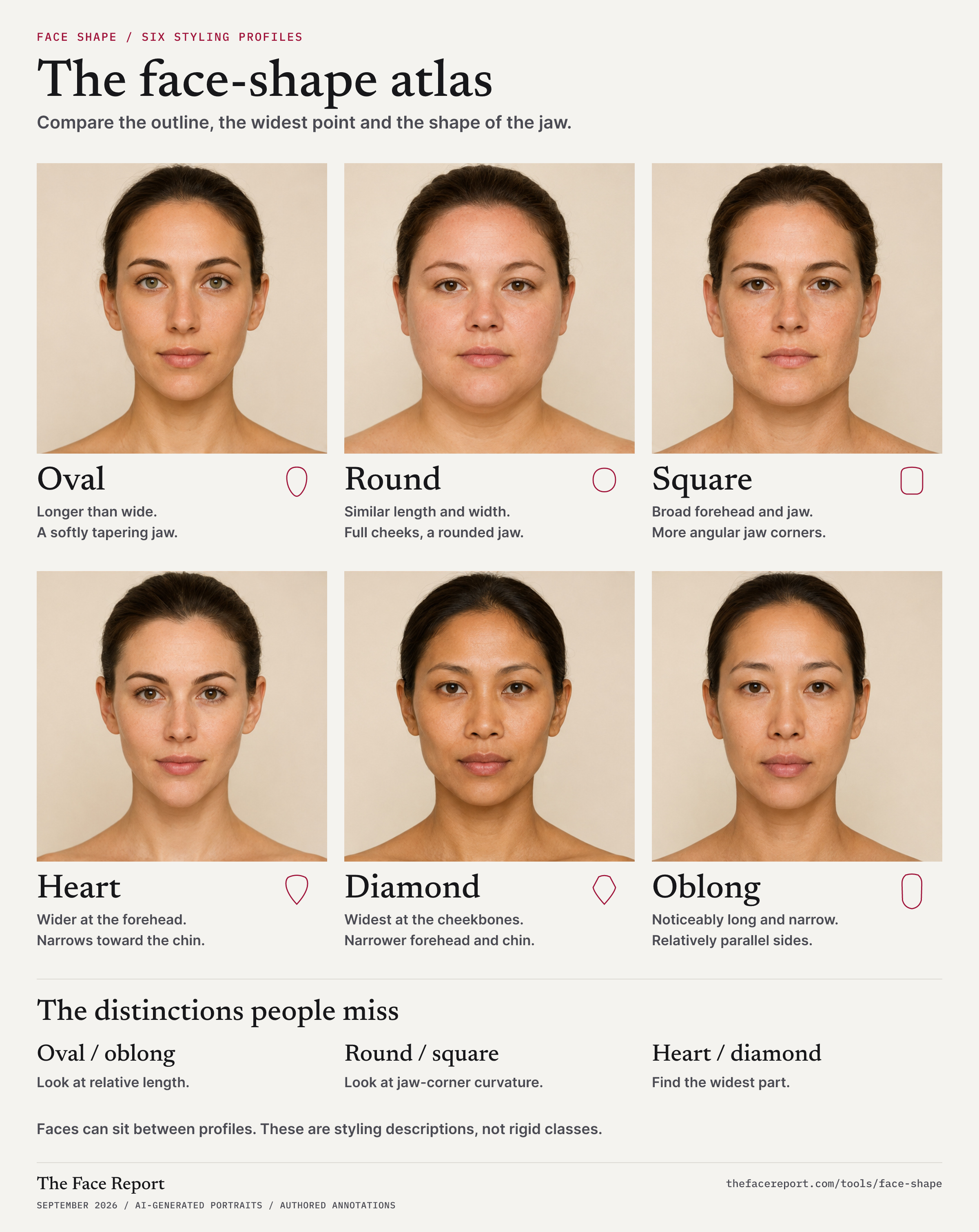
How do I find out what my face shape is?
The manual way is to measure four things in a mirror or photo - forehead width, cheekbone width, jaw width, and face length - and compare their relationships against the six standard profiles. The faster way is the detector above: upload one front-facing photo and it maps 478 landmarks and computes those ratios for you, entirely in your browser - including your runner-up shape, with borderline results flagged when you sit between two categories.
Is there an app to find my face shape?
You don't need to install one. This detector runs free in any mobile or desktop browser - no download, no account, and the photo is processed on your device rather than uploaded to a server. That's also the privacy advantage over most face-shape apps, which send your photo to their servers for analysis.
Can I find my face shape by uploading a photo?
Yes - that's exactly how this tool works. Use a clear, front-facing photo with hair pulled back off the forehead and jawline, even lighting, and a neutral expression. Angled photos, hair covering the face outline, and strong shadows are the three things most likely to skew the result, so if your result feels off, retake with those fixed.
How do I use my face shape for hairstyles and glasses?
The principle for both is visual balance: choose frames and styles that counter your face's dominant dimension. Round faces suit angular frames and hairstyles with height; long faces suit deeper frames and styles with width or fringe; square jaws pair with rounded frames and softening layers. After the detector gives you your shape, the per-shape hairstyle and glasses guides on this site give the full breakdown, and the hairstyle finder turns your result into a specific style list.
What face shape looks good with bangs?
Bangs suit long face shapes best: oblong and oval faces gain visual width from a fringe, which shortens the apparent face length. Heart shapes suit side-swept bangs that soften a wider forehead. Round faces should be careful with full, straight-across bangs - they remove more vertical line from an already short face - and do better with long, side-swept or curtain bangs. Square faces suit soft, wispy or curtain bangs over blunt ones, which would stack a second horizontal line on top of an angular jaw.
What's the rarest face shape?
There is no dependable universal percentage: results vary with the population, definitions, and classifier used. Diamond is often described as less common in styling guides because the cheekbones must be wider than both the upper forehead and jaw. These six categories are broad styling profiles, not population statistics or medical diagnoses.
Can my face shape change over time?
Your apparent face outline can change with weight, facial hair, hairstyle, soft-tissue changes, and the way a photo is taken. Underlying skeletal proportions are generally more stable than those visible factors. For a useful comparison over time, use similar lighting, camera distance, expression, and a straight-on head position.
Is face shape genetic?
Genetics contributes to facial structure, alongside growth, development, age, and soft tissue. But labels such as oval, round, and heart compress many continuous measurements into six broad styling categories. A face-shape result should not be treated as a genetic test or a diagnosis.
How accurate are AI face shape detectors?
There is no single trustworthy accuracy percentage for every face-shape detector. This tool maps a 478-point face mesh and compares several visible-mesh ratios with six shape profiles, but it has not been independently validated against a large human-labelled photo set. Treat the output as a styling estimate; angled photos, hair over the face, glasses, hands, strong contouring, and uneven lighting can change the result.
What's the difference between an oval face and a round face?
The main visual difference is elongation. In classical hairline-to-chin measurements, oval faces are often described as about 1.5 times as long as they are wide, while round faces are closer to equal length and width. Both have soft contours. The detector's on-screen mesh ratio uses an upper-forehead point rather than the hairline, so its number is lower than the classical tape-measure ratio.
What's the difference between a heart face and a diamond face?
Both have pointed chins, but they differ at the top of the face. Heart faces have a wide forehead, sometimes with a widow's peak; diamond faces have a narrow forehead with the cheekbones as the dominant widest feature. If your forehead is wider than your cheekbones, you're heart-shaped. If your cheekbones are wider than your forehead, you're diamond.
Does face shape matter for choosing a hairstyle?
It's one factor among several - hair texture, density, lifestyle, and personal preference all matter as much. Face-shape-based recommendations are really about visual balance: round faces benefit from styles that add length, oblong from styles that add width, and square from styles that soften the jawline. These are useful starting points, not strict rules - many people look great in styles outside their recommended set.
How does AI detect face shape from a photo?
The standard approach uses facial landmark detection. MediaPipe supplies a 478-point mesh, and this tool selects stable points around the visible upper forehead, cheeks, jaw, and chin. It compares their relative widths, visible height, and jaw angle with six shape profiles. The mesh does not detect the true hairline, which is why its ratio is different from a manual hairline-to-chin measurement.
Do men have different face shapes than women?
The same six categories - oval, round, square, heart, diamond, and oblong - can be used for everyone. This detector does not ask for sex or gender and applies the same geometric profiles to every photo. Hairstyle, facial hair, and makeup can change the perceived outline, so use the result as a starting point for styling rather than a rule about how someone should look.
What's the difference between a face shape analyzer, detector, finder, and calculator?
They're four names for the same job - working out which of the six shape profiles your face is closest to. 'Calculator' usually implies typing in manual tape measurements, while 'analyzer', 'detector', and 'finder' usually imply a photo tool. This page is both: upload a photo for the AI analysis, or scroll to the manual calculator section and use the four-measurement method with the same classification rules.
Which face shape is the most attractive?
There is no single 'most attractive' face shape. Attractiveness research points to proportional balance, symmetry, and averageness mattering far more than which of the six categories you fall into. Oval is the shape most often cited as conventionally flattering - its balanced length-to-width ratio suits the widest range of hairstyles and glasses - but every shape has widely admired examples, and many celebrated faces are square, heart, or round. Beauty standards also shift across cultures and eras, so treat your shape as information for styling choices, not a ranking.