How to Glow Up Your Face and Body: The Science-Backed Guide
Glow up tips based on peer-reviewed research - not TikTok trends. What works, what doesn't, and what's realistic in a week vs. six months.
A real glow up isn't one hack - it's systematic optimization across skincare, body composition, facial proportions, posture, and styling. Most "glow up tips" online are anecdotal, filter-dependent, or sell you products you don't need. This guide gives you the evidence-based playbook: specific routines, measurable targets, realistic timelines, and the peer-reviewed research behind every recommendation. Whether you're starting a glow up transformation from scratch or refining what you've already built, every section is designed to be actionable from day one.
Key Takeaway
The highest-impact glow up changes, ranked by research: (1) optimizing body fat percentage, (2) daily SPF + retinoid skincare, (3) correcting forward head posture, (4) hairstyle matched to face shape. Most people see noticeable changes within 8-12 weeks when addressing multiple pillars simultaneously.
Use our free face shape analyzer and symmetry score tool to establish your baseline before starting.
Start With Your Baseline: Know Your Face
You can't improve what you don't measure. Before starting any glow up transformation, you need objective data about your starting point - not a subjective impression from your phone camera. Knowing your face shape determines which hairstyles will work. Knowing your symmetry score identifies which side of your face to target with exercises. Knowing your facial ratios tells you how your proportions compare to population averages and the golden ratio. Without this baseline, you're guessing.
Face Shape Detector
Identify your face shape (oval, round, square, heart, diamond, oblong) - the foundation for hairstyle optimization and understanding your proportions.
Symmetry Checker
Measure left-right asymmetries in your face so you know which areas to target with exercises and habit correction.
Facial Ratios Analyzer
Understand the proportional relationships between your forehead, midface, and lower face - key for identifying where changes will have the most impact.
Golden Ratio Tool
See how your facial proportions compare to the phi ratio (1.618:1) - a mathematical benchmark used in aesthetic analysis.
Harmony Score
Get a composite baseline score that factors in symmetry, proportions, and feature harmony - use this to track your progress over time.
Full Analysis
Comprehensive report combining face shape, symmetry, ratios, golden ratio distance, and personalized improvement recommendations in one analysis.
| Metric | What It Tells You | How It Guides Your Glow Up |
|---|---|---|
| Face Shape | Oval, round, square, heart, diamond, or oblong classification | Determines optimal hairstyle, glasses, and facial hair choices |
| Symmetry Score | Left-right landmark displacement across key facial features | Identifies which side to target with exercises and habit changes |
| Facial Ratios | Proportional relationships between facial thirds and fifths | Reveals whether body fat, hairstyle, or exercises will have the most visual impact |
| Golden Ratio Distance | How closely your proportions align with phi (1.618:1) | Provides a mathematical benchmark for tracking proportional changes over time |
All tools are free and produce instant results from a single photo upload
How to Glow Up Your Face: The Five Levers, Ranked
"How do I glow up my face?" has a shorter answer than the rest of this guide, because a face has only five things you can change without a clinic - and they are not equally powerful. In order of how much they move how a face reads in photos and in person:
- 1
Skin surface Pillar 1 below
Evenness of tone, texture and shine do more for 'glow' than any feature. Daily SPF, a retinoid at night, and a bland moisturizer are the whole routine; everything else is optional. Weeks to months.
- 2
Soft-tissue definition Pillar 2 below
Lower overall body fat sharpens the jaw, cheekbones and under-eye area you already have. It is the biggest structural change available without surgery. Months.
- 3
Framing Pillar 4 below
Hair, brows and facial hair are the fastest visible change - a cut matched to your face shape and tidied brows can change a face in a day. Hours.
- 4
Carriage Pillar 3 below
Forward head posture folds the neck, shortens the jaw and shadows the eyes. Correcting it is free, immediate, and shows in every photo. Days.
- 5
Rest and color Pillar 6 below
Sleep, hydration and the colors you wear near your face change under-eye shadow, puffiness and how healthy your skin tone reads. Days.
Two of those five are measurable from a photo, which is how you tell a real change from good lighting. Our free skin analysis maps redness, tone evenness, texture and shine zone by zone, and the face age test reads the same zones for lines and tone against your overall estimate - re-run both after eight weeks of the skin routine and the difference is your result, not your mood.
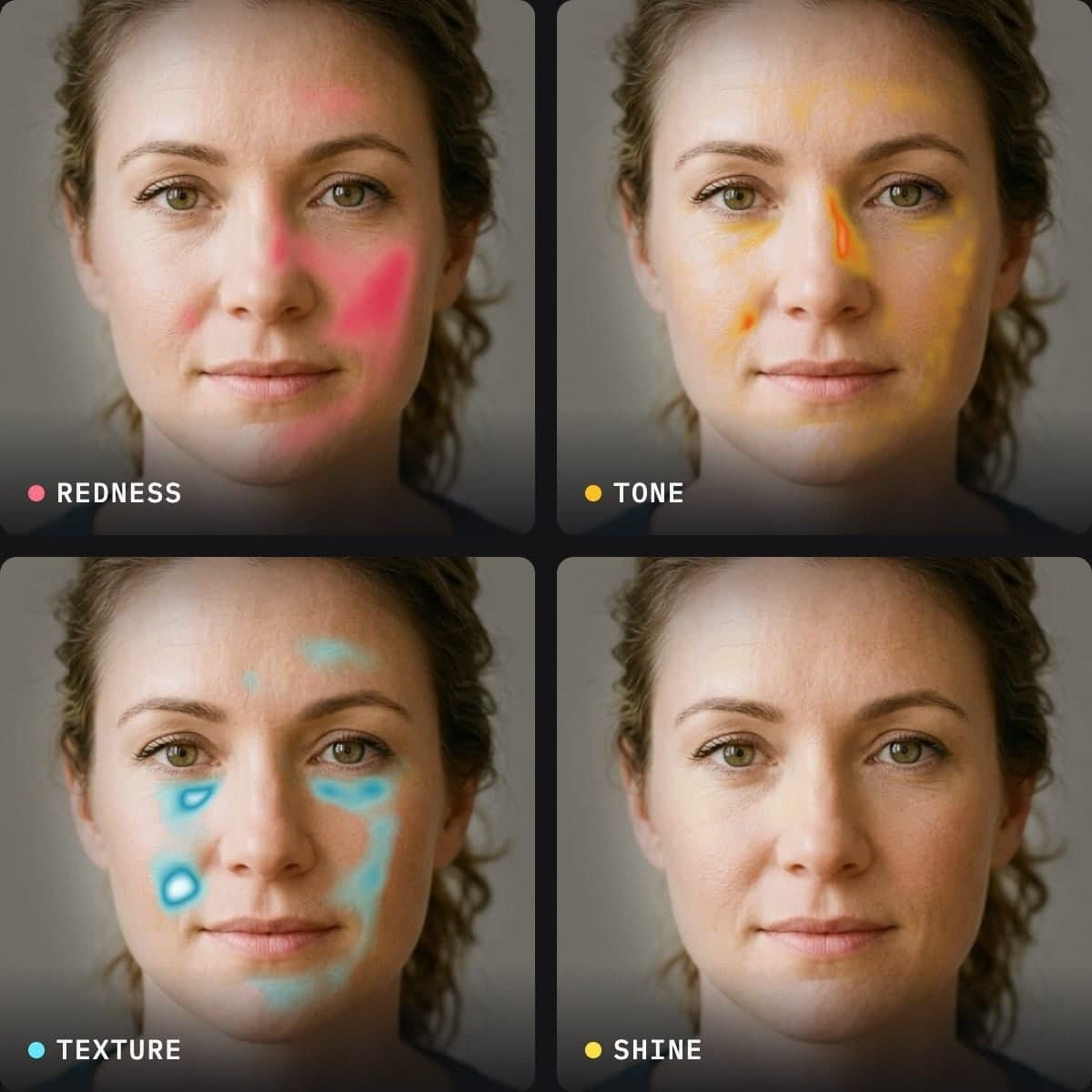
Color is the lever most guides skip: the same face reads healthier next to the right undertone. If you have never had it done, the free color season finder takes a minute, and if your aim is specifically a prettier face rather than a full-body overhaul, the prettier-face guide ranks nine changes by the strength of their evidence.
Pillar 1: The Skin Care Routine for Your Glow Up
Your skin is the canvas everything else sits on. No amount of hairstyle optimization or body composition work compensates for dull, damaged, or prematurely aged skin. The good news: an effective skincare routine is surprisingly simple. You need four active ingredients - and everything else is optional at best, harmful at worst.
| Step | Product | Why It Matters |
|---|---|---|
| 1 | Gentle cleanser | Removes overnight sebum without stripping the skin barrier |
| 2 | Vitamin C serum (10-20% L-ascorbic acid) | Required cofactor for collagen synthesis; reduces hyperpigmentation by inhibiting tyrosinase |
| 3 | Moisturizer | Locks in hydration; supports skin barrier function |
| 4 | SPF 30+ broad-spectrum sunscreen | Prevents ~80% of photoaging - the #1 cause of visible skin aging |
| Step | Product | Why It Matters |
|---|---|---|
| 1 | Oil-based cleanser (if wearing SPF/makeup) | Dissolves sunscreen and sebum that water-based cleansers miss |
| 2 | Gentle water-based cleanser | Removes remaining residue without over-stripping |
| 3 | Retinoid (tretinoin 0.025% or retinol 0.5-1%) | Increases dermal collagen by 80% over 12 months; accelerates cell turnover; reduces fine lines |
| 4 | Moisturizer | Buffers retinoid irritation and maintains skin barrier overnight |
Evidence: SPF
Daily broad-spectrum SPF 30+ prevents approximately 80% of photoaging - the single largest contributor to visible skin aging (wrinkles, hyperpigmentation, loss of elasticity). UV exposure accounts for more visible aging than genetics, smoking, and diet combined.
Evidence: Tretinoin
Tretinoin (prescription-strength retinoid) increases dermal collagen production by 80% over 12 months. It is the most well-studied topical anti-aging compound with over 50 years of clinical data. Start at 0.025% concentration and increase gradually to minimize irritation.
Evidence: Vitamin C
L-ascorbic acid is a required cofactor for collagen synthesis and a potent antioxidant that neutralizes UV-generated free radicals. At 10-20% concentration, it reduces melanin production and visibly improves hyperpigmentation within 8-12 weeks of consistent use.
What to Skip
Expensive 10-step routines with overlapping actives (niacinamide + vitamin C + AHA + BHA in one routine) increase irritation risk without proportional benefit. Jade rollers and gua sha do not "contour" your face - any visible effect is temporary fluid displacement that resolves within minutes. Collagen creams cannot penetrate the epidermis; collagen molecules are too large for topical absorption - see our breakdown on collagen supplements for skin for what works (oral hydrolyzed peptides) versus what doesn't (creams).
Skincare Timeline
4-6 weeks: Hydration improvements, reduced dryness and flaking. 8-12 weeks: Skin texture visibly smoother, early hyperpigmentation fading. 6+ months: Anti-aging effects compound - fine lines reduce, collagen density increases, overall skin quality transformation visible.
Pillar 2: Body Composition - The Single Biggest Lever
If you could only change one thing for a glow up transformation, optimizing your body fat percentage would have the greatest impact on your face. Submental fat (under the chin), buccal fat (in the cheeks), and periorbital fat all obscure underlying bone structure. As body fat decreases into an athletic range, jawline definition increases, cheekbones become more prominent, and the overall facial contour sharpens. This isn't cosmetic speculation - it's anatomy. For dedicated approaches beyond body fat, see our guide on how to get better cheekbones.
Males
Jawline definition: 12-15% BF
Cheekbone visibility: 10-14% BF
Essential fat level: ~3-5%. Most males carry facial fat proportionally to their overall body fat, with genetics determining distribution patterns.
Females
Facial definition: 20-22% BF
Essential fat level: ~10-13%. Females carry proportionally more essential fat, and facial fullness at moderate body fat levels is often desirable - over-reduction can accelerate facial aging.
| Category | Males | Females | Facial Impact |
|---|---|---|---|
| Essential Fat | 3-5% | 10-13% | Not sustainable; gaunt appearance |
| Athletic | 6-13% | 14-20% | Maximum facial definition; jaw and cheekbones visible |
| Fitness | 14-17% | 21-24% | Good facial definition; some softness in lower face |
| Average | 18-24% | 25-31% | Facial structure partially obscured by fat |
| Obese | >25% | >32% | Bone structure largely hidden; rounded facial contour |
Based on ACE & ACSM clinical body composition standards
Caloric deficit is king
A 500 cal/day deficit produces approximately 0.45 kg (1 lb) of fat loss per week. This is the rate supported by meta-analyses for preserving lean mass during a cut. Faster rates increase muscle loss risk.
Resistance training preserves muscle
Strength training 2-4 times per week during a caloric deficit signals the body to maintain lean mass and prioritize fat for energy. Without resistance training, up to 25% of weight lost can come from muscle tissue.
Reduce facial bloating
Reduce sodium intake (aim for <2,300 mg/day per AHA guidelines), increase water intake to support renal sodium clearance, and limit alcohol. Alcohol increases facial vasodilation and water retention - even moderate consumption causes visible puffiness the next day.
Body Composition Timeline
Expect 4-8 weeks for facial changes to become noticeable at a moderate deficit. The face is one of the first places many people notice fat loss because the skin is thin and tightly adherent to the underlying structures, making even small volume changes visible.
Pillar 3: Posture - The Fastest Free Improvement
Forward head posture - where the head protrudes in front of the spine - is endemic in people who spend hours at a desk or on a phone. It pushes the chin forward and downward, compresses the submental area, drops the hyoid bone, and makes the jawline appear softer and less defined. The skin under the chin bunches, and the jaw angle recedes visually. This is a perception problem, not a structural one - which means it can be fixed without changing any anatomy. Results are immediate.
Why This Matters
Correcting forward head posture visually lifts the chin and tightens the submental skin. The jawline looks sharper immediately - not because bone or muscle changed, but because the soft tissue is no longer compressed. This is arguably the fastest free glow up improvement most people can make.
Chin tucks (deep cervical flexor strengthening)
Retract your chin straight back (creating a "double chin") while keeping your eyes level. Hold for 5 seconds. Perform 3 sets of 10, twice daily. This strengthens the deep cervical flexors that hold your head in proper alignment over the spine.
Wall angels
Stand with your back, head, and arms flat against a wall. Slide your arms up and down in a "snow angel" motion, keeping contact with the wall throughout. 3 sets of 10. Strengthens the lower trapezius and rhomboids, which retract the shoulder blades and pull the head back.
Thoracic spine extension over foam roller
Place a foam roller perpendicular to your spine at mid-back level. Support your head with your hands, extend backward over the roller, hold for 3-5 seconds, then return. 2 minutes daily. Mobilizes the thoracic spine, countering the forward-rounded upper back that drives head-forward posture.
Ergonomic Setup
Exercises fix the deficit, but your workspace creates it. Set your monitor at eye level (top of screen at eye height), keep feet flat on the floor, retract shoulder blades slightly, and position your phone at eye level instead of looking down. Every hour spent looking down at a phone undoes the postural work from exercises.
Pillar 4: Hairstyle Optimization
Your hairstyle is the single biggest instant visual change most people can make. The wrong cut can emphasize facial width, elongate an already long face, or make a round face look rounder. The right cut creates the illusion of balanced proportions by adding volume where the face is narrow and reducing visual weight where it's wide. The key: your face shape determines which styles work.
| Face Shape | Goal | Recommended Styles | Avoid |
|---|---|---|---|
| Oval | Maintain natural balance | Most styles work; textured crops, side parts, medium length | Heavy bangs that shorten the face |
| Round | Add height, reduce width | Pompadours, quiffs, faux hawks, height on top with short sides | Chin-length bobs, side volume, round bangs |
| Square | Soften angular edges | Side-swept styles, textured layers, medium-length cuts | Buzz cuts, flat tops, blunt bobs |
| Heart | Add width at jaw level | Chin-length or longer styles, side parts, waves at jaw level | Short pixie cuts, slicked-back styles |
| Diamond | Widen forehead and jaw areas | Side-swept bangs, chin-length bobs, volume at temples | Slicked-back or center-part styles that expose narrow forehead |
| Oblong | Reduce vertical length | Bangs/fringe, side volume, layered cuts, chin-length styles | Long straight hair, high pompadours, center parts |
Next Step
Use our Face Shape Detector to identify your shape, then read our full Face Shape & Hairstyle Guide for detailed recommendations with photo examples and styling tips for every face shape.
Pillar 5: Facial Exercises - What Actually Works
Facial exercises (face yoga) have a mixed reputation, but the research is more positive than many expect - with important caveats. They work for increasing muscle fullness and tonus, but they cannot change bone structure. The key study:
Northwestern University Study
A Northwestern University study found that 20 weeks of daily 30-minute face yoga made participants appear approximately 3 years younger. The primary mechanism was increased upper and lower cheek fullness - the exercises hypertrophied the facial muscles, creating a more youthful, lifted appearance.
Best exercises for specific areas:
Cheek lifter
Open your mouth into an "O" shape, fold your upper lip over your teeth, smile to lift cheek muscles, then place fingers lightly on the top of the cheek and release the smile. Repeat 10 times. Targets the levator labii superioris and zygomaticus - the muscles responsible for mid-face fullness.
Jawline definer (chin lifts)
Tilt your head back and look at the ceiling. Push your lower jaw forward until you feel a stretch under the chin. Hold for 10 seconds, release. Repeat 10 times. Strengthens the platysma and suprahyoid muscles that support the submental area.
Forehead smoother
Place both hands on your forehead with fingers spread. Apply gentle inward pressure while trying to raise your eyebrows against the resistance. Hold for 10 seconds, repeat 10 times. Strengthens the frontalis while training it to contract without wrinkling.
Balanced Chewing
Most people habitually chew on one side. Over years, this creates asymmetric masseter development - the dominant side becomes thicker, making the face appear uneven. Consciously alternate chewing sides at every meal. This is a simple habit change that prevents further asymmetry and, over months, can help rebalance existing unevenness. See our facial symmetry guide for more exercises targeting asymmetry.
Evidence Level: Moderate
Facial exercises have moderate evidence for improving fullness and muscle tonus, but they cannot change bone structure. They're a useful complement to skincare, body composition, and posture work - not a standalone transformation method.
What About Mewing?
Mewing (maintaining the tongue flat against the roof of the mouth) is NOT evidence-based for adult facial restructuring. The British Orthodontic Society states there is no peer-reviewed evidence that tongue posture changes facial shape in adults. Adult bone remodeling is significantly slower than in children, and the maxillary suture begins fusing in the late teens. Proper tongue posture is beneficial for breathing and dental health, but should not be expected to reshape your jaw. See our full mewing results guide for the complete evidence review.
Pillar 6: Sleep, Hydration & Recovery
The five pillars above handle the active interventions. This pillar is about the recovery environment that allows everything else to work. Without adequate sleep, hydration, and stress management, your skincare underperforms, your body composition stalls, and your face retains fluid.
Sleep
7-9 hours per night
Growth hormone peaks during deep sleep (stages 3-4), driving collagen synthesis and cell turnover - the two processes most responsible for skin repair and youthfulness. Sleep deprivation increases cortisol by up to 37%, which promotes collagen breakdown. Studies show sleep-deprived individuals are consistently rated as less attractive and less healthy.
Water
Adequate, consistent hydration
Adequate hydration reduces facial puffiness by supporting renal sodium clearance and improves skin turgor (the skin's ability to snap back when pinched). Chronic mild dehydration causes the body to retain more water in tissues, paradoxically increasing facial bloating. Aim for consistent intake rather than overhydrating.
Alcohol
Minimize or eliminate
Alcohol increases facial vasodilation and water retention (the "puffy morning" effect), disrupts sleep architecture (suppresses REM and deep sleep), depletes B vitamins required for skin cell renewal, and accelerates skin aging through acetaldehyde-mediated oxidative stress. Even moderate consumption produces visible facial effects the following day.
Stress
Active stress management
Chronic stress elevates cortisol, which promotes collagen breakdown, increases inflammatory markers (worsening acne, rosacea, and eczema), triggers telogen effluvium (stress-related hair loss), and disrupts sleep quality. Meditation, exercise, and adequate social connection are evidence-based cortisol reducers.
How to Glow Up in a Week (and What's Realistic Overnight)
A week isn't enough time to change skin texture or body composition - but it is enough to change how put-together you look, because the fastest levers are styling and recovery, not biology. In order of visible impact per day of effort:
- Posture - the only genuinely overnight change. Chin parallel to the floor, shoulders back; it alters your jawline and neckline in photos immediately.
- A haircut matched to your face shape - the single largest one-day visual change you can buy. Use the face-shape guidance above before booking.
- Brows and facial hair cleanup - framing the eyes and jawline reads as "groomed" faster than any product.
- Sleep and hydration for 7 straight days - reduces periorbital puffiness and dark circles, the features most associated with looking tired.
- Start the skincare routine now - you won't see texture change in a week, but hydration plumping is visible in days, and week one is when the 6-month compounding starts.
Anything promising bone-structure or skin-transformation results in a week is selling something. The honest version of a one-week glow up is: styling, grooming, posture, and recovery - executed all at once.
The Glow Up Timeline: What to Expect
The best glow up transformations aren't overnight - they're built over 3-6 months of consistent habits across multiple pillars. Here's a realistic timeline based on the evidence above:
| Timeframe | What Changes | Which Pillars Drive It |
|---|---|---|
| Week 1-2 | Posture correction produces immediate visual improvement - chin lifts, jawline tightens. Skincare routine established. Reduced bloating from lower sodium and alcohol. | Posture Recovery |
| Week 4-6 | Skin hydration noticeably improves. Early body composition changes begin. Facial puffiness reduced. Sleep improvements visible in under-eye area. | Skincare Body Comp |
| Week 8-12 | Skin texture visibly smoother. Facial fat reduction becomes visible - jawline sharper, cheekbones more prominent. Facial exercise effects begin compounding. Hairstyle refinement complete. | Skincare Body Comp Exercises |
| Month 3-6 | Significant body composition transformation. Retinoid effects compound - fine lines reducing, collagen density increasing. Facial exercises produce measurable fullness gains. People start noticing. | All Pillars |
| Month 6-12 | Full transformation - the compounding effects of all six pillars produce a result far greater than any single change. Tretinoin has increased collagen by up to 80%. Body fat is in target range. Posture is habitual. Skin quality is fundamentally different. | All Pillars |
Individual results vary based on starting point, consistency, and genetics
Remember
The best glow ups aren't overnight - they're built over 3-6 months of consistent habits. Each pillar amplifies the others: better sleep improves skin recovery, lower body fat reveals bone structure, better posture frames the face, and the right hairstyle completes the picture. The compounding effect is what creates a true glow up transformation.
What NOT to Do: Common Glow Up Mistakes
Avoiding the wrong moves is as important as doing the right ones. These are the most common glow up mistakes - each one can stall or reverse your progress:
Don't crash diet
Extreme caloric restriction (<1,200 cal/day) causes the body to catabolize muscle tissue for energy. You lose weight, but up to 25% comes from lean mass - leaving you lighter but softer. Rapid fat loss also causes skin laxity (sagging), especially in the face where skin is thin. A moderate 500 cal/day deficit preserves muscle and allows skin to adapt gradually.
Don't over-exfoliate
Using AHAs, BHAs, retinoids, and physical scrubs in the same routine strips the skin barrier, causing transepidermal water loss, inflammation, redness, and paradoxically more breakouts. The skin barrier takes 2-4 weeks to repair once damaged. Stick to one exfoliant at a time, and use retinoids every other night when starting.
Don't expect mewing to reshape your jaw as an adult
As detailed in our mewing results guide, there is no peer-reviewed evidence supporting adult jaw restructuring through tongue posture. The British Orthodontic Society does not endorse these claims. Time spent on mewing for aesthetic jaw changes would be better invested in posture correction and body composition optimization.
Don't compare to filtered social media photos
Most glow up transformation photos on social media use different lighting, angles, and facial expression - and many use smoothing, slimming, and reshaping filters. Research shows that exposure to idealized social media imagery increases body dissatisfaction and unrealistic appearance expectations. Compare your progress to your own baseline photos taken under consistent conditions, not to curated online content.
Don't buy jawline exercise devices expecting dramatic results
Jawline exercise devices (Jawzrsize, mastic gum, etc.) may improve bite force, but a 6-month randomized controlled trial of 58 adults found no statistically significant changes in masseter muscle thickness or mandibular bone shape from chewing exercises. Functional strength improved, but visible aesthetic changes were not detected. See our jawline improvement guide for the full evidence review.