How to Fix an Asymmetrical Face - What Works & What Doesn't
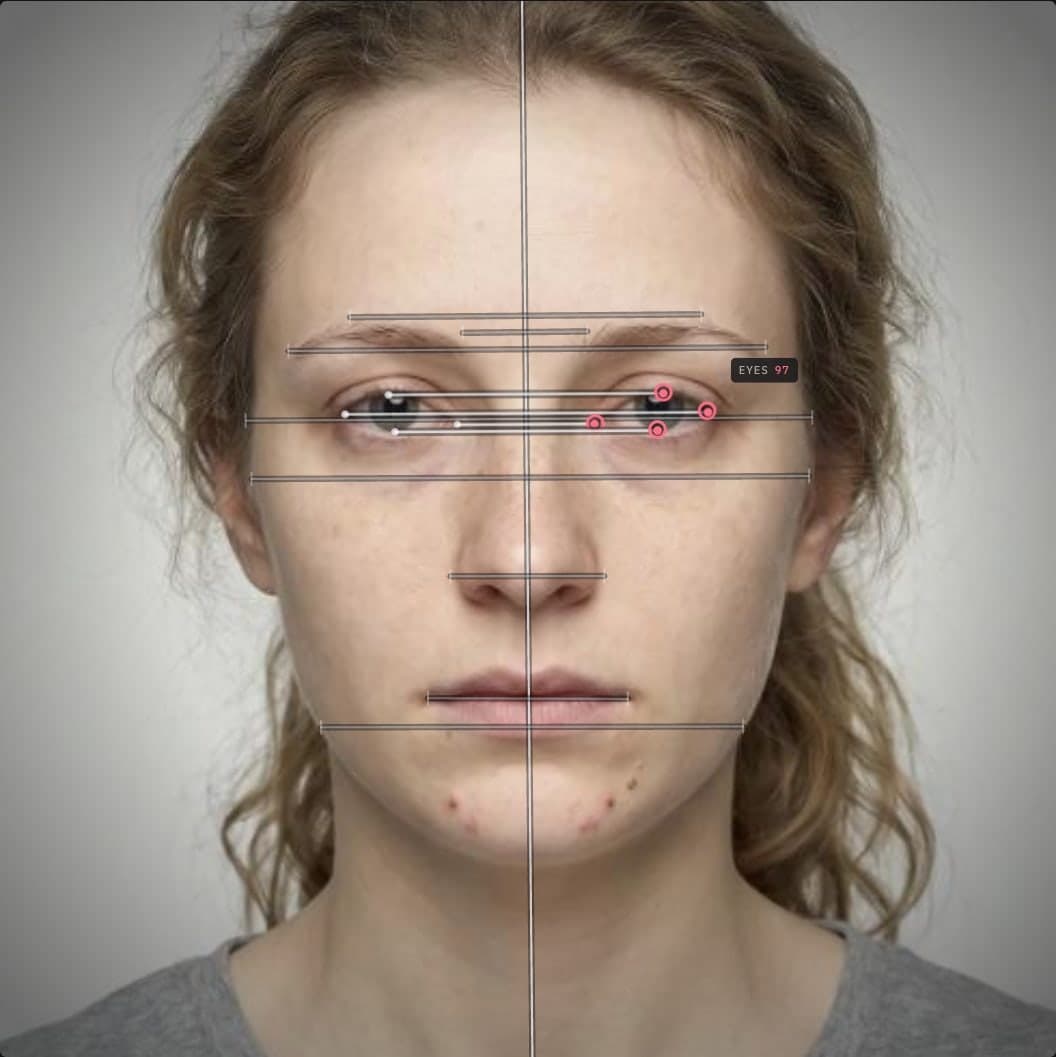
Every face is asymmetrical - the question is whether yours is asymmetrical enough that anything is worth doing about it, and most people who worry about it are wrong about the answer. This guide walks the honest path: first check whether the asymmetry is real or a camera-and-psychology artifact, then match the actual cause - muscular, soft tissue, or skeletal - to the fixes with evidence behind them, from free habit changes to clinical treatments. Start with an objective number: our free face symmetry test measures your left-right balance from one photo, so you're not diagnosing yourself off a bad selfie.
Key Takeaway
Match the fix to the cause: muscular and soft-tissue asymmetry can genuinely improve without surgery. Skeletal asymmetry can only be camouflaged or operated on - and most self-diagnosed asymmetry is neither: it's perception.
First: Is Your Face Actually Asymmetrical, or Is It the Camera?
Before fixing anything, rule out the two forces that manufacture fake asymmetry: your mirror habit and your phone's lens. When you look in a mirror you see a horizontally reversed face - and you've seen that reversed version thousands of times.
The Mere Exposure Effect
The Mere Exposure Effect causes us to prefer what we encounter frequently. Because you are constantly exposed to your mirrored face, an unflipped photograph - your face as others actually see it - reads as subtly wrong, and asymmetries that were invisible suddenly look glaring because they sit on the "wrong" side. Research confirms the bias: people prefer their own mirrored face, while friends and family prefer the true version. Neither group sees the asymmetry you think they see.
Run these three checks before spending a cent:
The flipped photo test
Flip a selfie horizontally. If the flipped version looks very different from the original, that difference is the Mere Exposure Effect at work - both versions look equally normal to everyone else.
Controlled photo conditions
Natural light, arm's length, lens at eye level, looking straight ahead, relaxed expression. Close-range front cameras distort proportions, and inconsistent angles create the illusion of asymmetry where none exists.
An objective measurement
Our symmetry checker tool uses AI landmark analysis to quantify your left-right balance, removing self-perception bias entirely. If the number comes back unremarkable, the rest of this guide is optional reading.
How Much Facial Asymmetry Is Normal?
All of it, statistically. Research using landmark-based midline deviation and 3D stereophotogrammetry finds measurable asymmetry in every face studied - one eye slightly higher, one cheek marginally fuller, one side of the jaw a fraction wider. The relevant question is never whether asymmetry exists but whether it falls outside the range most people would never notice in conversation. And perfect symmetry isn't even the ideal:
Averaged composites
Which are inherently more symmetric - are consistently rated as more attractive than individual faces. This supports the symmetry-attractiveness link.
Perfectly mirrored
Created by duplicating one half - often look uncanny and unsettling. They lack the subtle variation that makes a face look human and approachable.
Slight natural asymmetry
Contributes to perceived authenticity. Faces with minor, organic differences tend to appear more natural and trustworthy than artificially perfect ones.
The goal of any fix should be reducing pronounced asymmetry, not chasing a mathematical perfection that no human face achieves - and that would look wrong if achieved.
What Causes an Asymmetrical Face?
Four categories of causes, each with different improvement potential - identifying yours determines everything that follows:
| Type | Causes | Can It Be Fixed? |
|---|---|---|
| Skeletal | Genetic/developmental, jaw misalignment, injury/trauma | Not without surgeryCamouflage possible; correction needs orthognathic surgery |
| Muscular | Habitual one-sided chewing, sleeping on one side, resting face on hand, TMJ dysfunction | YesHabit correction, exercises, Botox |
| Soft tissue | Uneven fat distribution, volume loss, aging | YesFillers, lifestyle changes |
| Medical | Bell's palsy, torticollis, other conditions | DependsOften treatable depending on condition |
Muscular and soft tissue asymmetry respond well to non-invasive fixes. Skeletal asymmetry is a different problem with different solutions - and pretending otherwise is how people waste months on exercises that never had a chance.
Asymmetrical Face From Sleeping - and the Other Habits That Add Up
"Can sleeping on one side make your face uneven?" is one of the most-asked asymmetry questions, and it deserves a straight answer: plausibly yes, as a contributor. Sleeping consistently on the same side compresses facial tissue for hours every night, and side sleepers often show more pronounced folds and soft-tissue flattening on the compressed side. The evidence is observational - nobody has randomized people to sleep positions for a decade - so treat it as a likely contributor to soft-tissue asymmetry, not a proven primary cause. The fix costs nothing: sleep on your back, or alternate sides.
Sleep position is one of five chronic, one-sided habits that create cumulative asymmetry over months and years. Correcting them is free and, for muscular and soft-tissue asymmetry, often more effective than any treatment:
Sleep position
Back-sleeping removes the nightly compression entirely; alternating sides halves it. A slightly firmer pillow that keeps your face off the mattress helps side sleepers who can't switch.
Chewing
Habitual one-sided chewing makes the masseter muscle hypertrophy unevenly, visibly changing the lower face over time. If you always chew on the right, deliberately shift left until balance returns. Masseter symmetry also shapes the visible jawline - see how to improve your jawline naturally.
Hand resting
Resting your chin or cheek on your hand applies prolonged one-sided pressure to soft tissue. Over months and years it contributes to visible imbalance. Catch it during desk work.
Posture
A chronically tilted head causes asymmetric muscle engagement in the neck and jaw, which compounds over time and changes perceived facial symmetry directly.
Dental health
Malocclusion (a misaligned bite) drives asymmetric jaw development and uneven muscle use. Addressing bite issues early stops this asymmetry from progressing.
Can Exercises Fix an Asymmetrical Face?
Only the muscular component - but for that component, the evidence is cautiously positive:
- Routines that strengthen the weaker side more than the dominant side can rebalance muscle development - the same deficit-targeting principle as corrective physiotherapy.
- Face-yoga studies show measurable improvements in muscle tonus, stiffness, and elasticity with regular practice, particularly in the cheek and perioral muscles.
- Hard limits: no exercise changes bone structure, redistributes fat, or fixes nerve damage. If your asymmetry is skeletal or volumetric, exercises never had a chance.
- Timeline: months of consistent daily practice before visible change. Quick-fix claims are not supported by evidence.
If one cheek sits flatter or less lifted than the other, targeted routines are a reasonable, free starting point - our facial exercises for symmetry deep-dive has the JAMA Dermatology research and 7 targeted routines.
How to Fix an Asymmetrical Face Without Surgery
When habit correction and exercises aren't enough, several evidence-backed clinical treatments address specific asymmetry types:
| Treatment | Best For | How It Works | Evidence |
|---|---|---|---|
| Botox | Muscular asymmetry | Relaxes hyperactive muscles on the dominant side, allowing the weaker side to appear more balanced | Strong3D photogrammetric studies show measurable improvement |
| Dermal fillers | Volumetric asymmetry | Adds volume to the less-full side to restore visual balance | StrongWell-established in aesthetic medicine |
| Orthodontic treatment | Bite-related asymmetry | Fixes malocclusion, improves jaw alignment and dental midline | Strong |
| TMJ treatment | TMJ-caused asymmetry | Addresses underlying joint dysfunction that drives muscular imbalance | Moderate |
| Physical therapy / myofascial release | Muscle tension imbalances | Corrects chronic facial muscle tension patterns through targeted manipulation | Limited but promising |
Botox reduces muscle bulk on the overactive side (particularly effective for masseter asymmetry); fillers restore volume where it is lacking. Both are temporary - Botox lasts 3–6 months, fillers 6–18 months depending on the product - which allows iterative refinement. The same soft-tissue logic means fillers can camouflage mild skeletal asymmetry: the bone doesn't change, but the visual balance can improve enough that many people stop there.
What Only Surgery Can Change
Honesty about limits saves months of misdirected effort:
Surgery Required
- Significant skeletal asymmetry - uneven bone structure where the mandible, maxilla, or orbital bones differ substantially between sides. Repositioning bone is orthognathic surgery's job.
- Congenital structural differences - conditions like hemifacial microsomia, where one side of the face is underdeveloped from birth.
- Major jaw misalignment - when the mandible deviates significantly from the facial midline, surgery is the only structural correction.
When Facial Asymmetry Is Medical
Three patterns take this out of cosmetics entirely. Sudden-onset asymmetry - especially with facial weakness, drooping, or difficulty moving one side - needs emergency assessment; Bell's palsy and more serious causes present exactly this way. Progressing asymmetry that visibly changes over months deserves a maxillofacial or dental evaluation, as do TMJ pain, significant bite problems, and functional difficulty chewing. And distress that outweighs the asymmetry is its own signal:
Important: Your Mental Health Matters
In clinical settings, body dysmorphic disorder (BDD) can cause obsessive focus on perceived asymmetry that is objectively minimal - hours examining reflections, taking selfies from every angle, researching treatments for differences others cannot see. If concern about facial asymmetry is significantly affecting your daily life, mood, or social behavior, speaking with a mental health professional matters more than any cosmetic intervention. Others rarely notice the asymmetries that bother us most.
Find out if your asymmetry is even worth fixing
Our free Face Symmetry Checker measures your left-right balance with AI landmark analysis - eyes, nose, mouth, and jaw - so you know whether you're dealing with real asymmetry or the mirror effect before spending anything on fixes.
Try it on your own face
Stop reading. Start seeing - these tools turn this guide into a result.
Symmetry Score
FreeLeft vs right breakdown across eyes, nose, mouth, and jaw - measure where you actually differ.
True Mirror
FreeSee your face un-mirrored, the way other people do - most asymmetry only feels wrong because the sides swap.
Glow-Up Pack
5 tokensBest hairstyle + grooming for your face shape - both can soften visible asymmetry.
Custom Studio
1 tokenTest makeup, hair, and outfit changes to see what makes asymmetry less noticeable.
Procedure Preview
1 tokenSubtle filler can rebalance specific features. See the simulation before consulting a provider.