7 Facial Exercises for a More Symmetric Face
Most faces are naturally asymmetric - perfect bilateral symmetry doesn't exist in nature. Facial exercises may change muscle control or the appearance of fullness in some people, but the research has not shown that unilateral training corrects facial symmetry. This guide keeps the routine while making that limit explicit. Take our free face symmetry test to create a photo-based baseline before you start.
Key Takeaway
Small studies suggest face exercise can change cheek fullness, perceived age, or certain muscle properties. None of the cited studies tested correction of bilateral facial symmetry or this seven-exercise routine. Exercise does not remodel adult facial bones.
Why Faces Are Asymmetric
No human face is perfectly symmetric. Even faces widely considered attractive show measurable differences between left and right sides. Understanding why asymmetry exists - and which types are correctable - is the first step toward choosing an effective approach.
The mandible and maxilla develop slightly differently on each side. Genetic factors, jaw growth patterns, and even birth positioning can cause one side of the facial skeleton to be marginally larger or differently shaped than the other.
Not correctable with exerciseMuscle size, tension, and activation can differ between sides. Chewing preference, expression, dental function, injury, and normal variation may contribute, but a photo alone cannot identify the cause.
Exercise evidence is limitedUneven fat distribution and volume loss affect facial balance. Fat pads in the cheeks, temples, and under-eye area can differ between sides, becoming more pronounced with age-related volume loss.
Partially improvableA one-sided smile, brow raise, or squint can make dynamic expression look uneven. That does not establish a permanent muscular imbalance or prove that unilateral exercise will change resting symmetry.
Control may be trainable; structure is notKey Facts
- 3D facial scan research found that the right side of the face tends to be larger than the left in most people.
- Measurement methods differ: clinical anthropometric percentages are not interchangeable with an online checker's proprietary 0–100 score.
- The mirror vs. photo phenomenon: people are used to their mirrored reflection, so unflipped photos make asymmetries seem worse than they are. This is the Mere Exposure Effect - you prefer the version of your face you see most often.
Types of Asymmetry: Which Ones Respond to Exercise?
Not all asymmetry has the same cause. A photo cannot reliably distinguish skeletal, muscular, volumetric, and soft-tissue contributions, so use this table as context rather than self-diagnosis.
| Type | Cause | Modifiable with Exercise? | Alternative Treatment |
|---|---|---|---|
| Skeletal | Bone development | No | Orthognathic surgery |
| Muscular | Habitual patterns | Possibly - evidence limited | Clinical assessment if symptomatic |
| Volumetric | Fat pad differences | Not establishedExercise has not been shown to redistribute facial volume | Dermal fillers |
| Soft tissue | Skin laxity differences | Minimally | RF, HIFU, fillers |
The practical takeaway: use gentle, bilateral exercise for control or comfort, not as a promise to reshape one side. Stop if you develop pain, clicking, weakness, or worsening symptoms, and seek professional assessment for sudden or function-affecting asymmetry.
The Evidence for Facial Exercises
The research on facial exercises is growing but still limited. Here is what the best available studies show - including their limitations.
Participants: 16 women, ages 40-65, completed the full 20-week protocol.
Protocol: 30 minutes daily for 8 weeks, then every other day (3–4 times weekly) through week 20, using 32 facial exercises.
Results: Significant increase in upper cheek fullness and lower cheek fullness as rated by blinded dermatologists. Participants' faces were rated approximately 3 years younger after the program compared to baseline photos.
Relevance to symmetry: The study did not measure facial symmetry, compare left and right sides, or test unilateral extra repetitions. Its result is limited evidence that a face-exercise program can change rated cheek fullness and aging appearance in some participants.
Limitations
Small sample size (16 completers out of 27 original participants - 40.7% dropout rate). No control group. All participants were middle-aged women, so results may not generalize to men or younger demographics. Adherence to a long, instructor-taught protocol may not generalize to this shorter routine.
Design: Pre-experimental 8-week program in 12 middle-aged women, with no control group.
Measurements: Muscle tonus, stiffness, and elasticity were assessed using objective instrumentation before and after the program.
Results: Effects differed by muscle. Tonus and stiffness decreased in the frontalis, corrugator, orbicularis oculi, and orbicularis oris, but increased in the buccinator and digastric; measured elasticity increased across the evaluated muscles.
Relevance to symmetry: The study shows that measured muscle properties can change, but it did not assess left/right symmetry, appearance, or this routine. The authors call for larger randomized controlled studies.
Participants: 58 healthy adults over a 6-month study period. This is the largest and most rigorous study of its kind.
Results: Maximum occlusal force was significantly higher at 3 months. The trial found no significant change in masseter muscle thickness or mandibular shape.
Interpretation: Functional improvement (stronger bite) occurred without visible aesthetic change. This suggests that chewing alone may not be sufficient to create visible changes in facial appearance, though it improves muscular function. For symmetry correction, it provides no evidence that chewing reshapes the jaw or improves a facial symmetry score.
Design: Randomized controlled trial of 34 women assigned to facial roller or gua sha for 10 minutes, five times weekly over 8 weeks. There was no untreated control group.
Key finding: Both groups had changes in measured facial surface distances. Gua sha primarily changed measured muscle-tone properties, while the roller group showed changes in skin-elasticity indices.
Limitation: The study did not measure bilateral symmetry, long-term persistence after treatment, or structural bone change. The often-repeated “400% microcirculation” figure comes from separate research and is not a result of this RCT.
Evidence Summary
The evidence suggests facial exercise or massage can change some appearance ratings, surface distances, or measured tissue properties. Samples are small, protocols differ, and several studies lack a control group. None of these studies tested correction of bilateral symmetry, extra reps on a “weaker” side, or this page's seven-exercise routine.
The 7 Best Exercises for Facial Symmetry
These exercises target facial movement and control. Perform them gently and evenly on both sides; the cited studies do not establish that extra repetitions on a self-identified “weaker” side correct asymmetry. Use a mirror for feedback, not diagnosis.
Target: Zygomaticus major and minor muscles - the muscles responsible for cheek fullness and lift.
Instructions: Smile broadly while pressing your fingers against your cheeks for resistance. Focus on lifting the cheek muscles against the resistance of your fingers. Hold for 10 seconds at the top of each rep.
For symmetry practice: Keep effort even on both sides and stop if you feel jaw or facial pain. A flatter cheek in a photo does not prove that its muscles need extra repetitions.
Target: Buccinator muscles - the muscles that control cheek volume and tension.
Instructions: Fill one cheek with air and hold for 10 seconds, pressing the air against the cheek wall to create internal resistance. Release and switch sides. The air pressure provides resistance that the buccinator muscles work against.
For symmetry practice: Alternate sides evenly. Do not infer “underdevelopment” from one photo or add unilateral volume without professional assessment.
Target: Orbicularis oculi - the ring-shaped muscle surrounding each eye, responsible for eye opening width and upper eyelid position.
Instructions: Close your eyes tightly, squeezing the orbicularis oculi muscles. Focus on applying even pressure on both sides. Hold for 5 seconds, then release completely.
For symmetry: This exercise practices even voluntary contraction. It has not been shown to change eyelid anatomy or correct hooding or droop. New or sudden eyelid droop needs medical assessment.
Target: Lateral pterygoid muscles - deep jaw muscles that control side-to-side jaw movement and contribute to jawline symmetry.
Instructions: Open your mouth wide (about two finger-widths). Slowly shift your jaw to the left, hold for 5 seconds, then slowly shift to the right and hold for 5 seconds. The movement should be controlled and deliberate, not forceful.
For symmetry practice: Treat this as gentle, even mobility - not a strengthening diagnosis. Skip it and consult a dentist or physical therapist if you have TMJ pain, locking, or clicking.
Target: Masseter muscles - the primary muscles of mastication that create jawline definition and lower-face width.
Instructions: Chew gum, alternating sides every 10 minutes. Most people have a dominant chewing side they default to unconsciously. Alternating can be a useful awareness cue, but the visual effect of changing that habit has not been established.
Note: The 2024 gum chewing RCT found higher maximum bite force at 3 months, but no significant change in masseter thickness or mandibular shape. It does not support chewing gum to reshape the jaw. Avoid gum training if it causes pain or clicking.
Target: Frontalis muscle - the forehead muscle that raises the eyebrows. Uneven frontalis activation is a common cause of brow asymmetry.
Instructions: Place your fingers firmly above each eyebrow. Try to raise your eyebrows against the resistance of your fingers. Focus on making both sides move equally - use the mirror to check that one brow isn't lifting higher than the other.
For symmetry: If one eyebrow naturally sits higher or lifts more than the other, keep the resistance symmetrical. Brow position can reflect anatomy, habit, or nerve function; this exercise is not a diagnostic or corrective treatment.
Target: Levator anguli oris and zygomaticus muscles - the muscles that lift the corners of the mouth during smiling.
Instructions: Practice smiling evenly on both sides. Use a mirror to ensure both corners of your mouth lift to the same height. Hold the even smile for 10 seconds. Many people have a natural "crooked smile" where one side lifts more - this exercise practices voluntary control of the movement.
For symmetry: Focus on moving slowly and evenly without forcing either side. Stop and seek medical advice for new weakness or a sudden change in smile movement.
Building Your Daily Routine
This 10-minute split is a practical way to try all seven exercises, but the exact routine has not been clinically tested and no outcome is guaranteed. Gentle consistency is preferable to forceful or painful repetitions.
| Session | Exercises | Duration | Focus |
|---|---|---|---|
| Morning | #1 Cheek Lifter, #2 Cheek Puff, #5 Balanced Chewing | ~5 minutes | Mid-face volume + jaw balance |
| Evening | #3 Eye Squeeze, #4 Jaw Alignment, #6 Forehead Smoother, #7 Lip Corner Lifter | ~5 minutes | Eye area, jaw, forehead + smile balance |
Total daily commitment: ~10 minutes per day (split into two 5-minute sessions).
First review point: 8 weeks, using matched photos and without assuming a visible change.
Evidence context: the Northwestern protocol ran for 20 weeks, but it was longer, instructor-taught, and different from this routine.
Track Your Progress
Take progress photos every 2 weeks - same lighting, same angle, same expression, same distance from the camera. Subtle differences are easy to misread day-to-day; matched side-by-side comparisons reduce that noise. Use our Symmetry Checker tool to create a repeatable photo estimate. Treat small numerical changes as noise unless they persist across several carefully matched, straight-on retakes.
Habits That Worsen Asymmetry
Habits can change temporary puffiness, pressure marks, muscle comfort, or how you hold your head. Evidence that changing these habits permanently alters facial symmetry is limited, but the following adjustments are low-cost and practical.
Sleeping on one side
Side sleeping creates temporary pressure and can change morning puffiness or sleep lines. Long-term effects on structural facial symmetry are not established by the exercise studies cited here.
Try: Choose the position that supports good sleep and comfort. Alternating sides or a supportive pillow may reduce pressure, but back sleeping is not required for facial symmetry.
Chewing on one side
A chewing preference can accompany dental, bite, pain, or muscle-function differences. It does not by itself prove masseter hypertrophy, and a six-month gum-training RCT found no change in masseter thickness or jaw shape. For broader jaw context, see how to improve your jawline naturally.
Try: Avoid deliberately overloading either side. If you cannot chew comfortably on both sides, ask a dentist about the reason instead of trying to train through it.
Resting face on one hand
Leaning your chin or cheek against your hand during desk work creates prolonged pressure and may affect comfort or leave temporary marks. A permanent effect on facial structure has not been established.
Fix: Build awareness of this habit during desk work. Sit with both hands on the keyboard or desk. If you must rest your chin, alternate sides.
One-sided phone holding
Cradling a phone can create neck and jaw tension while you hold the position. It can also make progress photos less comparable if your head is habitually tilted.
Fix: Use speakerphone or earbuds. If you must hold the phone, alternate ears. Avoid cradling the phone between ear and shoulder.
When Exercises Aren't Enough
Facial-exercise evidence is limited even for muscular appearance, and exercise does not remodel adult facial bones. If asymmetry is structural, symptomatic, or concerning, an in-person clinician can assess causes that a photo cannot.
| Treatment | How It Works | Best For | Important Caveat |
|---|---|---|---|
| Botox | Relaxes hyperactive muscles on the dominant side, allowing the weaker side to appear more balanced. Lasts 3-6 months. | Masseter hypertrophy, uneven brow position, asymmetric smile lines | Clinician-onlyRisks, dose, and suitability require assessment |
| Dermal fillers | Adds volume to the less-full side to restore visual balance. Lasts 6-18 months depending on the product. | Volumetric asymmetry, uneven cheeks, chin deviation | Clinician-onlyVascular and other risks require qualified care |
| Orthognathic surgery | Repositions the mandible and/or maxilla to correct skeletal asymmetry. Major surgery with 6-12 week recovery. | Significant skeletal asymmetry, jaw deviation, functional bite issues | Specialist-onlyReserved for diagnosed skeletal or functional needs |
Practical Decision Framework
- Muscular asymmetry (uneven cheek fullness, crooked smile, masseter imbalance) → Gentle bilateral practice may help control or comfort, but no proven symmetry-correction timeline exists. Seek assessment for symptoms or persistent concern.
- Volumetric asymmetry (one cheek noticeably flatter, uneven under-eye area) → Exercise has not been shown to redistribute facial volume. A qualified clinician can discuss whether observation or treatment is appropriate - see our guide on methods to reduce nasolabial folds for filler types, costs, and longevity.
- Skeletal asymmetry (visible jaw deviation, misaligned bite) → Exercises cannot address this. Consultation with a maxillofacial surgeon is the appropriate next step.
Safety and Primary Research
Do not exercise through symptoms
Stop if an exercise causes pain, locking, clicking, dizziness, or worsening symptoms. Seek urgent medical care for sudden facial weakness or drooping. Progressive asymmetry, trouble chewing or speaking, or persistent TMJ symptoms need an in-person medical or dental assessment.
The studies below support only the outcomes they measured. None tested this seven-exercise routine or whether it changes bilateral facial symmetry:
- Alam et al., JAMA Dermatology (2018) - uncontrolled face-exercise study measuring aging-photo ratings and cheek fullness in 16 completers.
- Güzel et al., Medicina (2025) - pre-experimental n=12 study of muscle tonus, stiffness, and elasticity.
- Jung et al., Journal of Oral Rehabilitation (2024) - gum-chewing RCT measuring bite force, masseter thickness, and jaw shape.
- Ahn et al., Journal of Cosmetic Dermatology (2025) - facial roller versus gua sha RCT measuring contour and tissue properties.
Measure your symmetry
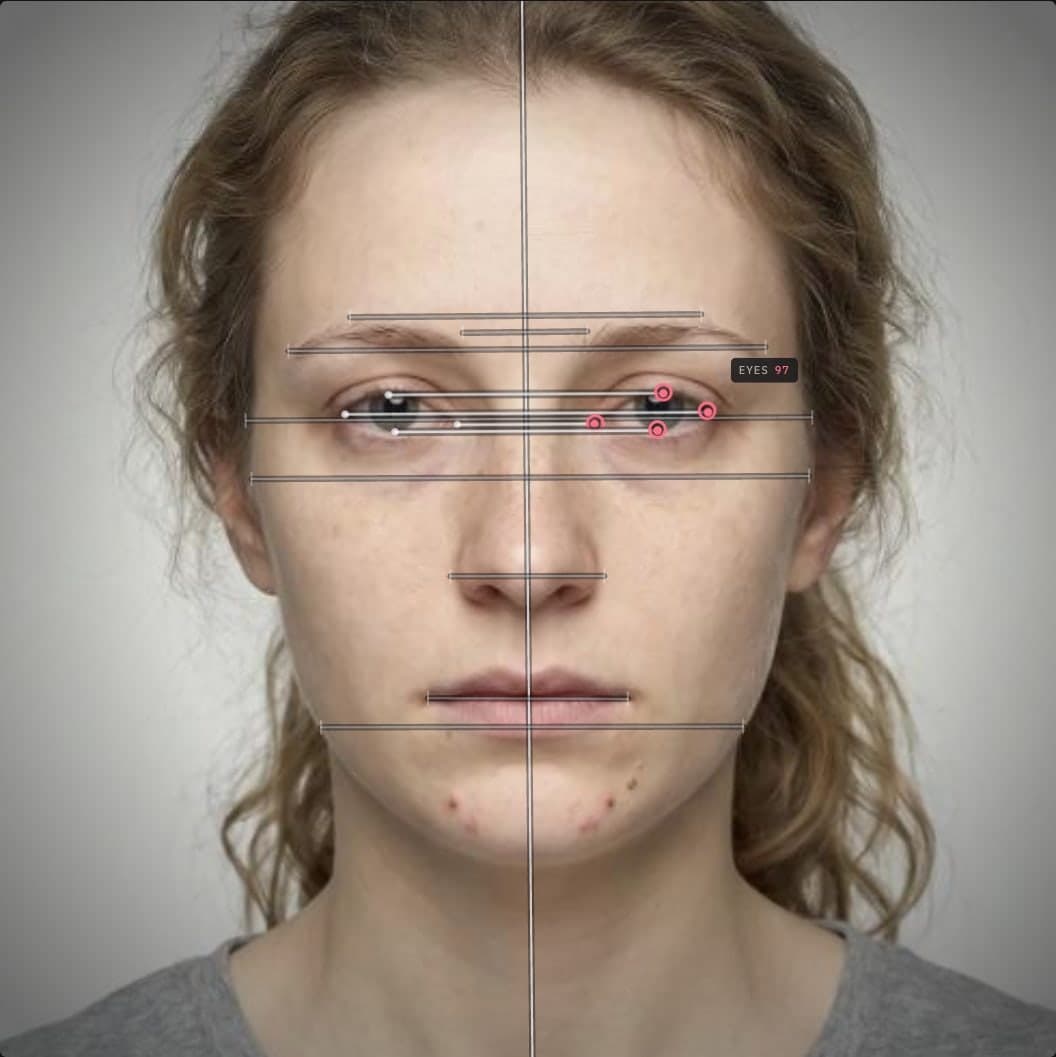
Upload a front-facing photo for a symmetry estimate and side-by-side mirror views. If you compare over time, match the camera, distance, lighting, and expression; small score changes can come from capture conditions.
Try it on your own face
Stop reading. Start seeing - these tools turn this guide into a result.
Symmetry Score
FreeCreate a straight-on photo baseline and compare only under matched capture conditions.
Time Machine
2 tokensExplore an age-progression concept separately from symmetry or exercise claims.
Custom Studio
1 tokenIf exercises move slowly, test what hair, makeup, or grooming changes could do in the meantime.
Glow-Up Pack
5 tokens5-image pack focusing on skin tone, grooming, and styling that supports facial structure.
Frequently Asked Questions
Can facial exercises fix an asymmetrical face?
Sometimes partly, and only for the muscular kind. Exercises can improve control and tone on a weaker side - an uneven smile, one brow that lifts less, a habitually slack cheek - because those are muscle-recruitment differences. They cannot move bone, cartilage, or the underlying skeleton, so asymmetry in the jaw, nose, orbit, or chin does not respond. No controlled trial has measured facial symmetry before and after an exercise program; the best-known study (JAMA Dermatology, 2018) measured perceived age in 16 women, not left-right balance.
How long do facial symmetry exercises take to work?
Plan on 8-12 weeks of daily practice before judging, and measure rather than eyeball. The 2018 face-yoga study ran 20 weeks at 30 minutes a day for its perceived-age result. Muscular control changes can show sooner - a more even smile in a few weeks is plausible - but day-to-day photos vary by more than the change you are looking for, so compare matched photos every two weeks under identical lighting, distance, and expression.
Which exercises help an uneven smile?
The ones that isolate the weaker side: unilateral smile holds (lift only the lower corner for 5-10 seconds, mirror-checked), cheek lifts against light finger resistance on the weaker side, and the balanced 'O-to-smile' transition to retrain both sides together. Keep repetitions gentle and symmetric in count; the goal is control, not fatigue. If the unevenness appeared suddenly or comes with drooping, numbness, or difficulty closing an eye, that is a medical assessment, not an exercise plan.
Are facial exercises safe, or can they make asymmetry worse?
They are low-risk when gentle. The realistic downside is over-training one side: adding extra repetitions to the 'weak' side on the strength of a single photo can build the wrong habit and overwork the muscles you meant to relax. Repetitive forceful expressions also fold the skin along the same lines, which matters more for expression lines than symmetry. Stop anything that hurts, keep sets even unless a clinician has identified a genuine weakness, and do not exercise through jaw joint pain or clicking.
How do I know if my asymmetry is muscular or skeletal?
A photo cannot settle it, but two checks narrow it down. First, compare a neutral, relaxed face with a full smile: asymmetry that appears or grows with expression is at least partly muscular; asymmetry that is identical at rest is more likely structural. Second, measure it - a symmetry test that draws paired landmarks on a straight-on photo shows whether the offsets sit in soft tissue (mouth corners, brows, cheeks) or in fixed points (nose bridge, jaw angles, chin). Structural asymmetry above a few percent is normal and usually invisible to other people.
Related Guides
How to Improve Facial Symmetry
Complete evidence-based guide to symmetry improvement
How to Improve Your Jawline
Evidence-based methods for jawline definition
How to Get Better Cheekbones
Face yoga, fillers, and lifestyle changes
Glow Up Tips
Science-backed tips for facial improvement
Mewing Results: What Science Says
Honest analysis of tongue posture claims