Canthal Tilt Calculator
Free photo-based canthal tilt analyzer. Estimates the angle between each eye's inner and outer corners, compares both sides, and draws the measured lines directly on your photo.
Canthal tilt is the angle of the line connecting the inner corner of your eye to the outer corner. A positive canthal tilt means the outer corner sits higher than the inner corner, a negative tilt means it sits lower, and a neutral tilt means the two corners are roughly level. The angle varies naturally between people - and often between a person's own two eyes - so no single value is "correct."
For a reliable result: keep the lens at eye level, your chin neutral, and both sides of your face equally visible.
Upload a photo
Drag and drop or choose a file
or
JPG, PNG up to 30MB
Your photo never leaves your device
 Example
What Is Canthal Tilt?
Canthal tilt is the angle of the line connecting the inner corner of your eye (medial canthus) to the outer corner (lateral canthus), measured against a face-horizontal reference. When the outer corner sits higher, the tilt is positive; when it sits lower, the tilt is negative; when the two corners are level, the tilt is near zero.
The angle varies across individuals and populations, and published studies do not establish one universal normal or ideal value. This calculator estimates each eye separately from a straight-on 2D photo, then draws the selected corner points and fitted reference on the image so you can inspect what was measured.
Positive vs Negative vs Neutral Canthal Tilt
The three configurations differ only in which eye corner sits higher - but they read very differently on a face:
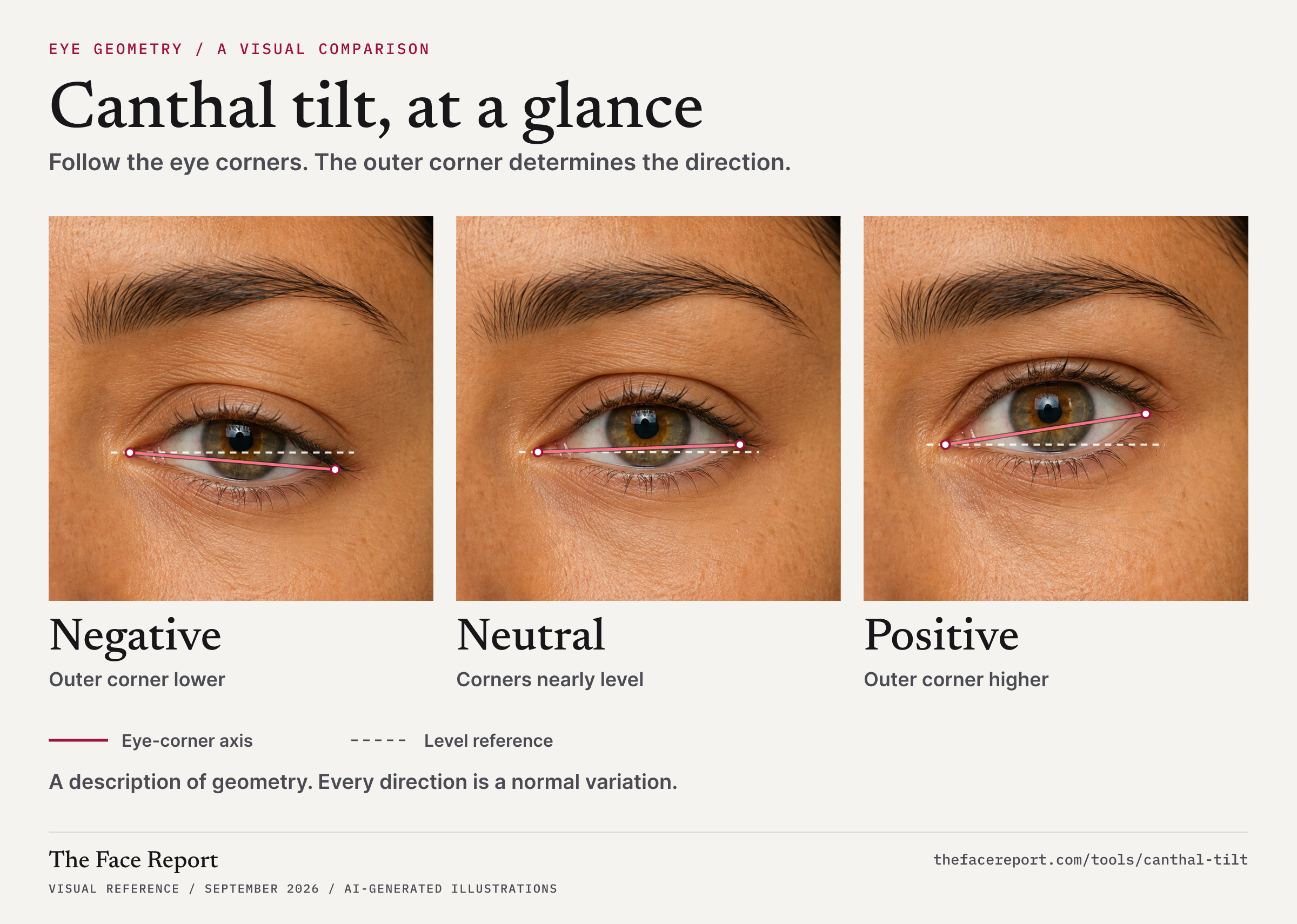
Compare the corner positions, not the eyebrow or lash line. The rose line joins the inner and outer eye corners; the dashed line is a level reference. These synthetic examples illustrate direction, not measured angle values or beauty ratings.
Open the image above to inspect the details at full size.
Canthal tilt, at a glance. The Face Report (2026). https://thefacereport.com/tools/canthal-tilt#canthal-tilt-comparison
How this was made & reuse permission
AI-generated adult eye illustrations, followed by an editorial geometry review and manually placed corner annotations. Head position can change a photo-based estimate; use a level, straight-on photo for your own check.
You may reproduce this reference graphic in articles, teaching materials and social posts. A credit to The Face Report and a link to this source page are appreciated. If you adapt it, identify your changes and keep its illustrative context clear. This permission applies to this graphic.
Permanent source link · Published September 4, 2026 · Version 1
Positive tilt
Outer corner above inner corner (above 0°). This is an upturned eye-corner line and one component of what online communities sometimes call "hunter eyes." Tilt alone does not define the full eye shape.
Neutral tilt
Corners level or only slightly offset in the photo. Because a 2D estimate changes with camera height and head pitch, values close to a boundary should be checked with another suitable photo.
Negative tilt
Outer corner below inner corner (below 0°). Often called downturned or "puppy eyes" in informal shape language. It is a geometric description, not a personality or beauty rating.
Is Negative Canthal Tilt Bad?
No. Negative canthal tilt can be normal anatomical variation, not a flaw. A 2023 review found that positive tilt was generally preferred in the included female-focused aesthetics literature, but it also found debate over the preferred degree and meaningful variation between studied populations. A 2025 image-manipulation study found that further lateral-canthus elevation reduced several ratings in its specific stimulus set. Neither result supports turning one angle into a universal verdict.
Online communities sometimes treat negative tilt as a defect that needs surgical correction. That framing isn't supported by the aesthetics literature, and canthoplasty is a real surgical procedure with real risks - not something to consider because of a number on a screen. If a strongly negative tilt appeared recently or is asymmetric, that can occasionally reflect age-related laxity or an eyelid condition, which is a question for an ophthalmologist, not a calculator.
What Your Canthal Tilt Means
The canthal tilt is reported in degrees. Positive numbers mean the outer canthus appears above the inner canthus; negative numbers mean it appears below. These bands describe the measured slope and align with the calculator's categories. They are not population percentiles, diagnoses, or attractiveness rankings:
+8° and above - Strongly upturned
The outer corners sit clearly higher than the inner corners in this photo. Higher positive values are a geometric description, not a better score.
+4° to below +8° - Upturned
The eye-corner line slopes upward toward the temple. This is one feature people may mean by positive canthal tilt or the informal 'hunter eyes' label.
+2° to below +4° - Slightly upturned
A smaller upward slope is visible in the measured eye-corner line. Camera height and head pitch can move a photo estimate by a degree or more.
0° to below +2° - Approximately level
The outer corners are level with or only slightly above the inner corners in the fitted face-horizontal reference.
-3° to below 0° - Slightly downturned
The outer corners sit slightly below the inner corners. This is a common type of anatomical variation, not a defect or diagnosis.
Below -3° - Downturned
The measured line slopes downward toward the temple. A recent or one-sided eyelid change belongs with an eye-care professional, not an online calculator.
Why Canthal Tilt Matters
Canthal tilt is one visible part of eye-area geometry. Research shows that changing canthal position can affect ratings in controlled images, but the direction and preferred degree depend on the image, population, and study design. Eyelid exposure, brow position, expression, lighting, and the rest of the face remain part of what a viewer sees.
In looksmaxxing communities, the eye-corner angle is also folded into a whole-face PSL rating - where tilt is one small component among symmetry and overall proportions, not a score on its own.
What positive tilt describes
- Outer corner above the inner corner
- An upward eye-corner line toward the temple
- One component of "cat eye" or "hunter eyes" language
- Not a complete eye-shape or attractiveness classification
What level / negative tilt describes
- Outer corner level with or below the inner corner
- A level or downward eye-corner line
- Sometimes called "downturned" or "puppy eyes"
- Normal variation, not a personality signal
How Your Tilt Is Calculated
A 478-point face detector supplies four canthus landmarks - the inner and outer corners of both eyes - plus five points used to fit the face midline. The calculator constructs a perpendicular face-horizontal axis, projects each inner→outer corner line against it, and reports:
- Left eye tilt in degrees
- Right eye tilt in degrees
- Average tilt across both eyes
- Left/right difference - the absolute gap between the two photo estimates
- Descriptive category - a plain-language label for the measured slope
The same decoded photo and detector output return the same numbers; no language model assigns the angle. Roll is normalized by the fitted face axis, while pitch and yaw remain important 2D limitations. The tool withholds a result beyond its pose limits instead of presenting a pose-driven category.
Tips for Accurate Measurement
Straight-on face, level camera
The fitted face axis compensates for image roll, but turning your face or placing the camera above or below eye level changes the 2D projection. Keep both ears similarly visible and the lens at eye height.
Keep your chin neutral
Looking down makes positive tilt appear stronger; looking up flattens or reverses it. The tool withholds results beyond a 5° pitch estimate, but a neutral chin produces the most repeatable photo.
Neutral, eyes-open expression
Smiling, squinting, or opening one eye more than the other can move the corner landmarks. Relax your face and look directly at the lens.
Clear eye corners
Keep hair, heavy shadows, and eyewear away from both inner and outer eye corners so the face-mesh detector can place the four measured points consistently.
Frequently Asked Questions
What is canthal tilt?
Canthal tilt describes the angle of the line between the inner and outer corners of an eye. Positive means the outer corner is higher, negative means it is lower, and a value near zero is approximately level. It is a geometric eye-shape measurement, not an attractiveness or health verdict.
What is a positive canthal tilt?
A positive canthal tilt means the outer corner is higher than the inner corner in a straight-on view. Online communities often connect positive tilt with 'hunter eyes,' but that informal label also refers to eyelid exposure, brow position, and orbital depth. A positive angle alone does not determine the full eye shape.
What is a negative canthal tilt?
A negative canthal tilt means the outer corner is lower than the inner corner, producing a downturned eye-corner line. It can be normal lifelong anatomy. If eyelid position changed recently, differs suddenly between sides, or affects comfort or vision, consult an optometrist or ophthalmologist rather than relying on a photo tool.
How is canthal tilt measured?
This tool detects 478 face-mesh points, selects the inner and outer corner of each eye, and fits a face midline from five additional points. It projects each eye-corner line against the perpendicular face-horizontal axis, which compensates for image roll. It then reports left, right, average, and the difference between sides. The result is still a 2D photo estimate and is sensitive to camera height and head pitch.
What is the perfect canthal tilt?
There is no universal perfect angle. Published studies use different populations, images, definitions, and rating tasks, and reported averages vary by sex and population. Some research associates positive inclination with particular ratings, while newer image-manipulation research found that further lateral-canthus elevation reduced several ratings. Treat the number as a description of your photo, not a target.
Can I change my canthal tilt?
Makeup, lashes, and brow styling can change how the eye area appears without moving the canthus. Exercises and mewing have not been shown to relocate adult canthal attachments. Canthopexy and canthoplasty are real oculoplastic operations with functional and cosmetic risks; questions about them belong with a qualified oculoplastic surgeon after an in-person examination.
Why are my left and right tilts different?
Small differences can reflect anatomy, landmark-estimation noise, expression, yaw, pitch, or camera perspective. The calculator suppresses results beyond its pose limits, but a well-lit, eye-level, straight-on photo with a neutral expression is still essential. Repeat with another suitable photo before interpreting a small difference.
Is this the same as the 'hunter eyes' trend?
Canthal tilt is one measurable component of that trend, not the whole definition. 'Hunter eyes' is informal looksmaxxing vocabulary that usually bundles positive tilt with low upper-lid exposure, a narrower opening, deeper-set eyes, and brow proximity. This calculator measures only the eye-corner angle and left/right difference.
What canthal tilt is most attractive?
Research does not identify one most attractive canthal tilt. Studies that edited faces reached different conclusions depending on the images, populations, and rating tasks used, and reviews describe the preferred degree as debated. Attractiveness ratings also depend on eyelid exposure, brows, expression, and the rest of the face, so treat any measured angle as a description rather than a ranking.
Does canthal tilt change with age?
The canthal tendons stay anchored to bone, but the soft tissue that supports the outer eye area can loosen gradually over decades, which can lower how the outer corner sits in photos. Facial growth before adulthood can also shift proportions. Day-to-day photo differences are more often pose, expression, or camera height. A change that is sudden or affects only one side belongs with an eye-care professional.
References
- Faderani et al. (2024). Facial Aesthetic Ideals: A Literature Summary of Supporting Evidence. Aesthetic Surgery Journal - reports limited, heterogeneous evidence and debate over a universal preferred tilt.
- Kempa et al. (2025). Understanding the impact of eyebrow and lateral canthal height on the perception of character traits. Rating study of 2,081 participants using edited images.
- Kalsi et al. (2022). The Influence of Sagittal Head Tilt on Periorbital Appearance. Shows why standardized camera/head pitch matters.
- Kim et al. (2021). Diagnostic analysis of vertical orbital dystopia and canthal tilt for surgical correction. Demonstrates a clinical measurement method and population-specific values.
Related Tools and Guides
Eye Shape Detector
Almond, round, hooded, monolid, upturned, downturned
Jawline Rating Test
Real gonial angle measurement, taper, symmetry
Face Symmetry Test
Photo-based left/right comparison across measured facial regions
Attractiveness Test
Symmetry and proportions scored, with separate jawline and face-shape measurements
PSL Rating Test
Symmetry and proportions translated into a broad PSL-style range
Golden Ratio Face Calculator
How closely your face length-to-width ratio matches phi (1.618)
Negative Canthal Tilt, Explained
What a downturned axis means and every fix, ranked honestly
Hunter Eyes Guide
The anatomy behind the label - and what's actually achievable