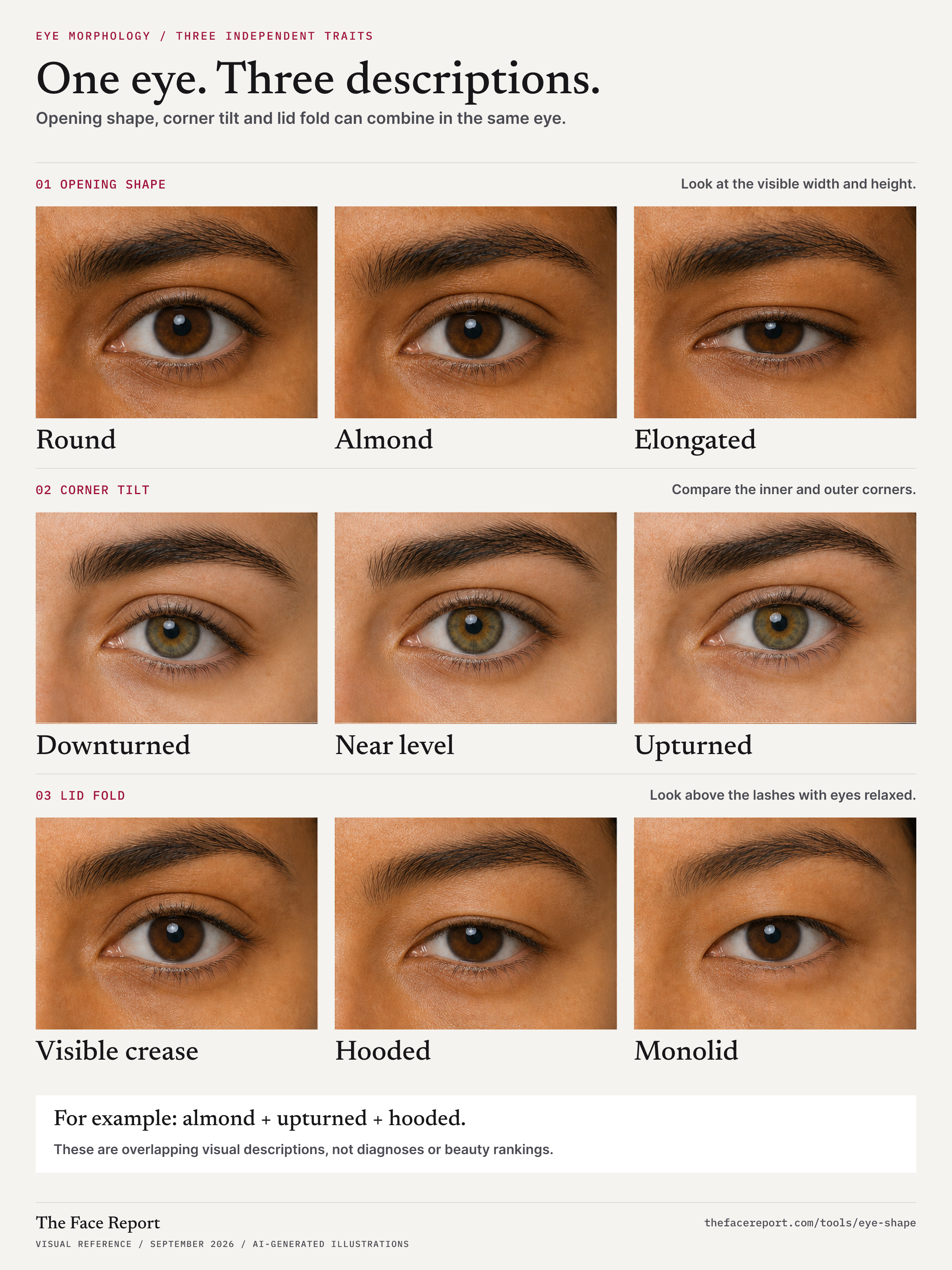
How do I know my eye shape?
Start with two separate observations: the visible opening can be round, almond, or elongated, while the inner-to-outer corner line can be upturned, level, or downturned. This tool estimates both from the eyelid-margin and eye-corner landmarks in a front photo. Hooded and monolid describe lid-crease traits and need a separate visual assessment; they are not inferred by this face mesh.
What is the most attractive eye shape?
There is no objective most-attractive eye shape. Eye appearance combines opening proportions, corner orientation, lid and brow anatomy, expression, lighting, and individual preference. The result here is a geometry description for styling exploration, not an attractiveness ranking.
Can my eye shape change?
Your result can change across photos because gaze, squinting, expression, head pitch, camera height, and lens perspective change the visible opening. Eyelid appearance can also change over time. For before-and-after comparisons, match camera position, lighting, gaze, and expression.
What about monolid?
Monolid refers to an upper eyelid without a clearly visible crease. The landmark mesh used here traces the eyelid margins and corners, but it does not locate the crease or skin fold. A monolid eye can still have a round, almond, or elongated opening and any corner orientation, so the tool reports those measurable axes without assigning a monolid label.
Why do my left and right eyes look different?
Some left-right difference is common, and a small head turn, uneven expression, hair, glare, or lens perspective can magnify it in a photo. This classifier averages both eye openings for its main label. Retake the photo straight on if one outline looks visibly misaligned.
How is this different from face shape?
Face shape describes the overall facial outline, such as oval, round, square, heart, oblong, or diamond. Eye shape here describes the visible eye opening and the corner orientation. Any face shape can appear with any eye-opening shape.
Can I change my eye shape with makeup?
Makeup does not change the measured anatomy, but placement can change the visual effect. Outer-corner liner can emphasize or counter the measured orientation; centered or outer-weighted shadow and mascara can make the opening appear taller or longer. The result suggestions are optional effects, not corrections.
Are hooded eyes unattractive?
No eye or lid type is inherently attractive or unattractive. Hooded describes how upper-lid skin overlaps the crease or visible lid space. It is also separate from opening shape and corner orientation, and this photo tool does not diagnose or score it.
Is diamond an eye shape?
Diamond is usually a face-shape label rather than an eye-shape category. When people apply it to eyes, they generally mean an almond-type opening with more angular taper toward both corners. This detector does not use a diamond label; it reports the measurable axes instead - opening shape (round, almond, elongated) and corner orientation (upturned, level, downturned).
What is the rarest eye shape?
There is no reliable population data behind the rarity rankings that circulate online. Eye-shape labels describe overlapping traits rather than exclusive categories, and studies do not count them with consistent definitions, so any claim that a particular shape is rarest is marketing language. This tool reports what is measurable in your photo without assigning rarity.
What color are my eyes if they look brown in some photos and green in others?
That pattern is hazel. Hazel irises carry brown pigment near the pupil and less toward the edge, and the colour that dominates depends on the light source, the distance of the camera and even the colour of your clothing. The detector reports hazel when the iris colour sits between brown and green, or when one eye reads light brown or amber and the other hazel or green in the same photo, rather than picking one.
Can a photo tell my eye color accurately?
It can tell the colour your camera recorded, which is close to what people see when the light is neutral daylight and no filter is applied. Warm indoor light shifts light eyes toward brown or amber; cool light and screen glow shift them toward blue and gray. If the reading surprises you, retake facing a window in daylight - the colour that persists across lighting is your eye colour.
What is the rarest eye color?
Among the common categories, green and gray are the least frequent - commonly cited estimates put green near two percent of people worldwide and gray below that - while brown is the majority colour. Claims about red, violet or truly black eyes describe lighting, albinism or very dark brown irises rather than distinct colours, and no reliable global census of eye colour exists, so treat exact percentages as approximate.