What Colors Suit a Deep Autumn?
A Deep Autumn is defined by depth first: dark hair, dark eyes, and skin that leans warm, anywhere from olive to deep brown. Think Natalie Portman, Oscar Isaac, or Eva Mendes, where hair and eyes read almost as dark as each other over a warm-toned complexion. Your natural contrast runs high and your base is warm-neutral rather than cool and icy. In plain terms, you are the darkest, richest corner of the Autumn family, where warmth and intensity meet.
Your palette answers that intensity with color that has weight. Spiced, saturated, low-lit shades like Brick Burgundy, Chocolate, Deep Olive, and Deep Teal echo the richness already in your hair and eyes, so you look grounded and lit from within. Anything pale or chalky does the opposite: it drains out beside your depth and leaves your features doing all the work alone.
This season is not about one skin tone or one gender. Deep Autumns exist across every complexion, from warm ivory to the deepest browns; what unites you is depth plus warmth, not any single background. The colors below are about harmony with your natural coloring, not a verdict on it.
The rule
Go deep and warm, never pale and cool: match your colors to the richness already in your hair and eyes. Not sure you're a Deep Autumn? Take our free AI color analysis - it reads your season from a selfie in seconds.
Wardrobe
Your best Deep Autumn colors
Your best colors are deep, warm, and spiced: Brick Burgundy, Chocolate, Deep Olive, Burnt Orange, Deep Teal, Warm Forest, Warm Aubergine, Tomato Red, Deep Mustard, and Espresso. Each one carries the same darkness and golden-earthy warmth already present in your hair and eyes, so instead of competing with your coloring they reinforce it, making your whole face look richer and more defined.
Brick Burgundy
#7C2D26
Chocolate
#5B3A28
Deep Olive
#565A2E
Burnt Orange
#B95B26
Deep Teal
#1F5F63
Warm Forest
#2F4A2C
Warm Aubergine
#5A2E3F
Tomato Red
#BE3A26
Deep Mustard
#A87E1E
Espresso
#3E2A1E
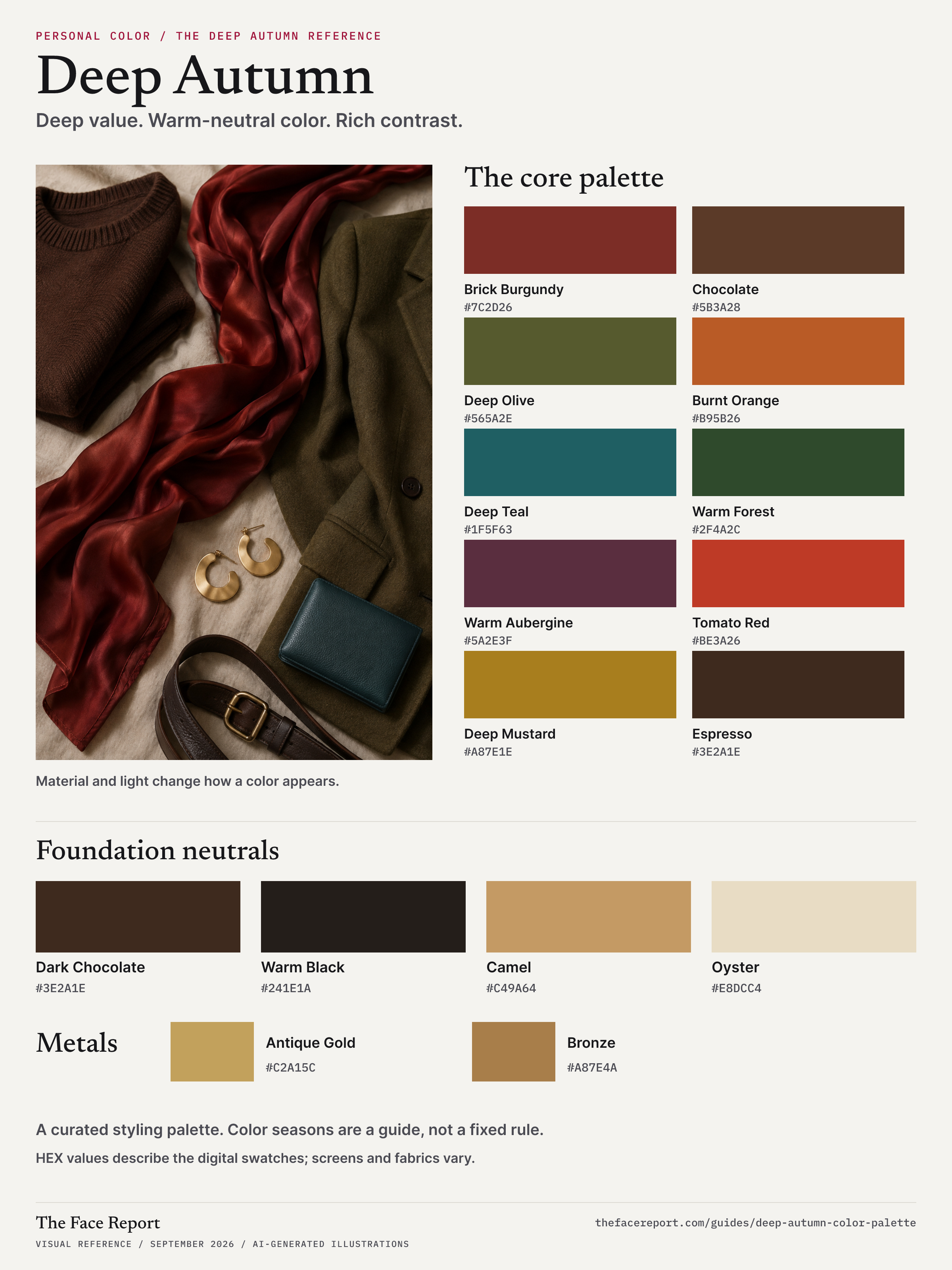
Save the palette for wardrobe planning: ten core colors, four foundation neutrals and two metals. The PNG preserves the exact digital swatch values. Fabric, lighting and your screen affect how a color appears.
Open the image above to inspect the details at full size.
The Deep Autumn reference palette. The Face Report (2026). https://thefacereport.com/guides/deep-autumn-color-palette#deep-autumn-color-palette
How this was made & reuse permission
The fashion still life is AI-generated. Every named swatch and hexadecimal value is rendered directly from The Face Report’s curated Deep Autumn palette. Seasonal color analysis is a styling framework, not a biological classification.
You may reproduce this reference graphic in articles, teaching materials and social posts. A credit to The Face Report and a link to this source page are appreciated. If you adapt it, identify your changes and keep its illustrative context clear. This permission applies to this graphic.
Permanent source link · Published September 4, 2026 · Version 1
Wardrobe
Colors to avoid
Steer clear of Icy Pink, Powder Blue, Light Grey, Pastel Mint, and Baby Lilac. These are pale, cool, and low in saturation, the exact opposite of your deep warm intensity. Against your natural depth they look chalky and thin, so your features suddenly seem harsh while the color itself looks bleached. If you love a pastel, wear it far from your face, never at the neckline.
Icy Pink
#EBD2DE
Powder Blue
#A9C6E8
Light Grey
#CDCFD2
Pastel Mint
#BFE6D2
Baby Lilac
#D6C6E6
How to wear it
Styling a Deep Autumn palette
Build your wardrobe base on Chocolate, Espresso, and Warm Black instead of grey or navy.
These dark warm neutrals sit at your natural depth, so tailoring and knitwear read intentional and rich rather than heavy or mismatched against your coloring.
Reach for one saturated statement shade like Tomato Red, Burnt Orange, or Deep Teal when you want impact.
Your high contrast can carry bold, spiced color that would overwhelm a softer season. These read as vivid and confident on you, not costume-like.
Pair a deep color with a warm neutral rather than stacking two brights, e.g. Deep Olive with Camel.
Camel and Oyster ground your richer shades so the outfit feels layered and expensive, letting one hero color do the talking.
Keep your strongest, warmest shades closest to your face, like a Brick Burgundy or Deep Mustard collar.
Warm depth at the neckline reflects up into your skin and eyes, sharpening your features; a pale scarf there would wash you out instead.
When you want softness, choose Warm Forest or Warm Aubergine over any pastel.
These give you a quieter, muted option that still carries depth and warmth, so you stay harmonised instead of fading the way a mint or lilac would.
Foundation
Your neutrals
Your neutrals should be as rich as your colors: Dark Chocolate, Warm Black, Camel, and Oyster. Dark Chocolate and Warm Black give you depth without the coldness of true black or grey, while Camel and Oyster offer lighter warm options that still hold their own beside your intensity. These four replace the navy-and-grey defaults that tend to flatten Deep Autumn coloring.
Dark Chocolate
#3E2A1E
Warm Black
#241E1A
Camel
#C49A64
Oyster
#E8DCC4
Jewelry
Your metals
Choose Antique Gold and Bronze over silver. Your undertone leans warm, so warm-toned metals melt into your skin and pick up the golden, spiced quality in your palette, while bright silver reads cold and slightly disconnected against you. Antique and bronze finishes, rather than high-shine yellow gold, also match your muted depth, feeling rich instead of flashy at your neckline and wrists.
Antique Gold
#C2A15C
Bronze
#A87E4A
Beauty
Makeup shades
Lean into warm depth: Deep Terracotta Blush, Brick-Red Lipstick, Black-Brown Liner, and Deep Gold Shimmer. Terracotta and brick echo your best clothing shades so your face and outfit agree, while black-brown liner gives definition without the hardness of jet black. Deep Gold shimmer on the lids catches your warm undertone. Skip cool pinks, frosty pastels, and grey-based shadows, which fight your warmth.
Deep Terracotta Blush
#B05B3E
Brick-Red Lipstick
#8E2F24
Black-Brown Liner
#2E2018
Deep Gold Shimmer
#B8904E
Hair
Hair color directions
Your coloring supports dark, warm hair: Espresso, black-brown, and deep auburn all sit naturally at your depth. These keep the strong contrast between hair and skin that makes Deep Autumn features read as striking. Warm auburn and espresso tones especially flatter your undertone. Avoid ashy or platinum lightening, which strips out warmth and depth and leaves your face looking washed out against pale, cool strands.
- •Espresso
- •Black-brown
- •Deep auburn
Get it right
Is it really Deep Autumn?
Deep Autumn is easy to confuse with its two neighboring seasons. Here's how to tell.
Deep Autumn vs True Autumn
Both are warm, but True Autumn is lighter and purely warm, living in mid-tone earthy glow rather than darkness. If deep shades like Espresso and Brick Burgundy energise you while lighter warm colors feel a touch flat, you are Deep Autumn. If true depth starts to overwhelm you and mid-tones look best, you lean True Autumn.
See the True Autumn palette →Deep Autumn vs Deep Winter
You share the same darkness, so the deciding factor is temperature. Hold Chocolate and Warm Forest against your skin, then icy, cool darks like true black and cool berry. If the warm, spiced darks make your skin glow and the cool ones look stark, you are Deep Autumn; if the cool darks look crisper and cleaner, you are Deep Winter.
See the Deep Winter palette →Reference
Deep Autumn celebrities
Commonly cited Deep Autumn examples include Natalie Portman, Oscar Isaac, Eva Mendes. They share the neutral, deep-value, high-contrast coloring the Deep Autumn palette is built around.
FAQ
Frequently asked questions
Is Deep Autumn warm or cool?
Deep Autumn is warm, with a neutral base that keeps it from being as purely warm as True Autumn. Your colors and metals should lean warm: think Chocolate, Burnt Orange, and Antique Gold rather than icy or blue-based shades. When choosing between two versions of a color, pick the warmer, earthier one and you will stay in harmony with your coloring.
What colors should a Deep Autumn avoid?
Avoid pale, cool, low-saturation shades: Icy Pink, Powder Blue, Light Grey, Pastel Mint, and Baby Lilac. They are the opposite of your deep warm intensity, so they look chalky beside you and make your features seem harsh. If you love a pastel, wear it away from your face and pair it with a rich neutral like Dark Chocolate to anchor it.
Deep Autumn vs Deep Winter, how do I tell?
You share the same depth, so it comes down to warm versus cool. Deep Autumn glows in warm, spiced darks like Warm Forest and Brick Burgundy, while Deep Winter looks crisper in cool darks and true black. Hold both types of dark near your face: whichever makes your skin look clear and lit, rather than stark, tells you which season you are.
Who is an example of a Deep Autumn?
Natalie Portman, Oscar Isaac, and Eva Mendes all read Deep Autumn: dark hair and eyes over warm-leaning skin, with high natural contrast and real depth rather than a light or icy cast. Use them as a directional cue, not a rule. What matters is the pattern you share, deep plus warm, not matching any one person's exact features.
Can a Deep Autumn wear black?
Yes, but choose your black carefully. Your best version is Warm Black rather than a stark, cool jet black, which can look a little hard against your warmth. Even better, reach for Dark Chocolate or Espresso as your go-to dark neutral. If you do wear true black, warm it up with Antique Gold or a Brick-Red lip near your face.
What hair color works for a Deep Autumn?
Stick to dark and warm: Espresso, black-brown, and deep auburn all match your natural depth and keep the strong hair-to-skin contrast that makes your features pop. Warm auburn especially plays up your undertone. Avoid ashy, platinum, or heavily lightened shades, which strip warmth and depth and can leave your face looking washed out against the paler, cooler strands.
Not sure Deep Autumn is your season?
Our free AI color analysis reads your undertone, value and contrast from a single selfie and places you in one of the 12 seasons in seconds.
Find my color season - freePut your palette to work
Confirm your season, then take your full palette everywhere.