Original Data Study
We Analyzed 15,447 Faces: What the Data Says
On 19 August 2026, people ran 15,447 facial analyses on our free tools. We aggregated a single full day of results - symmetry, overall harmony, and face shape - into the dataset below. It's anonymous, reported only in aggregate, and it turns up a few things that contradict what the looksmaxxing internet will tell you - and we've checked each finding against the peer-reviewed research.
49.2%
of scored analyses were classified as oval
71.5/100
average overall harmony score
91+
reached by only the top 0.1% of scans
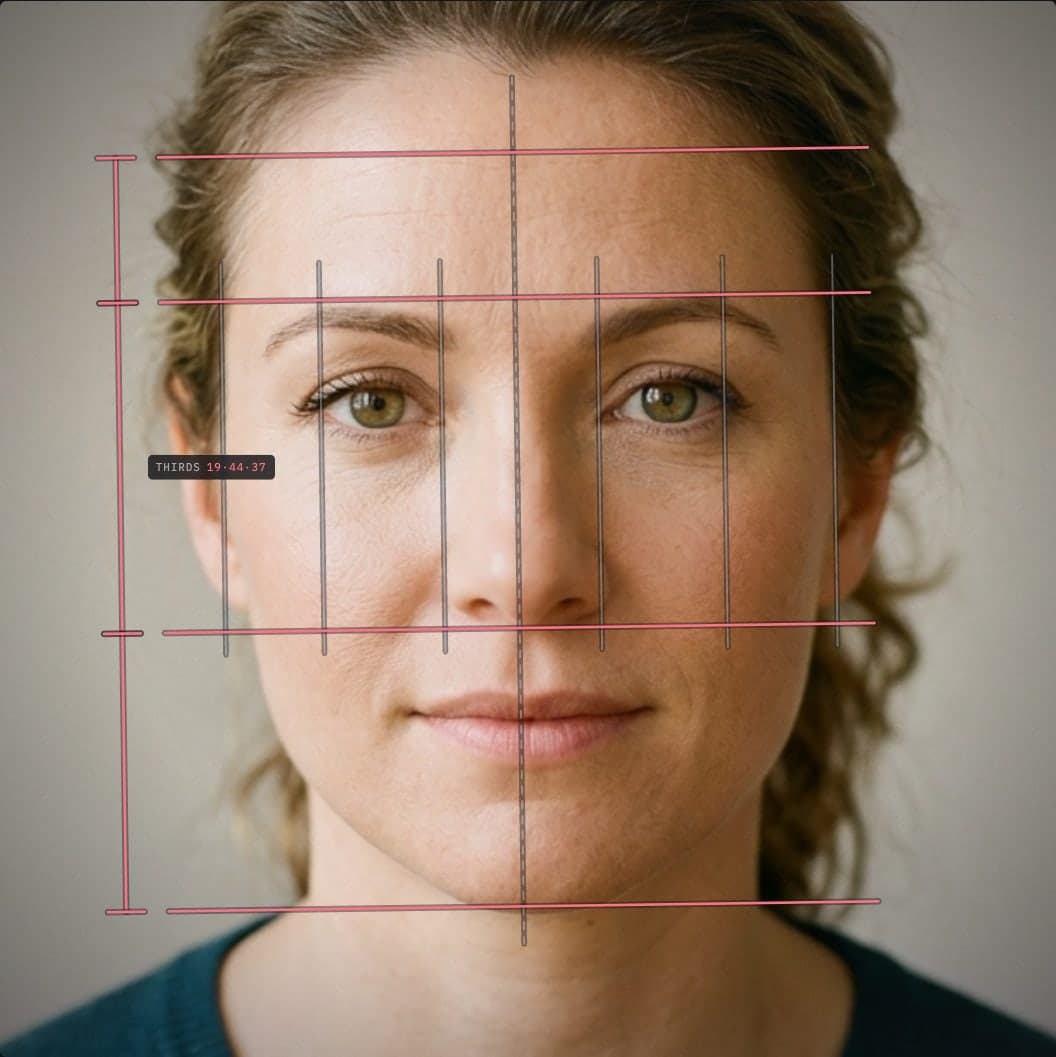
One scan, measuredsynthetic subject · 478 landmarks
How to read this
Data as of 19 August 2026. 15,447 analyses (15,429 with a full score) from one full UTC day. These are analyses, not necessarily unique people; repeat users can contribute multiple results. Each result comes from facial landmarks on one uploaded photo, scored by our algorithm - not clinical measurement. We use a one-day window because free-scan results are deleted after two days under our retention policy, so a longer window can't be reconstructed. Scores here come from the engine as it runs today; it was recalibrated in June and July 2026, so older scores sat on a lower scale and aren't comparable. Users are self-selected, so the numbers describe this sample, not the whole population. No personal data is used, and each headline finding is checked against peer-reviewed research (cited at the end).
Oval Was the Most Common Classification in This Sample
Oval accounts for 49.2% of the scored analyses in this snapshot; diamond accounts for 5.4%. Oval is the "balanced" reference shape, so a classifier leans toward it whenever no other shape strongly dominates - which likely inflates its share.
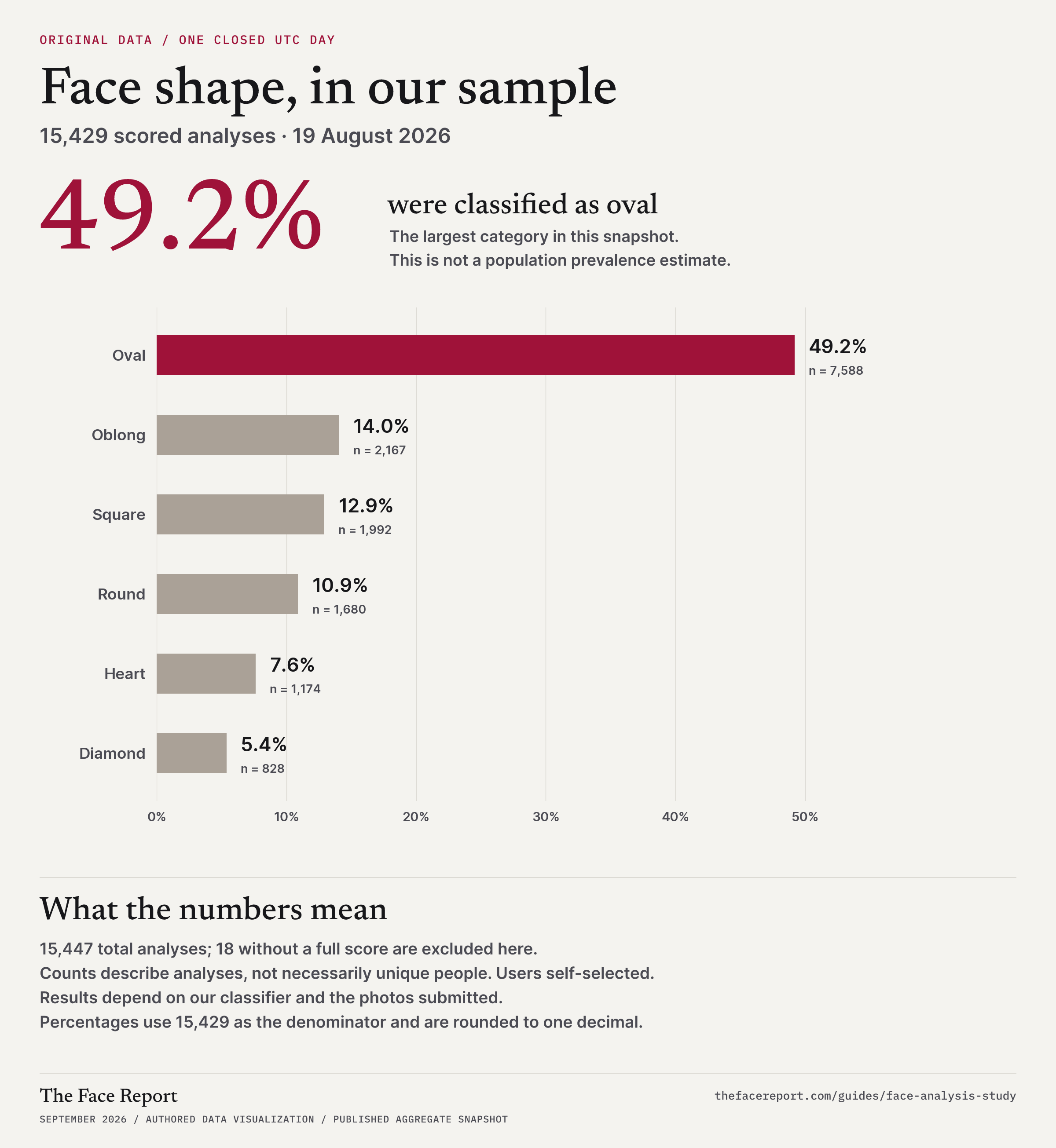
Detected shapes in the published 19 August 2026 snapshot. The denominator is 15,429 scored analyses, excluding 18 without a full score. These are analyses, not necessarily unique people, and the distribution describes our self-selected sample rather than the general population.
Open the image above to inspect the details at full size.
Face shape, in our sample. The Face Report (2026). https://thefacereport.com/guides/face-analysis-study#face-shape-study-distribution
How this was made & reuse permission
An authored matplotlib chart built directly from the existing public aggregate snapshot. Counts reconcile to the scored denominator; percentages are rounded to one decimal. The source records a single closed UTC day, 19 August 2026. Historical individual results have expired under the retention policy, so this is a visualization of the published snapshot, not a new extraction. Classification and photo quality affect the results. No individual records or demographic data are included.
You may reproduce this reference graphic in articles, teaching materials and social posts. A credit to The Face Report and a link to this source page are appreciated. If you adapt it, identify your changes and keep its illustrative context clear. This permission applies to this graphic.
Permanent source link · Published September 4, 2026 · Version 1
View the underlying counts
| Shape | Analyses | Share |
|---|---|---|
| Oval | 7,588 | 49.2% |
| Oblong | 2,167 | 14.0% |
| Square | 1,992 | 12.9% |
| Round | 1,680 | 10.9% |
| Heart | 1,174 | 7.6% |
| Diamond | 828 | 5.4% |
Against the research
Decades of work find that ‘average’, prototypical faces are rated more attractive than most individuals (Langlois & Roggman, 1990), and that averageness and symmetry are modest-but-real, cross-cultural contributors to attractiveness (Rhodes, 2006). Which of six shape buckets you land in barely registers next to that - and the buckets themselves are a styling convention, not an anatomical taxonomy.
The Average Harmony Score Is 71.5 - and the Top End Is Thin
Overall harmony averaged 71.5/100 (median 75), so a mid-70s result is genuinely average. Roughly 30% of faces reach 80+, which makes an 80 a top-third result rather than a rare one. The thin part is higher up: the top 10% scored 84+, the top 1% scored 89+, and only about one scan in a thousand reached 91+. A "perfect" 100 effectively doesn't happen, because the top of the scale needs all four measured components to line up at once.
Below 50
7.4%
50–59
7.9%
60–69
16.6%
70–79
38.2%
80 and above
29.9%
Against the research
There is no scientific ‘perfect face’. Attractiveness is multi-factor - averageness, symmetry and sexual dimorphism each contribute modestly (Rhodes, 2006) - so treat this as one geometric proxy among many, not a verdict. The distribution is wide and its top end is thin: reaching 91 takes close alignment across all four measured components at once, which is why only about one scan in a thousand gets there.
Symmetry Is Where Faces Differ Most
The median symmetry score was 75/100, but no metric varied more (standard deviation 20.5). The bottom 10% of faces scored below 38; the top 10% above 89. Some of that range is real, and some is photographic - a slightly turned head or uneven light drops the score - which is exactly why near-perfect symmetry is rare and visible asymmetry is completely normal.
75
median symmetry
38
bottom-10% score
89
top-10% score
97
highest recorded
Against the research
Perfect symmetry barely exists in nature. A statistical-shape study of 321 healthy adults found asymmetry is the norm, with the left side dominant in roughly 81–86% of asymmetric cases (Ercan et al., 2008). Symmetry does track with attractiveness, but the effect is modest (Rhodes, 2006) - so a mid-range score is completely normal.
Does Face Shape Predict Harmony? Not the Way It Looks
Oval and diamond faces scored highest, heart lowest - a spread of about nine points. Before reading that as a ranking, note that it is largely circular: the classifier calls a face "oval" when no single feature dominates, and the harmony score rewards exactly that balance. Oval scoring well is partly a restatement of how both are defined, not an independent finding.
| Face shape | Mean harmony | Faces |
|---|---|---|
| Oval | 74.2 | 7,588 |
| Diamond | 73.4 | 828 |
| Oblong | 69.4 | 2,167 |
| Round | 69.3 | 1,680 |
| Square | 68.3 | 1,992 |
| Heart | 65.1 | 1,174 |
Is the Golden Ratio Really the Secret to a Beautiful Face?
It's the looksmaxxing internet's favourite number - but the evidence is thin. We deliberately left raw golden-ratio scores out of this study because our values were too noisy to report honestly, and the research suggests the "1.618 ideal" is oversold in the first place.
Against the research
The popular ‘golden ratio’ / Marquardt phi-mask standard has been formally critiqued: its goodness-of-fit method is faulty, it best matches masculinised white fashion models, and it doesn’t describe most people’s actual preferences (Holland, 2008). Treat any single ‘ideal ratio’ as a rough guide, not a law - which is also why we left our own noisy golden-ratio numbers out of this study.
If you want to inspect the geometry rather than treat it as a beauty law, the free Golden Ratio Face Calculator shows the measured visible-face ratio, its target, and the pose caveat alongside the score.
What the Data Actually Means for You
An average harmony score is in the mid-70s, not the 90s. Scores cluster tightly around the middle, so a few points either way is noise, not a verdict.
Visible asymmetry is the norm, not a flaw. Symmetry is the most variable trait we measured, and much of a low score is just camera angle.
Face shape looks predictive but mostly isn't. The shape label and the harmony score measure overlapping things, so chasing a different 'shape' matters far less than proportion, grooming, and body composition.
Compare yourself to the distribution, not an imaginary 10. The realistic gains are the evidence-based fundamentals, not a perfect score.
Frequently Asked Questions
What is the average facial symmetry score?
Across 15,447 faces analysed on The Face Report on 19 August 2026, the median facial symmetry score was 75 out of 100, with a mean of about 69. Symmetry was the most variable trait measured (standard deviation 20.5): the bottom 10% scored below 38, while the top 10% scored above 89. This fits the research - perfect symmetry essentially doesn't exist. A statistical-shape study of 321 healthy adults found facial asymmetry is the norm, with the left side dominant in roughly 81–86% of asymmetric cases (Ercan et al., 2008). Much of a low score also reflects photo conditions, since a slightly turned head lowers it, so visible, normal asymmetry is expected.
What is the most common face shape?
Oval is the most common detected face shape: 49.2% of the 15,447 analysed faces were classified as oval. Oblong was second at 14.0%, followed by square (12.9%), round (10.9%), heart (7.6%), and diamond - the rarest - at 5.4%. Because oval is widely treated as the 'balanced' reference shape, a classifier tends to label faces that don't strongly express another shape as oval, which likely inflates its share. It's worth noting that face-shape categories are a styling convention, not a rigorous scientific construct - research links attractiveness far more to averageness and symmetry than to which shape bucket a face falls in (Langlois & Roggman, 1990; Rhodes, 2006).
What is a good facial harmony score?
On the current scale, the average overall harmony score was 71.5 out of 100 and the median was 75, so a score in the mid-70s is genuinely average. About 30% of faces scored 80 or above, so an 80 puts you in roughly the top third rather than in rare territory. The top end is much thinner: the top 10% scored 84+, the top 1% scored 89+, and only about one scan in a thousand reached 91 or higher. These figures describe scores produced by the scoring engine as it runs today (measured 19 August 2026); the engine was recalibrated in June and July 2026, and scores from before those dates sat on a lower scale and are not comparable.
What is the highest possible facial harmony score?
The scale runs to 100, but in practice the top is thin. Across 15,447 faces measured on 19 August 2026, the top 1% scored 89 or above and the top 0.1% scored 91 or above; the single highest score observed in that snapshot was 92. Treat that last number as an observation, not a ceiling - the highest score in any sample rises as more faces are scanned, so the percentiles are the meaningful figures. A score near the top requires close alignment across all four measured components at once (symmetry, facial thirds, facial fifths, and golden-ratio proximity), which is why it is rare rather than impossible.
Is the golden ratio the secret to an attractive face?
Not really. The idea that a 1.618 'golden ratio' or the Marquardt phi-mask defines a beautiful face has been formally criticised in the plastic-surgery literature: the method used to test fit is faulty, the mask best matches masculinised white fashion models, and it doesn't reflect the preferences of most people (Holland, 2008). Symmetry and averageness have better evidence as beauty cues, and even those are modest in size (Rhodes, 2006). We excluded our own golden-ratio figures from this study because the raw values were too noisy to report honestly - but the broader point stands: treat the golden ratio as a rough guideline, not a law of attractiveness.
Which face shape scores highest for facial harmony?
Oval (mean 74.2) and diamond (73.4) faces scored highest, followed by oblong (69.4), round (69.3), and square (68.3), with heart lowest at 65.1. Read that gap with care: it is largely circular. The classifier labels a face 'oval' when no single feature strongly dominates, and the harmony score rewards exactly that kind of balance - so oval faces scoring well is partly a restatement of how both are defined, not an independent finding. Research links attractiveness to averageness and symmetry rather than to shape categories (Langlois & Roggman, 1990; Rhodes, 2006), so shape is best read as a styling cue, not a ranking.
How were these faces analysed?
The figures are aggregate statistics from 15,447 facial analyses run on The Face Report's free tools during a single UTC day, 19 August 2026 (15,429 of them produced a full score). Each analysis maps facial landmarks from a single uploaded photo and computes algorithmic scores for symmetry, proportion, and overall harmony, plus a face-shape classification. A one-day window is used because free-scan results are automatically deleted after two days under our data-retention policy, so a longer window cannot be reconstructed. The data is anonymous and reported only in aggregate - no individual results, names, or demographic attributes are included. These are self-selected users curious about their own faces (skewing young and male), and the scores are an AI tool's outputs, not clinical or medical measurements, so the numbers describe this sample. Where possible we check them against peer-reviewed research rather than presenting them as standalone truth.
References
- Langlois, J. H., & Roggman, L. A. (1990). Attractive Faces Are Only Average. Psychological Science, 1(2), 115–121. View source
- Rhodes, G. (2006). The Evolutionary Psychology of Facial Beauty. Annual Review of Psychology, 57, 199–226. View source
- Ercan, I., Ozdemir, S. T., Etoz, A., et al. (2008). Facial asymmetry in young healthy subjects evaluated by statistical shape analysis. Journal of Anatomy, 213(6), 663–669. View source
- Holland, E. (2008). Marquardt's Phi Mask: Pitfalls of Relying on Fashion Models and the Golden Ratio to Describe a Beautiful Face. Aesthetic Plastic Surgery, 32(2), 200–208. View source
How Do You Compare?
Run the same free face analysis these 15,447 faces did - get your symmetry, harmony, and face shape in seconds and see where you land on the distribution. Private, no signup.
Analyze My Face FreeSee your own numbers
The fastest way to use this data is to find where you land on it.
Full Face Analysis
FreeYour complete report - symmetry, harmony, ratios, and face shape - measured the same way as this study.
Symmetry Checker
FreeSee your symmetry score and where it falls against the median of 75.
Face Shape Detector
FreeFind out if you're part of the 49% with an oval face - or one of the rarer shapes.
Looksmaxxing: An Honest Guide
What actually moves these numbers, what's overhyped, and where to start.