Negative Canthal Tilt: What It Actually Means
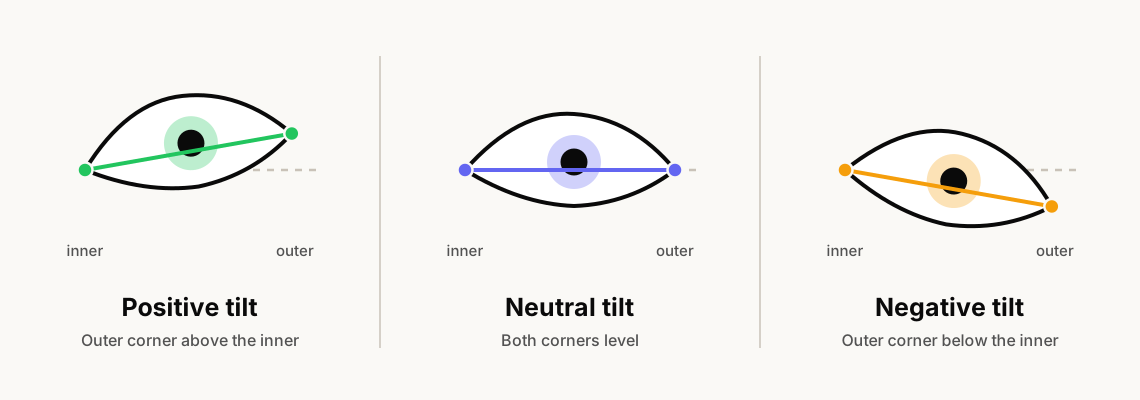
A negative canthal tilt means the outer corner of your eye sits lower than the inner corner, so the eye's axis slopes slightly downward toward the temple. It's a descriptive measurement, not a defect - but TikTok and looksmax forums treat it as a verdict, so this guide covers what the evidence actually says, how to measure yours properly, and which "fixes" are real versus theatre. Estimate your tilt free before assuming anything.
Key Takeaway
A value below 0° describes the direction of the eye axis; it is not a defect or an attractiveness cutoff. Published preference studies use different faces, populations, edits, and reference lines, so they do not establish one ideal angle. Styling may change the visual framing, while a photo cannot diagnose eyelid health or tell you whether treatment is appropriate.
Do I Have a Negative Canthal Tilt? The 60-Second Check
Take a photo at exact eye level, head level, neutral expression, looking straight at the lens. Then compare the height of each eye's outer corner against its inner corner: outer higher = positive tilt, level = neutral, outer lower = negative. A line drawn against the image is sensitive to head roll, while pitch, yaw, camera height, and lens perspective can also change how the eye area appears.
The reliable version is to measure the angle: our free canthal tilt tool detects a 478-point face mesh, locates both corners of each eye, and estimates the left, right, and average angle against a fitted face axis - in your browser, with no photo upload or login. That face-relative reference reduces simple roll error, but it cannot remove every effect of pose, expression, perspective, or landmark placement.
Measured examplesynthetic subject · 478 landmarks
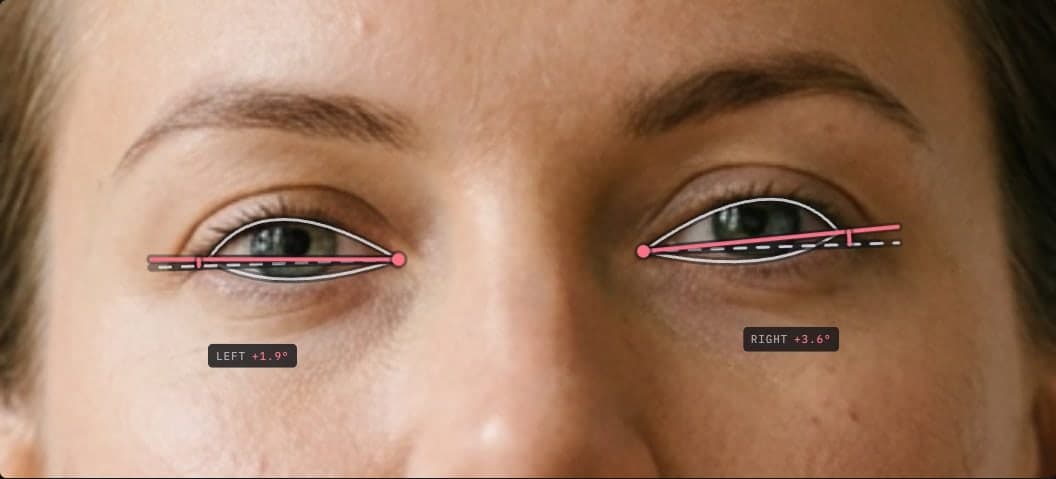
For context on what real faces measure, the facial measurement norms publish canthal-tilt percentiles from one closed day of scans - the same bands the tool shows under your own reading.
Positive vs Neutral vs Negative: The Full Spectrum
Canthal tilt is a continuum, and where the labels switch matters less than forums suggest:
Above 0°
PositiveThe outer corner sits above the inner corner. Some beauty and forum discussions call this a lifted or cat-eye axis, but the angle alone does not define a complete eye shape.
Around 0°
NeutralThe inner and outer corners sit at nearly the same height. Small photo, pose, and landmark differences can move a near-zero estimate across the sign boundary.
Below 0°
NegativeThe outer corner sits below the inner corner. This is a descriptive direction, not a diagnosis, defect, personality signal, or standalone attractiveness rating.
Is a Negative Canthal Tilt Actually Unattractive?
The research does not support turning one angle into a verdict. Some studies of edited faces preferred a more positive tilt in a specific sample, while newer work using different edits found that lateral-canthus elevation reduced several ratings. Reviews describe the preferred degree as debated and population-specific. The useful conclusion is that a study average is not a personal score and no validated negative-angle cutoff makes an eye unattractive.
The practical question isn't "is my tilt negative?" but "is my tilt actually what's driving how my eye area reads?" The surrounding brows, lids, expression, lighting, and the rest of the face all contribute. Our eye shape tool describes more of the visible eye area, while our hunter-eyes guide explains why that forum label cannot be reduced to tilt alone.
What Causes a Negative Canthal Tilt
Canthal position reflects inherited bone, tendon, and eyelid anatomy. Surrounding tissues and eyelid support can also change with age or a medical condition. A photograph adds another layer: manual image-horizontal measurements change with head roll, while pitch, yaw, expression, focal length, and landmark placement can alter the apparent geometry. A new one-sided change, especially with pain, irritation, exposure, or vision symptoms, belongs with an eye-care professional rather than a photo comparison.
Can You Fix It? Every Option, Ranked Honestly
Separate presentation from anatomy. Makeup and brow styling can change the visual line around the eye, but they do not relocate a canthal attachment. Exercises, mewing, and tape have no good evidence of permanently moving it. Surgery can alter canthal position in selected patients, but that is an individualized medical decision rather than a routine "fix" for a score.
Brow shaping
Apparent fixLifting the brow's arch toward the temple (threading, waxing, brow lamination) raises the perceived axis of the whole eye area.
Verdict: This can change the visual framing around the eye, but it does not move either canthus. A brow pencil is a reversible way to preview the effect before a salon treatment.
Eyeliner & lashes
Apparent fixWinged liner angled upward from the outer third, and lash extensions (or mascara focus) concentrated at the outer corner.
Verdict: These techniques can create an upward visual line without changing anatomy. Results depend on eye shape and application, and makeup is fully reversible.
Fixing puffiness & under-eye bags
MarginalTemporary swelling or an eyelid condition can change the contours around the eye without changing the canthal angle itself.
Verdict: Use ordinary sleep and allergy care that is appropriate for you; do not treat a cosmetic angle as a medical diagnosis. New, persistent, painful, or one-sided swelling belongs with a clinician.
Eye taping / 'fox eye' tape
SkipAdhesive tape or stickers pulling the outer eye area toward the temple, popularised on TikTok.
Verdict: This is temporary and adhesive can irritate delicate skin around the eye. Stop if it causes redness, pain, or irritation; it does not change the underlying attachment.
Eye exercises / mewing
SkipClaims that facial exercises or tongue posture can lift the canthal angle.
Verdict: The canthal tendons anchor to bone. No exercise changes where they attach. Save the effort.
Canthopexy / canthoplasty
MedicalOculoplastic surgery that re-anchors (canthopexy) or reshapes (canthoplasty) the lateral canthus a few degrees higher.
Verdict: These procedures can change canthal position, but technique, suitability, and outcomes are individual. Risks include asymmetry, eyelid malposition, exposure symptoms, scarring, and revision; assessment belongs with a qualified oculoplastic surgeon.
Surgical options are listed for completeness, not as a recommendation. This is measurement and information, not medical advice - decisions about canthopexy or canthoplasty belong with a board-certified oculoplastic surgeon.
Primary Research and Safety Context
The evidence is narrower and less uniform than online angle charts imply. A 2007 experimental preference study altered medial canthal tilt in female faces; it did not establish a universal degree target. A 2025 rating study of 2,081 participants found different effects when the lateral canthus was elevated. A 2023 literature review describes the ideal degree as debated and notes population differences.
Photography matters too: a small standardized head-pitch study showed that sagittal pose changed measured periorbital features. For surgery, the American Academy of Ophthalmology EyeWiki overview describes clinical assessment and risks. These sources support cautious measurement and individualized care, not a universal beauty threshold.
A Reality Check Before You Obsess Over Degrees
Canthal tilt discourse is a textbook example of a measurable trait getting inflated into a make-or-break feature because it's easy to draw red lines on screenshots. If you measured yours and it's negative: that describes direction, not your worth or attractiveness. If checking and re-checking your eye angle is making you more anxious rather than more informed, that's the signal to step back - and if appearance thoughts are distressing or hard to control, talking to a GP or mental-health professional is a better use of the energy than any forum thread.
Frequently Asked Questions
What is a negative canthal tilt?
A negative canthal tilt means the outer corner of your eye (the lateral canthus) sits lower than the inner corner (the medial canthus), so the eye's axis slopes downward toward the temple. A value below 0° is negative by definition. It is a descriptive geometry term, not a diagnosis, defect, or attractiveness verdict.
Is negative canthal tilt bad or unattractive?
No angle is inherently bad. Preference studies are mixed and limited: they use different edited faces, populations, and definitions, and do not establish a universal ideal or a cutoff at which an eye becomes unattractive. Canthal tilt is one feature within the whole eye area and face, so a photo-based angle should not be treated as a personal rating.
How do I know if I have a negative canthal tilt?
Take a front-facing photo at eye level with a neutral expression and look at whether each outer corner sits above, level with, or below its inner corner. Manual lines drawn against the image are sensitive to head roll. Our free tool estimates a face-relative horizontal axis to reduce simple roll effects, but yaw, pitch, lens perspective, expression, and landmark placement can still affect the photo-based estimate.
Can you fix a negative canthal tilt without surgery?
Styling can change how the eye area is framed, not where the canthi attach. Brow shaping, winged eyeliner, or outer-corner lash emphasis may create a more upward visual line. There is no good evidence that eye exercises, mewing, or tape permanently relocate the canthal attachments. Surgery is a medical decision, not a routine response to a calculator result.
What surgery fixes negative canthal tilt?
Lateral canthopexy and canthoplasty are oculoplastic procedures that may change lateral canthal position or eyelid support. They are not interchangeable cosmetic presets, and risks can include asymmetry, eyelid malposition, exposure symptoms, scarring, and revision. A qualified oculoplastic surgeon must assess anatomy, eye health, and realistic goals; this guide and tool are not medical advice.
What causes a negative canthal tilt?
Canthal position reflects inherited bone, tendon, and eyelid anatomy, and the surrounding tissues can change with age or an eyelid condition. A photograph can also change the apparent angle through head pitch or yaw, lens perspective, expression, and landmark error. A new one-sided change, especially with discomfort or eyelid-function symptoms, should be assessed by an eye-care professional rather than diagnosed from a photo.
Do any celebrities have a negative canthal tilt?
Celebrity lists are not reliable measurements. Public images vary in pose, lens, expression, retouching, and age, and assigning an angle without a standardized frontal image is guesswork. Use examples only as style inspiration, not as evidence that a named person has a particular measured tilt.
Negative vs positive canthal tilt - what's the difference?
Positive tilt means the outer corner sits higher than the inner corner; negative tilt means it sits lower; near 0° means the corners are approximately level. Those directions describe geometry only. The informal 'hunter eyes' label bundles positive tilt with other traits such as eyelid exposure and orbital depth, so canthal tilt alone does not classify the whole eye area.
How do you get a positive canthal tilt?
You can change how the eye area is framed, not where the canthi attach. Brow shaping, an upward-angled winged liner, and lash emphasis at the outer corner can create a more lifted visual line, and all of it is reversible. There is no good evidence that exercises, mewing, or tape relocate the canthal attachments, which anchor to bone. Surgery can alter canthal position in selected patients, but that is an individualized medical decision made with a qualified oculoplastic surgeon - not a technique for chasing a calculator number.
Does canthoplasty fix a negative canthal tilt?
Canthoplasty can reposition the lateral canthus in selected patients, so in a narrow technical sense it can change a measured negative tilt. Whether it is appropriate is a different question: it is a real oculoplastic operation with risks that include asymmetry, eyelid malposition, exposure symptoms, scarring, and revision surgery. Suitability depends on eyelid anatomy, eye health, and goals that only an in-person assessment by a qualified oculoplastic surgeon can weigh. A photo-based angle is not an indication for surgery.
What eyeliner works for a negative canthal tilt?
The usual approach is to build the visual line upward before the outer corner: keep liner thin across the lid, begin lifting slightly before the lateral canthus, and angle the wing up toward the tail of the brow rather than following the downward eye axis. Concentrating mascara or lash extensions at the outer third supports the same effect. This changes framing, not anatomy - and no liner technique is required; a downturned axis is a normal way for eyes to look.
Is there a canthal tilt test or calculator I can use on a photo?
Yes. A canthal tilt calculator locates the inner and outer corner of each eye and reports the angle of the line between them against a level reference. Ours does this from a 478-point face mesh in your browser, shows left, right, and average in degrees on your own photo, and places the average against percentile bands from eye-level scans. The estimate depends on pose, expression, and landmark placement, so retake at eye level if the two eyes disagree by more than a couple of degrees.
Stop Guessing - Measure Your Tilt
One eye-level photo gives you a face-relative estimate for both eyes, in degrees, using a 478-point landmark detector - processed in your browser. Free, no signup.
Check My Canthal Tilt FreeMeasure it, then decide
The eye area reads as a unit - see where yours actually stands.
Canthal Tilt Calculator
FreeA photo-based estimate for both eyes from a 478-point landmark detector - with the measured lines shown.
Eye Shape Detector
FreeTilt is one variable - see how your full eye area reads, including shape and proportions.
Looksmaxxing, Honestly
The evidence-based guide to what actually improves a face - and what's forum mythology.
Hunter Eyes Guide
Why the forum label combines tilt with eyelid and orbital traits - without a universal cutoff.