Hunter Eyes: The Honest Anatomy Guide
"Hunter eyes" is forum shorthand for a narrow, intense eye area: a positive canthal tilt, low upper-eyelid exposure, a level lower lid, and deep-set orbits. Those features are real; the package and its cutoff are informal. This guide breaks the label into its measurable parts, shows you how to check them separately, and distinguishes presentation from anatomy and unsupported advice. Measure your canthal tilt free - it's the component everything else hangs on.
Key Takeaway
The bone-level traits are structural - no exercise moves a canthal tendon or reshapes the adult orbit. Brow styling, makeup, lighting, and ordinary care for temporary puffiness can change presentation, not the underlying category. There is no validated hunter-eyes threshold, and weight loss is not an eye-shaping treatment.
What "Hunter Eyes" Actually Consists Of
The label bundles four separate anatomical traits. Knowing which ones you have - and which are even changeable - beats arguing about the package:
Positive canthal tilt
The outer corner of the eye sits higher than the inner corner. It is the most frequently cited part of the forum label, but there is no agreed scientific threshold at which positive tilt becomes 'hunter eyes.'
Can it change? The attachment is anatomical. Brow shaping and outer-corner makeup can change its visual framing; some oculoplastic procedures can alter canthal position, but only after individualized medical assessment.
Low upper-eyelid exposure
The upper lid sits low enough that little or no lid skin shows above the lash line, and the lid slightly covers the top of the iris - the 'hooded', intense look.
Can it change? Mostly anatomical. Expression, temporary swelling, skin changes, and camera angle can alter how much lid appears in a photograph without changing the underlying eye anatomy.
Straight, level lower lid
The lower lid runs nearly horizontal rather than curving down, which narrows the visible eye opening into the 'squinted' hunter shape.
Can it change? Mostly anatomical. Squinting changes expression for a moment, not lower-lid structure, and repeatedly forcing a squint is not a training method.
Deep-set eyes & brow proximity
Eyes that sit deeper under a prominent brow ridge, with the eyebrow close to the eye - creating natural shadow and intensity.
Can it change? Orbital depth and brow-ridge shape are structural. Brow grooming and lighting can change presentation, but they do not move the orbit or make the eye anatomically deeper-set.
Measured examplesynthetic subject · 478 landmarks
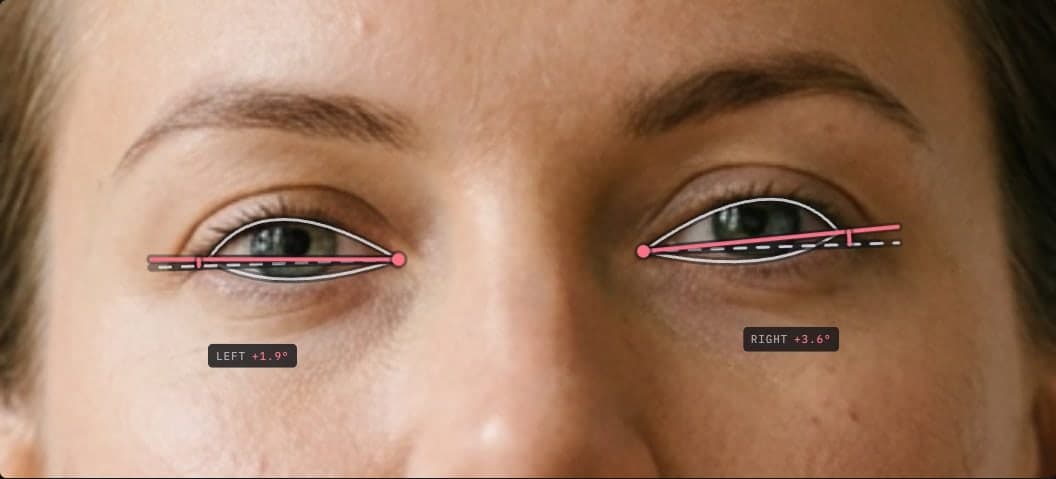
Do I Have Hunter Eyes? Check the Two Measurable Parts
1. Canthal tilt. Positive tilt means the outer corner sits above the inner corner, but no scientific body defines a degree at which that becomes "hunter eyes." A manual image-horizontal line changes with head roll, while pitch, yaw, perspective, and expression can also affect the photo - measure it properly here. The tool uses a fitted face axis to reduce simple roll error and returns a photo-based estimate in your browser.
2. Eyelid exposure and shape. In a relaxed, eye-level photo: how much upper lid shows above the lash line, and does the lid slightly cover the top of the iris? Low exposure plus positive tilt is part of what forums usually mean, but orbital depth and lower-lid shape are separate traits. Our eye shape tool reads the full eye-area geometry from the same photo. If the fold under your brow hides the lid entirely, that trait is hooding - our hooded eyes guide has a 30-second mirror check for it.
How to Get Hunter Eyes: Every Lever, Ranked Honestly
One anatomical fact filters all of it: the canthal tendons and orbital bones do not respond to exercise. The realistic options below either affect presentation or support ordinary wellbeing; none creates a new orbital structure, and weight loss should not be pursued for an online eye label:
Body-fat changes
Not a targetWeight loss cannot target the eye area and does not change canthal attachments or orbital bone. Do not pursue weight loss solely to chase an eye label; if a weight change is medically appropriate, use ordinary health guidance from a qualified professional.
Sleep and allergy care
General careSleep and clinician-recommended allergy care may reduce temporary puffiness for some people, but they do not create a new canthal angle or orbital structure. New, persistent, painful, or one-sided swelling should be assessed clinically.
Brow grooming
Appearance onlyA flatter brow shape can change the visual framing around the eye, but it does not alter eye anatomy. Preview any change with makeup first; the most suitable shape depends on the rest of the face and personal preference.
Photo technique
Appearance onlyCamera height, head pitch, focal length, lighting, and expression can change how narrow or deep-set an eye area appears. That can be useful for a photograph, but it is also why casual online comparisons are not reliable anatomy measurements.
Eye exercises & 'squinting training'
SkipNo exercise moves the canthal tendons or reshapes the orbital bone. Habitual squinting just trains expression lines. There is no evidence base here at all.
Mewing for the eye area
SkipTongue posture has no demonstrated effect on adult orbital anatomy or canthal tilt. See our mewing guide for the full evidence review.
Bone smashing / DIY anything
SkipStriking your orbital area risks fractures and permanent eye damage for zero benefit. Do not.
"Hunter vs Prey Eyes" Is a Continuum, Not a Verdict
Preference studies have tested individual eye-area changes in narrow samples, with results that depend on the faces, edits, and raters used. They do not validate two biological eye types. Eye configuration varies continuously across tilt, eyelid exposure, lid shape, orbital depth, and many other features, so the binary taxonomy is not evidence-based. Use the terms only as informal style shorthand, not as a ranking of people or a reason to pursue treatment. For the downturned side of the geometry, see our negative canthal tilt guide.
Primary Research and Safety Context
No study validates "hunter eyes" as a complete category. A 2007 experimental study found a preference for accentuated medial canthal tilt in edited female faces, while a 2025 study with 2,081 raters found that lateral-canthus elevation reduced several ratings in a different edited-face design. A 2023 evidence review says the preferred degree remains debated and highlights population differences. These findings cannot be converted into one universal threshold or personal score.
A small standardized photography study showed that head pitch changes measured periorbital features, which is why casual selfie comparisons are unreliable. If you are considering surgery, the American Academy of Ophthalmology EyeWiki overview describes the clinical assessment and risks. A calculator cannot determine candidacy or predict an outcome.
A Reality Check on Eye-Area Obsession
Eye-type content can make ordinary anatomical variation feel like a personal failing with a purchasable fix. A forum label is not a diagnosis, and a photo result is not a reason for surgery or weight loss. If checking your eyes in every reflection is raising your anxiety rather than answering a question, step back - and if appearance thoughts feel distressing or hard to control, a GP or mental-health professional beats any forum.
Frequently Asked Questions
What are hunter eyes?
'Hunter eyes' is looksmaxxing-community shorthand for an eye area with positive canthal tilt, relatively low upper-eyelid exposure, a straighter lower lid, and deep-set eyes under the brow. It is forum vocabulary, not a medical or scientific category, and there is no validated numeric threshold that determines whether someone has it.
Are hunter eyes attractive?
Research does not validate 'hunter eyes' as a package or rank it against every other eye shape. Studies of isolated canthal changes have produced population- and stimulus-specific results, including conflicting findings about elevation. Treat the label as one online aesthetic description, not a requirement or an objective attractiveness rating.
How do I know if I have hunter eyes?
Check the traits separately rather than forcing a binary label. Our free tool gives a photo-based estimate of left and right canthal tilt. In a relaxed, eye-level image you can also observe upper-lid exposure and lower-lid shape, but pose, lens perspective, expression, and lighting all affect the appearance. No clinical test or agreed cutoff classifies 'hunter eyes.'
How do you get hunter eyes?
The underlying traits are largely structural, so exercises, squint training, and mewing do not relocate canthal attachments or reshape the adult orbit. Brow styling, makeup, lighting, and ordinary care for temporary puffiness may change presentation. Do not pursue weight loss or surgery solely to satisfy an online label; surgical questions require an individualized oculoplastic assessment.
Are hunter eyes genetic?
Canthal position, orbital depth, brow-ridge shape, and eyelid anatomy have inherited structural components, while age, expression, temporary swelling, and photography can change how those traits appear. Because 'hunter eyes' has no validated definition, it is more accurate to discuss each feature separately than to call the whole label genetic or acquired.
Hunter eyes vs prey eyes - is that real?
No. The terms describe an online binary, while real eye anatomy varies continuously across several independent traits. Preference studies that edit one feature do not validate the hunter-versus-prey taxonomy, and their findings should not be turned into a personal verdict. Measure individual features if useful and ignore the ranking language.
Which celebrities have hunter eyes?
Celebrity lists are subjective and usually rely on selected public photographs rather than standardized measurements. Pose, expression, lens, lighting, retouching, and age can all change the apparent eye area, so it is not responsible to assign named people a measured category from casual images. Use references for styling inspiration, not anatomical proof.
Can surgery give you hunter eyes?
Some oculoplastic procedures can alter canthal position or eyelid support, but they cannot guarantee an informal multi-trait label. Risks can include asymmetry, eyelid malposition, exposure symptoms, scarring, and revision, and suitability depends on eye health and anatomy. That discussion belongs with a qualified oculoplastic surgeon, not a forum or photo calculator.
Find Out What Your Eyes Actually Measure
One eye-level photo gives you a face-relative estimate for both eyes, in degrees, using a 478-point landmark detector - processed in your browser. Free, no signup, no forum required.
Measure My Canthal Tilt FreeMeasure it, then decide
Your eye area has real numbers - get them before taking anyone's word for it.
Canthal Tilt Calculator
FreeEstimate both eye angles against a fitted face axis and see the measured lines on your photo.
Eye Shape Detector
FreeLid exposure and eye-area geometry - the other half of the hunter-eyes equation.
Negative Canthal Tilt Guide
The other end of the tilt spectrum - what it means and what actually changes it.
Looksmaxxing, Honestly
The evidence-based guide to what improves a face - and what's forum mythology.
Looksmaxxing Chart
The PSL tiers hunter eyes get judged against - sub 5 to True Adam, on both scales.