Do I Have Hooded Eyes? The 30-Second Check
Hooded eyes are a lid variation where a fold of skin from below the brow rests over the crease, hiding part or all of the mobile eyelid when your eyes are open. Some people are born with them; many develop them gradually with age. They're extremely common, entirely normal, and mostly matter for one practical reason: makeup and styling advice written for visible lids doesn't work on them. Answer the three questions below in front of a mirror and you'll know in about thirty seconds.
The 30-Second Mirror Check
Face a mirror at eye level, relax your brows and expression, and answer honestly - raised brows are the #1 reason people misread their own lids.
What Hooded Eyes Actually Are
Your upper eyelid has two zones: the mobile lid (the moving part that holds your lashes) and the brow zone above the crease. On a hooded eye, skin and soft tissue from the brow zone fold down over the crease, so when your eyes are open the mobile lid partly or fully disappears underneath. The crease is still there - you can usually see it with your eyes closed - it's just covered when they're open.
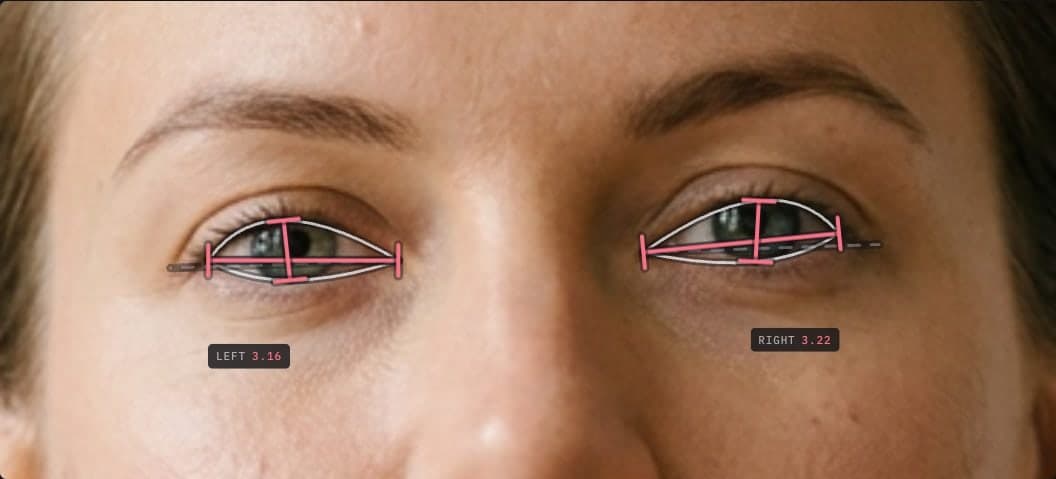
That's the whole definition. It says nothing about your eye's size, shape, or corner angle - a hooded eye can be round or almond, upturned or downturned. Those are separate axes, and unlike hooding, the opening shape and corner orientation are measurable from a photo.
Measured examplesynthetic subject · 478 landmarks
Hooded vs "Normal" Eyes (and Monolid, Deep-Set, Ptosis)
"Normal" is a misnomer - a visible lid and a hooded lid are both normal. Here's how to tell the commonly confused categories apart:
Hooded
A fold of skin from below the brow drapes over the upper-lid crease, hiding part or all of the mobile lid when the eyes are open.
Key tell: The crease exists but disappears under the fold; little or no lid space shows above the lashes.
Visible lid (“non-hooded”)
The crease and a strip of mobile lid stay visible when looking straight ahead. Often called “normal,” though both variants are normal.
Key tell: You can see eyelid skin between your lashes and your crease line.
Monolid
The lid runs smooth from lashes to brow without a visible crease fold - a complete, common lid structure in its own right, not a hooded crease.
Key tell: No crease line to hide: the surface is continuous rather than folded over.
Deep-set
The eyeball sits further back under a prominent brow ridge, creating shadow. The crease may be perfectly visible.
Key tell: Depth and shadow come from the orbit, not from skin resting on the lash line.
Ptosis (medical)
The lid margin itself - not a skin fold above it - sits lower than normal, sometimes covering part of the pupil.
Key tell: The edge holding the lashes droops. Sudden, one-sided, or vision-blocking droop needs a clinician, not a guide.
Are Hooded Eyes Attractive?
No lid type is inherently attractive or unattractive, and no research validates a ranking of eyelid configurations. Widely admired faces exist with every lid pattern - hooded, visible, monolid, deep-set. Studies that edit isolated eye-area features produce narrow, stimulus-specific results that can't be converted into a verdict on a whole category of eyelid.
The honest version: hooding changes which techniques flatter your eyes, not whether your eyes are worth flattering. Treat it as a styling context - like knowing your face shape before a haircut - not a score.
What Causes Hooded Eyes (and Why Age Deepens Them)
Inheritance. Many people simply have hooded lids from childhood - it runs in families the way any facial structure does, and it needs no explanation or fix.
Age. Skin thins and loses elasticity over time, and the brow drifts slightly downward, so a fold can appear or deepen in your 30s–60s even if your lids were fully visible before. Clinicians call the age-related excess-skin component dermatochalasis. This is ordinary aging, not a condition - it only becomes a clinical question if the fold starts blocking the upper part of your vision.
Temporary mimics. Morning puffiness, allergies, fluid retention, and tired late-evening photos all add weight above the crease and can make a borderline lid look fully hooded. If your "hooding" comes and goes, that's presentation, not anatomy.
What Actually Helps: Every Option, Ranked Honestly
One anatomical fact filters everything below: hooding is skin drape, not muscle weakness - so nothing you can train removes the fold. What's left is presentation (which genuinely works), marginal support, and one option that belongs to medicine:
Eyeliner technique
Works (presentation)Classic liner vanishes under the fold, so hooded-specific techniques draw where the eye reads when open: a fine tightline at the lashes, or a “batwing” / floating wing mapped with the eye open so the flick sits above the fold. Smudge-proof, long-wear formulas matter more here than on visible lids because the fold touches the liner all day.
Eyeshadow placement
Works (presentation)Matte transition shades blended above the natural crease - placed with the eye open - recreate visible depth the fold hides. Shimmer concentrated on the mobile lid and inner corner reads through the hood; shimmer everywhere flattens it. None of this changes the lid, and none of it needs to.
Brow grooming and styling
Works (presentation)Lifting stray hairs, brushing brows up, and keeping the underside of the brow clean visually raises the fold's starting point. A brow gel does this in seconds. It changes framing, not anatomy - and heavy-handed overplucking to “open up” the eye area is a styling decision to preview carefully, not an upgrade.
Skincare and retinoids
Partial / honest limitsRetinoids and sunscreen support skin elasticity over months and may modestly slow how age-related lid-skin laxity progresses. No cream lifts an existing fold, whatever the packaging implies. Puffiness care (sleep, allergy management a clinician recommends) can reduce temporary heaviness that mimics extra hooding.
Eyelid tape and stickers
Partial / honest limitsTape physically holds the fold up for hours, and for some people that's a fine occasional styling tool. Honest caveats: it can irritate or stretch delicate lid skin with daily long-term use, results vary by skin weight, and it trains nothing - the fold returns when the tape comes off.
“Eye-opening” exercises
SkipNo exercise reduces a skin fold: hooding is skin and soft-tissue drape, not a weak muscle you can train. Repeatedly raising your brows or squinting just practices expressions. There is no evidence base here at all.
Blepharoplasty (eyelid surgery)
Medical territoryUpper-lid blepharoplasty removes excess fold skin and is an established procedure - but whether it's appropriate, safe, or likely to deliver what you imagine is an individualized conversation with a qualified oculoplastic or facial plastic surgeon, covering risks like asymmetry, scarring, dry eye, and revision. A guide, a photo score, or a trend cycle is not a reason to book a consult.
For eyeliner and shadow specifics matched to your measured opening shape - hooded lids come in round, almond, and elongated too - the eye shape analyzer includes styling ideas per result.
Hooded Eyes vs "Hunter Eyes"
They overlap more than the internet admits. "Hunter eyes" is forum shorthand for a bundle of traits - positive canthal tilt, a level lower lid, deep-set orbits, and low upper-lid exposure, which is essentially hooding. So a hooded lid is one ingredient of the label many forums treat as aspirational, while makeup content often frames the same anatomy as something to disguise. Both framings are marketing; the anatomy is just anatomy. Our hunter eyes guide breaks the full bundle into its measurable parts, and the negative canthal tilt guide covers the corner-angle axis.
When It's Medical, Not Cosmetic
Three situations move this topic from styling to medicine. First, ptosis - when the lid margin itself sits low, rather than a skin fold resting above it - especially if it appeared suddenly, affects one side, or varies through the day. Second, any fold heavy enough to block the upper part of your visual field. Third, surgical correction: upper-lid blepharoplasty is an established procedure, but candidacy, risks, and realistic outcomes are an individualized conversation with a qualified oculoplastic or facial plastic surgeon - the American Academy of Ophthalmology's patient overview is the right starting point, not a before/after feed.
A Reality Check Before You Change Anything
Hooded lids sat on a huge share of human faces long before anyone monetized eyelid anxiety. If you found this page because a filter, a trend, or a comment made you inspect your eyes for the first time, notice that sequence - the concern was installed, not discovered. Style your lids however you enjoy. And if checking your eyes in every reflection is raising your anxiety rather than answering a question, a GP or mental-health professional beats any guide, tool, or procedure.
Frequently Asked Questions
What are hooded eyes?
Hooded eyes are a common lid variation where a fold of skin from below the brow rests over the upper-lid crease, hiding part or all of the mobile eyelid when the eyes are open. Many people are born with hooded lids, and many develop them gradually as skin elasticity changes with age. It is a normal anatomical variant, not a flaw or a diagnosis.
How do I know if I have hooded eyes?
Look straight ahead in a mirror with relaxed brows. If the skin under your brow rests on or near your lash line and you cannot see your crease or much of your mobile lid, your eyes are likely hooded. Raised brows, smiling, and camera angle all change the appearance, which is why a relaxed, eye-level check beats judging from photos. Hooding is a lid-crease trait, so a landmark-based photo tool cannot classify it - our eye shape analyzer measures the separate axes of opening shape and corner orientation instead.
What is the difference between hooded eyes and normal eyes?
“Normal” is a misnomer - both are normal. The practical difference is whether mobile-lid space stays visible when the eyes are open: on a visible (non-hooded) lid you can see skin between the lashes and the crease line, while on a hooded lid a fold from below the brow covers that space. The distinction matters mostly for makeup technique, since products placed on a hidden lid transfer onto the fold.
Are hooded eyes attractive?
No lid type is inherently attractive or unattractive, and no research validates a ranking of eyelid configurations. Widely admired faces exist with hooded, visible, monolid, and deep-set lids alike. Preference studies on isolated eye-area features produce narrow, stimulus-specific results that cannot be turned into a verdict about a whole lid category. Treat hooded lids as a styling context, not a score.
What causes hooded eyes?
The two main causes are inheritance and age. Many people simply inherit the lid structure and have hooded eyes from childhood. With age, thinning skin, reduced elasticity, and gradual brow descent can create or deepen a hood - clinicians call the age-related excess-skin component dermatochalasis. Temporary puffiness from sleep, allergies, or fluid retention can also mimic extra hooding without changing the underlying lid.
Do hooded eyes get worse with age?
Hooding often becomes more pronounced with age because skin loses elasticity and the brow sits slightly lower over time - this is ordinary aging, not a condition. Sunscreen and general skin care support elasticity but do not lift an existing fold. If the fold or lid ever hangs low enough to block the upper part of your vision, that is a functional issue worth raising with an eye doctor rather than a cosmetic question.
Hooded eyes vs ptosis - what is the difference?
Hooding is extra skin above a normally positioned lid: the fold hangs over the crease, but the lid margin holding the lashes sits where it should. Ptosis is when the lid margin itself sits too low, sometimes covering part of the pupil. The distinction matters because ptosis can have medical causes. A droop that appears suddenly, affects one side, changes through the day, or interferes with vision deserves a clinical assessment, not a self-check.
Are hooded eyes the same as monolids?
No. A monolid runs smooth from lashes to brow without a visible crease fold - a complete lid structure in its own right, common in many East and Southeast Asian populations. A hooded eye has a crease, but a fold of skin from above covers it. They can look similar when open, and both are entirely normal; the difference is whether a crease exists under the fold.
Can you get rid of hooded eyes without surgery?
No non-surgical method removes the fold itself. Makeup technique, brow styling, and grooming genuinely change how hooded lids present; skincare supports elasticity at the margins; tape holds the fold up temporarily with honest downsides. “Eye-opening exercises” do nothing - hooding is skin drape, not muscle weakness. Surgical removal (blepharoplasty) exists, but suitability and risks are an individualized conversation with a qualified oculoplastic or facial plastic surgeon.
Which celebrities have hooded eyes?
Celebrity lid-type lists are subjective and built from selected photos, where expression, brow position, makeup, lighting, and retouching all change how hooded an eye appears. It is not responsible to assign named people an anatomical category from casual images. If you want references for makeup or styling, look for tutorials by artists who work on hooded lids rather than celebrity guesswork.
Now Measure the Axes a Mirror Can't
Hooding is a lid-crease trait, so our photo analyzer does not detect or diagnose it - the face mesh has no crease landmark. What it does measure from one front photo: your visible opening shape (round, almond, elongated) and corner orientation (upturned, level, downturned), which hooding does not change. Free, processed in your browser, no signup.
Analyze My Eye Shape FreeCheck the rest of your eye area
Hooding is one axis. The measurable ones take a single photo.
Eye Shape Detector
FreeOpening shape and corner orientation measured from one front photo - with styling ideas per result.
Canthal Tilt Calculator
FreeYour eye-corner angle in degrees against a fitted face axis - the other measurable eye-area trait.
Hunter Eyes Guide
The four traits behind the forum label - low lid exposure (hooding) is one of them.
Negative Canthal Tilt Guide
What a downturned eye axis means and an honest ranking of every fix.