Facial Measurement Norms: Where Your Numbers Sit Among 14,144 Faces
Most "ideal ratio" figures online are copied from art manuals or from each other. These are measured. On 31 August 2026, 14,144 people ran a front photo through our free analyzers, which compute the same twelve ratios from 478 landmarks in the browser. Below are the percentiles for each - the average, the middle half, and the 5th and 95th marks - with the calculator's own reference band beside them so you can read your result in context.
How to read the table
p50 is the median - half of measured faces sit below it. p25 to p75 is the middle half. If your number falls between p10 and p90 you are inside the range that covers eight people in ten. Percentiles are used instead of extremes on purpose: a maximum only ever rises as more faces are scanned, a percentile stays true.
The Twelve Measurements, in Percentiles
| Measurement | p5 | p10 | p25 | Median | p75 | p90 | p95 | Calculator band |
|---|---|---|---|---|---|---|---|---|
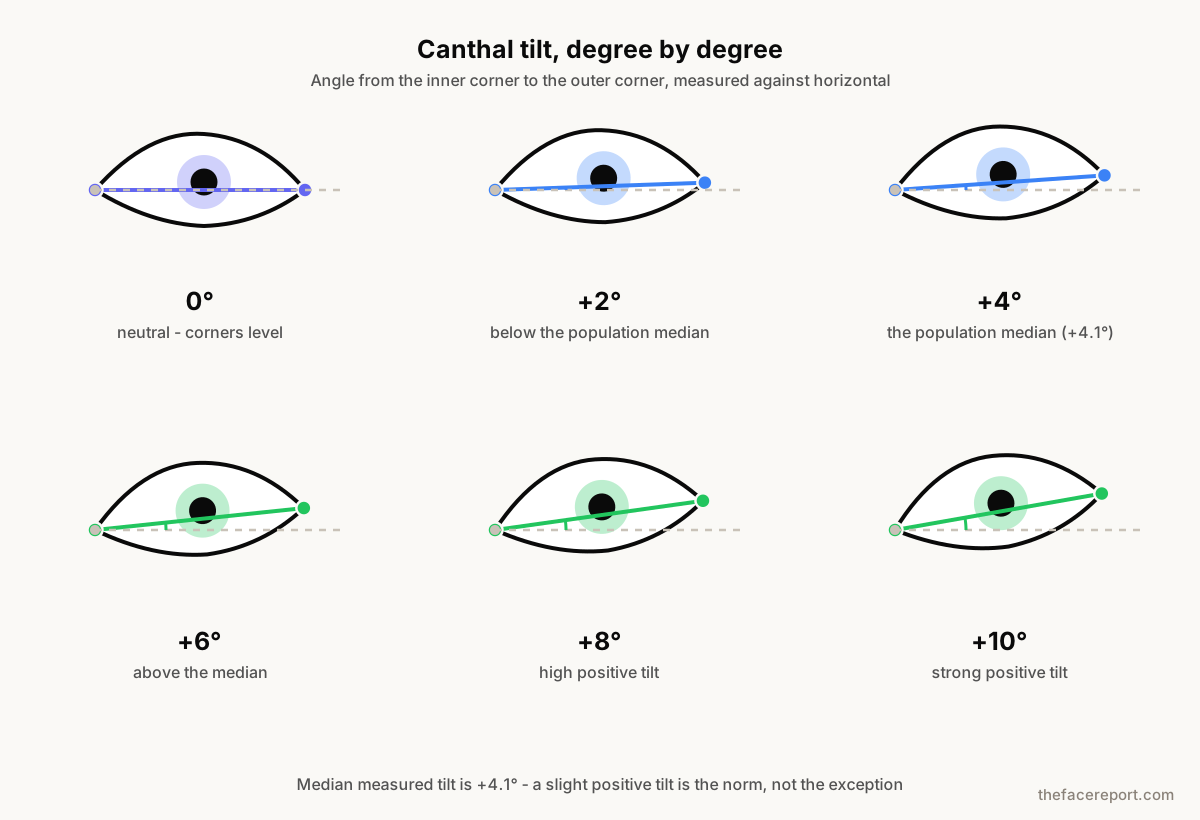
Canthal tilt Average inner-to-outer eye-corner angle against a fitted face-horizontal axis. Positive = outer corner higher. | -2.0° | -0.6° | +1.7° | +3.9° | +6.0° | +7.8° | +8.9° | +2.0° to +7.0° |
Eye spacing Distance between the inner eye corners divided by the average visible width of one eye. | 1.08 | 1.11 | 1.17 | 1.24 | 1.32 | 1.40 | 1.45 | 1.05 to 1.35 |
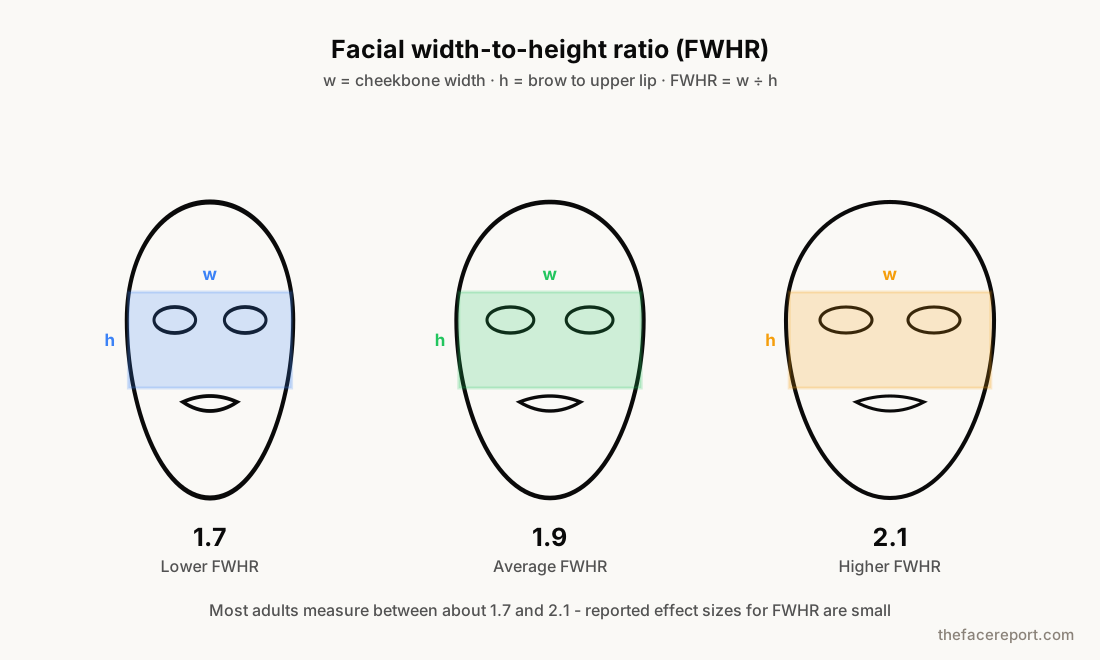
Face width-to-height (fWHR) Cheekbone width divided by the visible upper-face height (upper-eyelid midpoint to upper lip). A calculator-specific variant of the research fWHR. | 1.72 | 1.79 | 1.89 | 2.02 | 2.17 | 2.34 | 2.49 | 1.80 to 2.10 |
Face length-to-width Visible face-mesh height (mesh top to chin) divided by cheekbone width. | 1.10 | 1.13 | 1.17 | 1.22 | 1.26 | 1.31 | 1.34 | 1.18 to 1.28 |
Pupil distance / face width Distance between the iris centres divided by cheekbone width. | 0.44 | 0.45 | 0.46 | 0.48 | 0.50 | 0.52 | 0.53 | 0.46 to 0.50 |
Midface length Brow midpoint to nose base as a share of visible face height. | 0.39 | 0.40 | 0.42 | 0.44 | 0.46 | 0.48 | 0.49 | 0.38 to 0.44 |
Lower face length Nose base to chin as a share of visible face height. | 0.34 | 0.35 | 0.38 | 0.40 | 0.42 | 0.44 | 0.46 | - |
Jaw-to-cheekbone width Detected jaw width divided by cheekbone width. | 0.75 | 0.76 | 0.78 | 0.79 | 0.81 | 0.83 | 0.84 | - |
Mouth width / face width Mouth-corner width divided by cheekbone width. | 0.32 | 0.33 | 0.35 | 0.38 | 0.40 | 0.44 | 0.48 | 0.38 to 0.45 |
Nose / mouth width Nostril (alar) width divided by mouth width. | 0.69 | 0.74 | 0.79 | 0.84 | 0.88 | 0.92 | 0.94 | 0.72 to 0.86 |
Nose length / face height Nose bridge to tip as a share of visible face height. | 0.18 | 0.19 | 0.20 | 0.22 | 0.23 | 0.24 | 0.25 | 0.20 to 0.24 |
Lip fullness Outer-lip height (top of upper lip to bottom of lower lip) divided by mouth width. | 0.25 | 0.28 | 0.33 | 0.38 | 0.44 | 0.50 | 0.55 | 0.25 to 0.40 |
n = 14,144 scans, 31 August 2026 (00:00–24:00 UTC). Aggregate only; no photos, names or demographics are stored. Licensed CC BY 4.0 - cite with a link.
What Each Distribution Says
Canthal tilt
median +3.9°middle half +1.7° to +6.0°A slight positive tilt is the norm, not the exception: three quarters of faces measure above +1.7°, and only about one in ten sits at or below zero. The median of +3.9° matches the +4.1° measured on a separate day in August, so the figure is stable.
Eye spacing
median 1.24middle half 1.17 to 1.32The art-class rule of one eye-width between the eyes (1.0) is below the 5th percentile on measured photos: the typical gap is about 1.24 eye-widths. Close-set and wide-set are both within the normal spread.
Face width-to-height (fWHR)
median 2.02middle half 1.89 to 2.17Research fWHR (brow to upper lip) usually reports means near 1.8–2.0; this eyelid-anchored version runs a little higher, so compare only with this calculator's own band, not with study figures.
Face length-to-width
median 1.22middle half 1.17 to 1.26The mesh top sits below the hairline, so this is shorter than a hairline-to-chin index. 1.22 is the middle; below about 1.13 the face reads round or square, above about 1.31 oblong.
Pupil distance / face width
median 0.48middle half 0.46 to 0.50One of the tightest distributions on the face: 90% of people fall within 0.44–0.53. For pupillary distance in millimetres, see the PD tool - photos have no scale until the iris supplies one.
Midface length
median 0.44middle half 0.42 to 0.46The visible-mesh denominator makes this share larger than a hairline-based third, and the median sits at the top of the calculator's band. The top tenth of faces read 0.48 or above.
Lower face length
median 0.40middle half 0.38 to 0.42Midface plus lower face account for roughly 84% of the visible mesh height; the remaining 16% is the strip from brow to mesh top, which is why the classic 'equal thirds' cannot be read off this mesh directly.
Jaw-to-cheekbone width
median 0.79middle half 0.78 to 0.81Very tight: almost everyone measures 0.75–0.84. A wide jaw relative to the cheekbones is more than 0.83; a strongly tapered one under 0.76.
Mouth width / face width
median 0.38middle half 0.35 to 0.40Expression moves this more than any other ratio; a relaxed, closed mouth is the comparable state. The median lands exactly on the bottom of the calculator's band.
Nose / mouth width
median 0.84middle half 0.79 to 0.88The nose is usually a little narrower than the mouth; a nose as wide as the mouth (1.0) is beyond the 95th percentile in this set.
Nose length / face height
median 0.22middle half 0.20 to 0.23Ninety percent of noses fall between 0.19 and 0.24 of the visible face height - a narrow band, which is why a nose reads 'long' after a small change.
Lip fullness
median 0.38middle half 0.33 to 0.44The widest relative spread on the face (the 95th percentile is more than double the 5th). Half of measured faces sit above the top of the calculator's band, so 'full' lips are common, not rare.
Measurements in Millimetres
Everything above is a ratio because a photo has no scale. The one absolute measurement we can recover is pupillary distance, using the iris (11.7 mm) as the ruler: adult PDs run roughly 54–74 mm with a mean near 63 mm (Dodgson, 2004). The pupillary distance tool reports yours; first-party millimetre percentiles will be added to this page once a full day of iris-calibrated readings has accumulated.
What These Norms Are Not
- Not clinical anthropometry. Farkas measured with calipers on the head; these are landmark ratios on front photos taken with phone lenses at unknown distances, which widens the spread by a few percent.
- Not a random sample of humanity. It is everyone who chose to scan on one day - skewed young, and toward people curious about their faces.
- Not split by sex, age or ancestry, because the free tools store none of those.
- Not a ranking. Every band contains widely admired faces at both ends; the median is a description of what is common, not of what is right.
Frequently Asked Questions
What is the average canthal tilt?
Across 14,144 faces measured on 31 August 2026, the median canthal tilt was +3.9° with a mean of +3.4°; the middle half of people sit between +1.7° and +6.0°, and only about one in ten measures level or negative. A separate August snapshot gave a median of +4.1°, so the figure is stable. A mild positive tilt is the ordinary human eye, not a special trait.
What is the average fWHR?
On this calculator's definition (cheekbone width over upper-eyelid-to-upper-lip height) the median is 2.02, the middle half 1.89–2.17. Research fWHR anchors the height at the brow instead and reports means closer to 1.8–2.0, so a research figure and a calculator figure are not interchangeable - compare each with its own distribution.
What is the average eye spacing ratio?
The median inner-corner gap is 1.24 eye-widths (middle half 1.17–1.32). The drawing-class rule of exactly one eye-width between the eyes falls below the 5th percentile of measured faces, so most people who worry about close-set eyes are measuring themselves against a canon almost nobody meets.
What is a normal face length-to-width ratio?
Measured on the visible face mesh (mesh top to chin over cheekbone width), the median is 1.22 and 90% of people fall between 1.13 and 1.31. Because the mesh top sits below the hairline, these numbers are lower than a hairline-to-chin index and should not be compared with the classic 1.618 claims.
Why percentiles instead of averages and maximums?
Because an average hides the spread and a maximum only ever rises as more faces are scanned. A percentile answers the question people actually have - where does my number sit among measured humans - and stays true as the sample grows. Every figure here comes from one closed UTC day so the totals reconcile, and the page is regenerated after any change to the measurement engine.
Are these split by sex, age or ethnicity?
No. The free tools store no demographics, so the norms describe everyone who scanned that day together. Published anthropometry finds modest average differences between sexes on several of these ratios with heavily overlapping distributions; if you want a sex-specific reference, use the literature and treat these pooled percentiles as the population-wide spread.
Why does my number differ from these norms?
Three usual reasons, in order: camera. A phone held close is a wide-angle lens that widens whatever is nearest and changes several ratios by a few percent; head turn and tilt shift the eye and jaw measurements; expression moves the mouth and lower face. Retake at arm's length or further, straight-on, relaxed, in even light, and compare again. If the number is stable across photos, that is your measurement - and every band above contains widely admired faces at both ends.
Sources
- Farkas, L. G. (1994). Anthropometry of the Head and Face (2nd ed.). Raven Press.
- Geniole, S. N., Denson, T. F., Dixson, B. J., Carré, J. M., & McCormick, C. M. (2015). Evidence from meta-analyses of the facial width-to-height ratio as an evolved cue of threat. PLoS ONE, 10(7), e0132726.
- Dodgson, N. A. (2004). Variation and extrema of human interpupillary distance. Proc. SPIE 5291, Stereoscopic Displays and Virtual Reality Systems XI.
- Our companion study of harmony and symmetry score distributions (15,447 faces).
See Where Your Measurements Sit
One front photo, all twelve ratios, in your browser - then read each one against the table above.
Measure My Ratios FreeMeasure yours against the table
The norms are only useful next to your own numbers.
Facial Ratios Calculator
FreeAll twelve measurements from one photo, with the reference bands shown.
Canthal Tilt Calculator
FreeYour eye-corner angle in degrees, left and right.
Pupillary Distance Tool
FreeThe one measurement a photo can give in millimetres.
Face Analysis Study
Harmony and symmetry score distributions across 15,447 faces.