The Norwood Scale: Hair Loss Stages 1-7, Explained
The Norwood scale is how dermatologists describe male pattern hair loss: seven stages from a full adolescent hairline to a horseshoe of hair around the sides. Most men who look it up are trying to answer one question - is my hairline maturing or receding - and the chart alone cannot answer it, because the difference is time, not shape. This guide gives the stages, the hairline types, an honest account of what treatment can do, and a four-question check that organises what you can see into a stage band.
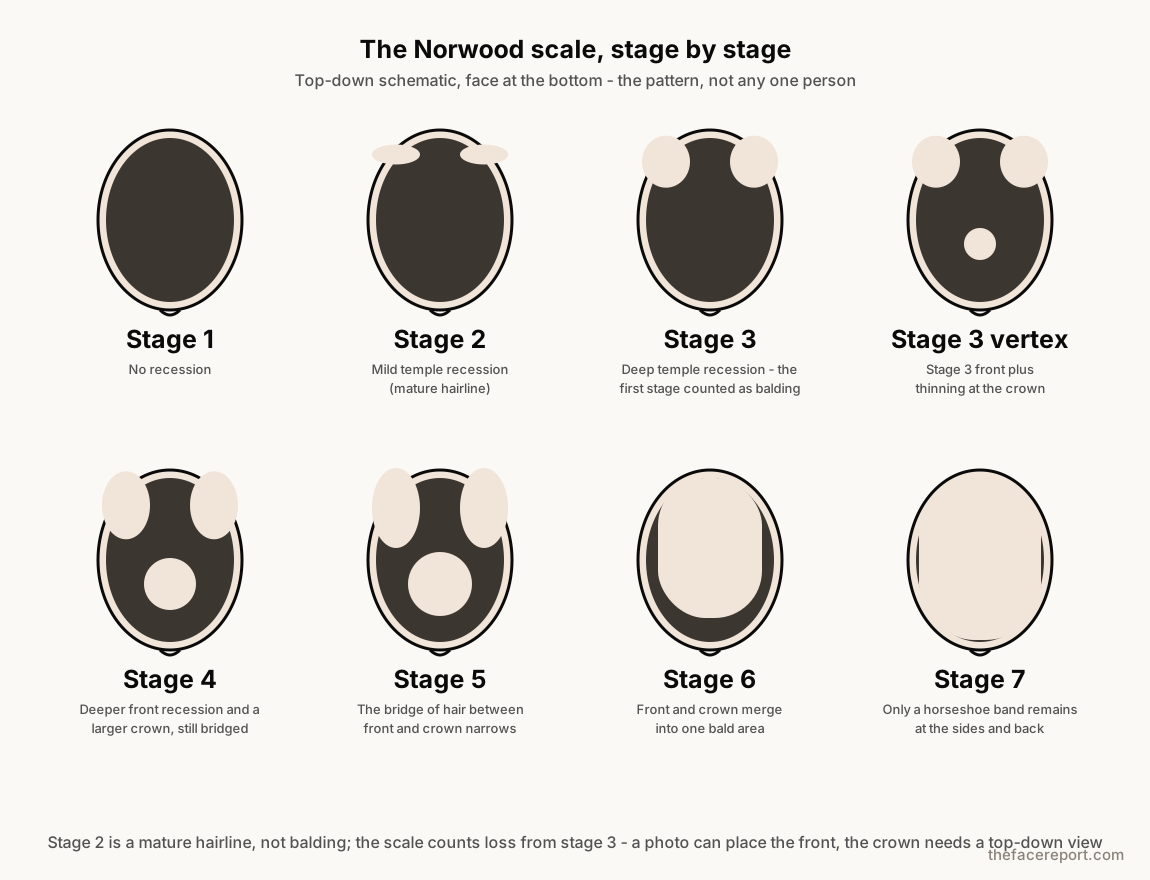
Short Answer
Stage 1 is the adolescent hairline, stage 2 is the normal adult (mature) hairline that most men develop and is not balding, and pattern loss is counted from stage 3. A front photo places your temples; only a top-down photo shows the crown, which decides the higher stages. Treatment does most at stages 2-4 and little at 6-7.
What Norwood Stage Am I?
Take two photos in the same light - straight-on with the hair pushed back, and from directly above - then answer these four questions from them.
The Four-Question Hairline Check
Answer from photos, not memory. This organises what you can see into a Norwood band; it cannot see your crown, and only change over time separates maturing from receding.
The Norwood Stages, One by One
Stage 1 - No recession
The adolescent hairline: straight or gently curved across the forehead with the temples filled in.
What it means: No pattern loss. Most men leave stage 1 in their late teens or twenties as the hairline matures by a centimetre or so.
What to do: Nothing to do. A photo now is a useful baseline.
Stage 2 - Mature hairline
Slight, symmetrical recession at the temples - usually under about 1.5 cm behind the adolescent line - with the centre holding.
What it means: This is the adult hairline, not balding. Roughly nine in ten men develop it and most never progress. It is the stage most often mistaken for hair loss.
What to do: Photograph the hairline once a year in the same light. Change over 12 months, not the stage itself, is the signal.
Stage 3 - Deep temple recession
The temples recede deeply, forming a clear M, U or V; hair at the temples is sparse or gone.
What it means: The first stage Norwood counts as male pattern hair loss. The follicles at the temples have miniaturised.
What to do: If it is progressing and it bothers you, this is the stage where treatment has the most to preserve. A dermatologist can confirm the pattern.
Stage 3 vertex - Front plus crown
Stage 2-3 recession at the front with a separate thinning patch at the crown (vertex).
What it means: Two fronts of loss. The crown patch is invisible in a mirror, which is why many men discover it from a photo taken from behind.
What to do: Same as stage 3; the crown responds to treatment at least as well as the front.
Stage 4 - Bridged
Deeper front recession and a larger crown patch, still separated by a band of hair across the top of the head.
What it means: Established pattern loss. The front and crown are approaching each other.
What to do: Treatment slows and partly reverses loss for many at this stage; expectations should be about preserving the bridge, not restoring stage 1.
Stage 5 - Narrow bridge
The band of hair between front and crown becomes narrow and sparse.
What it means: The two areas are about to join.
What to do: Medical options still help retention; surgical options begin to depend on how much donor hair the sides and back hold.
Stage 6 - Merged
Front and crown have joined into one bald area; hair remains at the sides and back.
What it means: Extensive loss on top.
What to do: Regrowth from medication is limited at this stage; the realistic choices are a short cut or shave, a hair system, or transplant candidacy assessed on donor density.
Stage 7 - Horseshoe
Only a narrow band of hair remains around the sides and back of the head.
What it means: The most advanced stage on the scale.
What to do: Most men at stage 7 who want to change it choose to shave, or explore scalp micropigmentation; transplant donor supply is usually the limit.
Hairline Types (Shape Is Not Stage)
A widow's peak, a high forehead and a rounded hairline are inherited shapes, not stages of loss. The scale only cares whether the temples and crown are changing. Knowing your type stops the most common misreading - a naturally high or M-shaped hairline mistaken for recession.
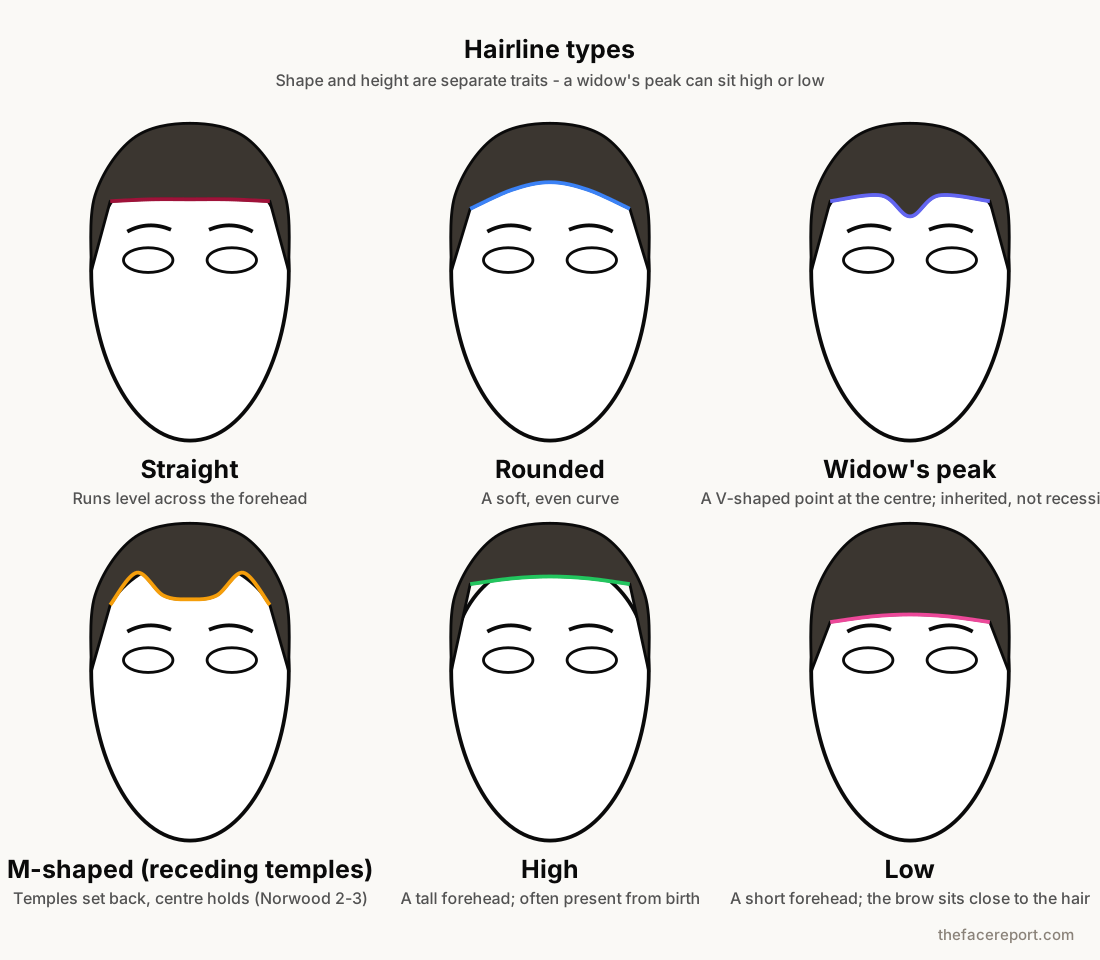
| Type | What it looks like | Note |
|---|---|---|
| Straight | Runs level across the forehead from temple to temple. | Common in youth; can stay straight for life or mature into a slight M. |
| Rounded | A soft, even curve with no corners at the temples. | Frames the face evenly; the hairline most often described as feminine, but common in men too. |
| Widow's peak | A V-shaped point at the centre of the forehead. | A normal inherited trait, present from childhood. Not recession - the temples on either side can be full or receded independently. |
| M-shaped (receding temples) | The temples sit further back than the centre, forming an M. | A slight M is a mature hairline (Norwood 2); a deep M is Norwood 3. Depth and change over time separate the two. |
| High | The whole hairline sits high, giving a tall forehead. | Usually genetic and stable from adolescence. Height alone says nothing about hair loss; the question is whether it is moving. |
| Low | The hairline sits close to the brows, giving a short forehead. | Also inherited. A low hairline that recedes to average height is often misread as balding when it is maturing. |
What Can Actually Be Done, by Stage
Two treatments have regulatory approval for male pattern loss - topical minoxidil and oral finasteride - and the evidence for both says the same thing: they slow loss in most men, regrow some hair in a proportion, work best while follicles are miniaturised rather than gone (stages 2-4), and stop working when stopped. Both carry possible side effects that belong in a conversation with a doctor, not a guide. Beyond those, low-level laser devices have modest evidence, hair transplantation moves hair from the sides and back and is limited by how much is there, and the long tail of oils, supplements and massage has little or no evidence. Mewing and other posture claims have none. At stages 6-7 the realistic choices are a close crop, a shave, scalp micropigmentation or a system.
Frequently Asked Questions
What is the Norwood scale?
The Hamilton-Norwood scale is the standard classification of male pattern hair loss, published by James Hamilton in 1951 and revised by O'Tar Norwood in 1975. It describes seven stages from a full adolescent hairline (1) to a horseshoe of hair around the sides and back (7), plus a '3 vertex' variant for men who thin at the crown early. Dermatologists and transplant surgeons use it to describe pattern and extent, not cause.
How do I know what Norwood stage I am?
Two photos in the same light: one straight-on at eye level with the hair pushed back, one from directly above (a friend or a mirror over your head). The front photo places the temples - slight symmetrical recession is stage 2, a deep M or U is stage 3. The top-down photo is the only way to see the crown, which decides between 3 and 3 vertex, and between 4, 5 and 6. Compare with the chart above; the self-check on this page walks you through the four questions.
Is a Norwood 2 hairline balding?
No. Stage 2 is the mature hairline that most men develop between about 17 and 30: the temples move back a centimetre or so, symmetrically, and then stop. Norwood himself counted pattern loss from stage 3. What distinguishes maturing from receding is not the shape but the trajectory - a hairline that keeps moving over 12 months, thins at the temples, or is joined by a crown patch is progressing; one that settled is mature.
What is the difference between a mature hairline and a receding hairline?
Depth, symmetry and time. A mature hairline sits roughly 1-1.5 cm behind the adolescent one, recedes evenly at both temples, keeps the hair behind it dense, and stops changing. A receding hairline goes deeper than that, often unevenly, leaves fine miniaturised hairs at the temples, and continues to move year on year. Yearly photos settle the question better than any chart.
At what age does male pattern hair loss start?
It can begin any time after puberty; population studies report roughly a quarter of men with visible pattern loss by 30 and about half by 50, with wide individual variation. Earlier onset tends to progress further, which is why dermatologists take a receding hairline at 20 more seriously than the same picture at 45.
Can hair loss on the Norwood scale be reversed?
Partly, and mostly early. Two treatments have regulatory approval for male pattern hair loss - topical minoxidil and oral finasteride - and in trials they slow loss in most men and regrow some hair in a proportion, with the best results at stages 2-4 where follicles are miniaturised rather than gone. Both need continued use to keep the effect and both have possible side effects to discuss with a doctor. Low-level laser devices have weaker evidence; supplements, oils and scalp massage have little or none. At stages 6-7, regrowth from medication is limited and the remaining options are surgical or cosmetic.
Does the Norwood scale apply to women?
Rarely. Women usually lose hair in a diffuse pattern over the crown with the frontal hairline preserved, which the Norwood stages do not describe; clinicians use the Ludwig scale (three grades of central thinning) or the Sinclair scale instead. A woman with true temple recession in a male pattern should see a dermatologist, because that pattern can point to a hormonal cause worth checking.
Is a widow's peak a sign of a receding hairline?
No. A widow's peak is an inherited hairline shape present from childhood - a point at the centre with the hairline dipping on either side. Recession happens at the temples independently of it, which is why a widow's peak can become more prominent as the temples recede around it, without the peak itself changing.
What hairstyles work at each Norwood stage?
Stages 1-2: anything. Stage 3: shorter sides with texture on top, or a fringe brought forward; avoid slicked-back styles that expose the temples. Stage 3 vertex to 4: keep the top short and textured so the crown blends; length on top exaggerates contrast. Stages 5-6: a close crop all over reads far better than length trying to cover. Stage 7: a shave or a very short buzz. Our hairstyle finder matches cuts to your face shape; pair its picks with these stage rules.
Sources
- Norwood, O. T. (1975). Male pattern baldness: classification and incidence. Southern Medical Journal, 68(11), 1359-1365.
- Hamilton, J. B. (1951). Patterned loss of hair in man: types and incidence. Annals of the New York Academy of Sciences, 53(3), 708-728.
- American Academy of Dermatology. Hair loss: diagnosis and treatment.
Find the Cut That Works With Your Hairline
The hairstyle finder measures your face shape from one photo and matches specific cuts to it. Pair its picks with the stage rules above.
Find My Hairstyles FreeWork with the hairline you have
The stage sets the constraint; the face shape picks the cut.
Hairstyle Finder
FreeCuts matched to your measured face shape.
Hairstyles by Face Shape
The full guide to which cuts suit which shape.
Mewing Results: What Science Says
Why posture claims do not extend to hair or bone.
Face Shape Detector
FreeOval, round, square, heart, diamond or oblong from 478 landmarks.