Nose Shapes: The Types, and What Actually Defines Them
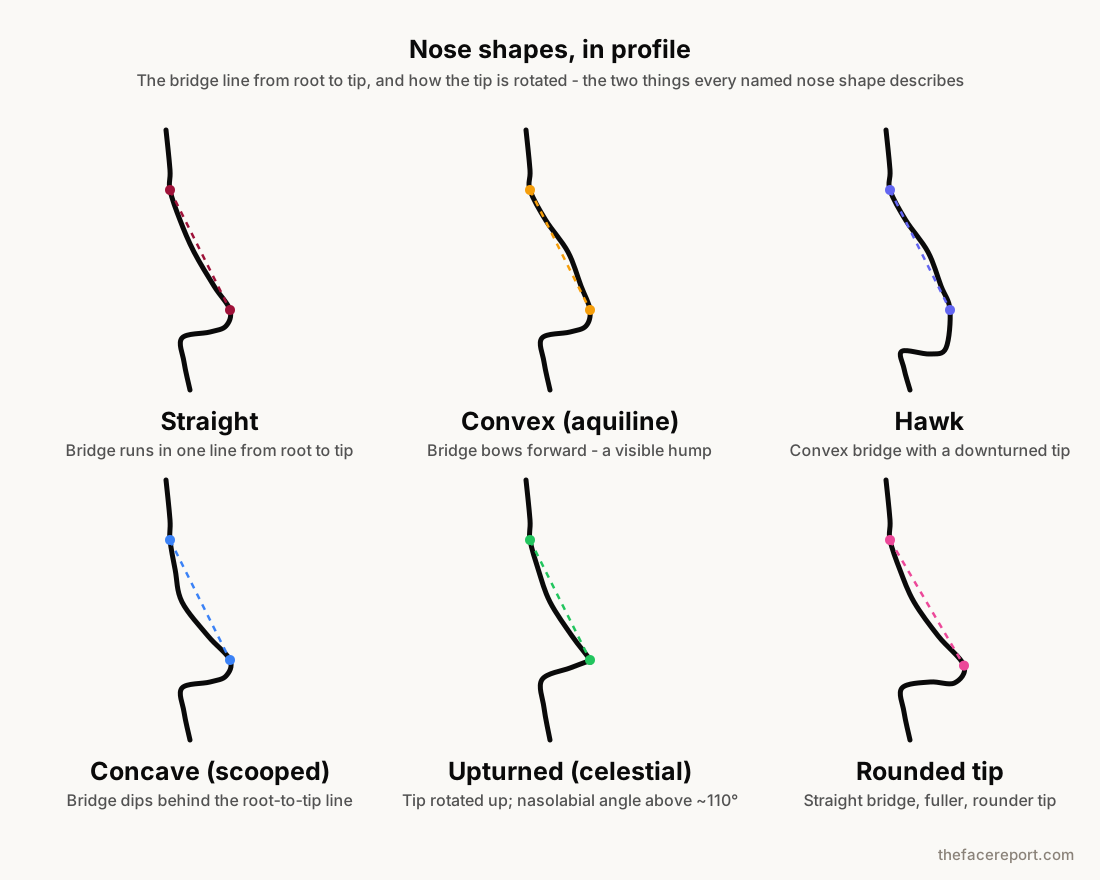
Every named nose shape - straight, aquiline, hawk, snub, upturned, fleshy - is a description of two things seen from the side: the line of the bridge between the nose root and the tip, and how the tip is rotated. Learn those two and the chart stops being a guessing game. Measure both from one side photo, free, and the analyzer names your type.
Short Answer
Look at your side view. A bridge that runs straight from root to tip is a straight nose; one that bows forward is convex (aquiline); one that dips is concave. A tip that points up makes it upturned or, with a short scooped bridge, snub; a convex bridge with a drooping tip is a hawk. Width and tip fullness come from the front view. None of these types is better, rarer than the marketing claims, or a clue to ancestry.
The Nose Shape Types
Each card gives the bridge, the tip, what the shape looks like, and the geometry our analyzer uses to report it.
Straight
also: Greek noseBridge: Straight line from root to tip
Tip: Neutral rotation
The bridge runs in one unbroken line from the nose root to the tip, with no hump and no dip. The classical sculpture profile, which is where the Greek label comes from.
Analyzer reads it as: Dorsum within a few percent of the root-to-tip line; nasolabial angle roughly 90–115°.
Convex (aquiline)
also: Roman nose, hooked nose (mild)Bridge: Bows forward - a visible hump
Tip: Neutral or slightly down
The bridge rises above the straight root-to-tip line, usually at the junction of bone and cartilage about a third of the way down. Reads as strong and defined in profile; from the front the hump is invisible.
Analyzer reads it as: Bridge deviates more than about 3.5% of nose length in front of the chord.
Hawk
also: Beak nose, strongly aquilineBridge: Pronounced hump
Tip: Drooping (nasolabial angle below about 90°)
A convex bridge combined with a tip that points down toward the lip. The combination, not the hump alone, is what makes a profile read as hawk-like.
Analyzer reads it as: Convex dorsum plus a nasolabial angle under 90°.
Concave (scooped)
also: Ski-slope nose, saddle (when severe)Bridge: Dips behind the root-to-tip line
Tip: Often slightly up
The bridge curves inward so the tip sits forward of the line from the root. A gentle scoop is common; a deep one is usually the result of injury or surgery and is called a saddle nose.
Analyzer reads it as: Bridge deviates more than about 3.5% of nose length behind the chord.
Upturned (celestial)
also: Turned-up noseBridge: Straight or slightly concave
Tip: Rotated up (nasolabial angle above about 115°)
The defining trait is the tip, not the bridge: it angles upward so more of the nostrils show from the side. Very common in children and often persists.
Analyzer reads it as: Nasolabial angle above 115°; dorsum straight or mildly concave.
Snub
also: Button nose (when small and rounded)Bridge: Short, slightly concave
Tip: Upturned and rounded
A short nose with a scooped bridge and an upturned, rounded tip. Button is the same profile in a smaller, softer version with a rounder tip.
Analyzer reads it as: Concave dorsum plus an upturned tip; usually a low nose-length ratio on the front view.
Fleshy (bulbous tip)
also: Round-tipped noseBridge: Any - usually straight
Tip: Wide, rounded, soft-edged
Defined by the tip rather than the bridge: the tip is full and rounded with soft cartilage definition. The bridge can be straight, convex or concave underneath it.
Analyzer reads it as: Reported from the front-view tip and alar width; the profile tool describes the bridge separately.
What the Front View Adds: Width and Tip
The profile names the type; the front view describes size. Four traits carry most of it, and two of them have measured population ranges from the 14,144-face norms set.
| Trait | How it is read | Range |
|---|---|---|
| Alar (nostril) width | Width across the nostrils compared with the distance between the inner corners of the eyes. | Roughly equal is the classic canon; wider and narrower are both common and both normal. |
| Nose length | Nose root to tip as a share of visible face height. | Our measured median is 0.22 of face height (10th–90th percentile 0.19–0.24). |
| Nose-to-mouth width | Nostril width compared with mouth width. | Median 0.84 (10th–90th percentile 0.74–0.92) across 14,144 faces. |
| Tip definition | Whether the tip reads as two distinct points (defined) or one rounded mass (bulbous). | A visual trait, not a measurement - lighting changes it more than any other nose feature. |
The Two Angles Behind Every Nose Shape
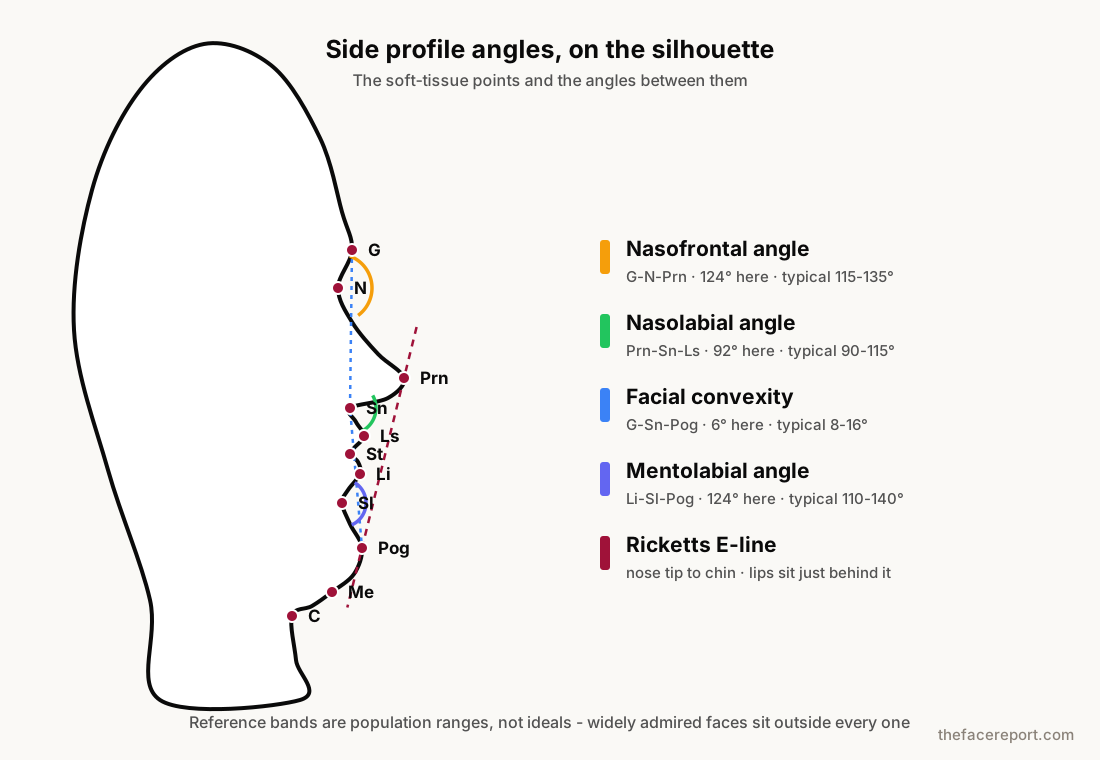
Surgeons do not use the chart names; they use two angles. The nasofrontal angle (forehead to nose, at the root) typically runs 115–135° - smaller reads as a prominent brow or high root. The nasolabial angle (tip to upper lip) typically runs 90–115° - below it the tip droops, above it the tip is upturned. Add whether the bridge sits in front of or behind the root-to-tip line and you have reconstructed the whole chart from three numbers. Those three are exactly what the side profile analyzer draws on your photo.
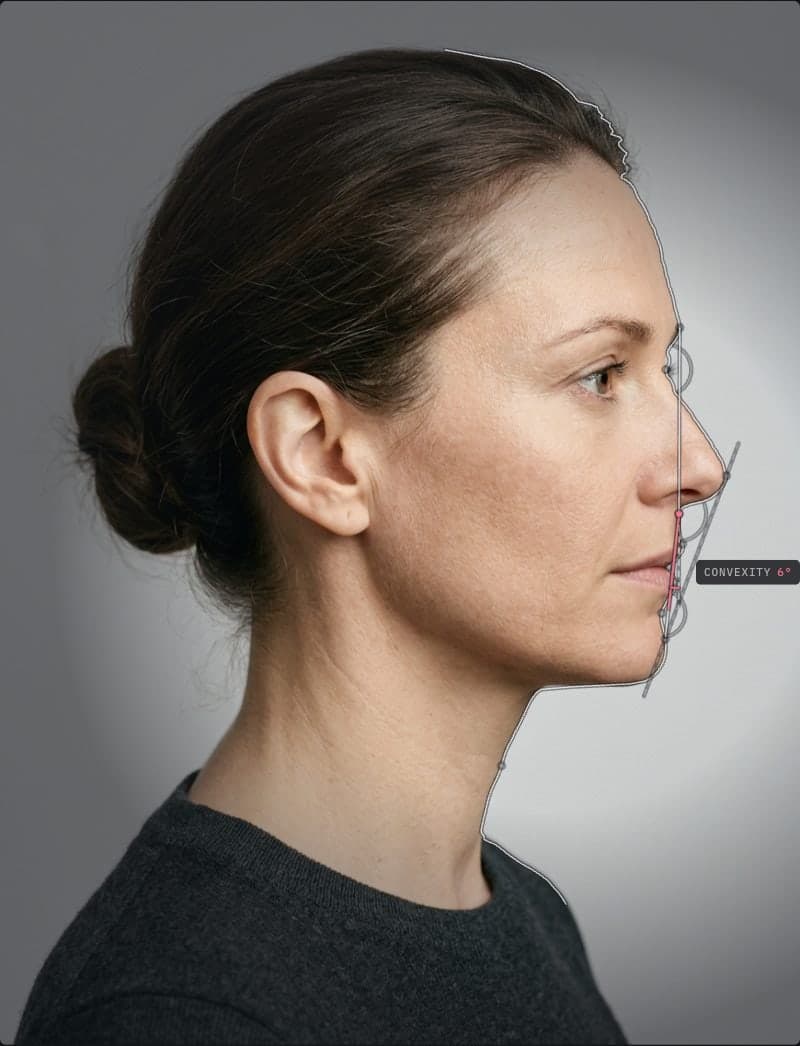
Measured examplesynthetic subject · 478 landmarks
Frequently Asked Questions
What nose shape do I have?
Look at a true side view and ask two questions. First, the bridge: does the line from nose root to tip run straight, bow forward (convex, a hump) or dip inward (concave)? Second, the tip: does it point roughly level, up (more nostril visible from the side) or down toward the lip? Those two answers place you on the chart above - straight, convex, hawk, concave, upturned or snub - and the front view adds width and tip fullness. Our free side profile analyzer measures both from one 90° photo and names the type.
What is the most common nose shape?
There is no reliable census. The rankings that circulate online come from surgeon blogs quoting small studies of clinic patients or celebrity photos, and they disagree with each other. In profile studies, a straight or mildly convex bridge with a neutrally rotated tip is the most frequently described pattern, and a slightly upturned tip is very common in women and children - but no shape is rare enough to be remarkable.
What is the most attractive nose shape?
No single one. Preference studies find that raters like noses that sit within the typical ranges for the face around them - a nasolabial angle roughly 90–115°, a bridge close to straight, width in proportion to the eyes - rather than any named shape, and those preferences shift by decade and by culture. A nose reads as attractive mainly when it does not draw attention away from the eyes and mouth, which is a statement about balance, not about type.
Can I change my nose shape without surgery?
The bone and cartilage cannot be reshaped by exercise, tape, clips or massage - claims otherwise have no evidence. What genuinely changes how the nose reads: makeup contouring (perception only), weight change (a small effect on tip softness), posture and camera height (a phone held low exaggerates nostrils and tip rotation), and time - the tip tends to drop and the nose lengthens slightly with age as the cartilage support weakens. Non-surgical filler can camouflage a hump or lift a tip temporarily; it adds volume rather than removing it and is a medical procedure with real risks.
Does nose shape change with age?
Yes, slowly. The nose finishes growing in the late teens, then over the following decades the tip drops a few degrees as the cartilage support loosens, the bridge can appear more convex because the tip has fallen away from it, and the skin thickens in some people. This is why an upturned nose at twenty often reads as straight at fifty.
Is this a nose shape chart by ethnicity?
No, and deliberately so. Nose shape varies enormously within every population, the popular labels that tie shapes to nationalities are neither anatomically defined nor reliable, and a shape says nothing about ancestry. This chart describes geometry - the line of the bridge and the rotation of the tip - and our tools report that geometry without inferring anything about who you are.
How do I measure my nose from a photo?
From the side: the nasofrontal angle (forehead to nose, typically 115–135°), the nasolabial angle (tip rotation, typically 90–115°) and whether the bridge sits in front of or behind the root-to-tip line. From the front: nostril width relative to the eyes, and nose length as a share of face height. The side profile analyzer measures the profile set and the facial ratios calculator measures the front-view set, both free and in your browser.
Sources
Find Out Which Nose Shape You Have
One side photo. The analyzer traces your profile, measures the bridge line and tip rotation, and names the type - free, private, in your browser.
Analyze My Profile FreeMeasure it instead of guessing
The chart names the pattern; the tools tell you which one your face actually shows.
Side Profile Analysis
FreeBridge line, tip rotation and the profile angles, drawn on your photo.
Facial Ratios Calculator
FreeNose length and width ratios from the front view, with population ranges.
Facial Measurement Norms
Percentiles for nose, eye and face ratios across 14,144 measured faces.
Full Face Analysis
FreeEvery feature in context, with personalised recommendations.