Lip Shapes: Which One Do You Have?
Every named lip shape - full, thin, heart-shaped, bow-shaped, downturned - is a description of four things: how tall the lips are for the width of the mouth, how far apart the corners sit, whether the upper or the lower lip carries more height, and how pronounced the cupid's bow is. Upload one front photo and the reader measures all four on your own face, in your browser, and names the shape.
Find Your Lip Shape From a Photo
For a clean read: face the camera squarely, lips relaxed and closed, no smile, even light.
Upload a photo
Drag and drop or choose a file
or
JPG, PNG or HEIC, up to 30MB
Your photo never leaves your device
 Example
The Lip Shape Chart: 9 Types
The nine shapes the reader can name, drawn to the same mouth width so the differences are the traits and nothing else. One dominant trait names the shape; a mouth with no dominant trait is balanced, which is the most common read.
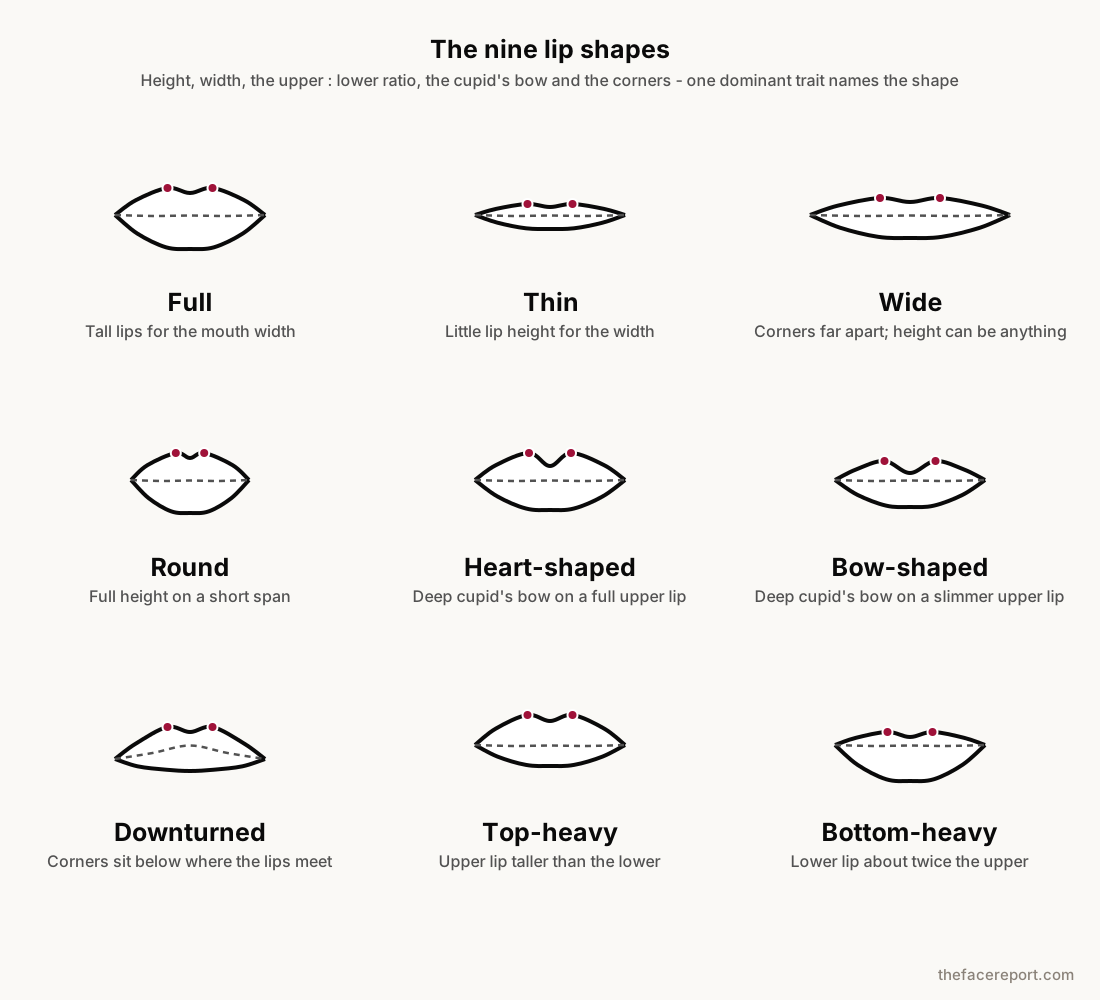
Full
also: plump lipsDefined by: Tall vermilion on both lips relative to mouth width
Both lips carry height: the outer lip line sits high on the upper lip and low on the lower one, so the mouth reads as tall for its width. Fullness is a ratio, not a size - a wide mouth with the same lip height reads less full.
Reader names it when: Lip height to mouth width in the upper quarter of measured faces (above about 0.43).
Thin
also: narrow lips, fine lipsDefined by: Low vermilion height relative to mouth width
Little visible lip between the skin and the mouth line. Often paired with a flatter cupid's bow. Thin lips are common and get thinner with age as the vermilion rolls inward.
Reader names it when: Lip height to mouth width in the lower quarter of measured faces (below about 0.33).
Wide
also: broad mouthDefined by: Corners far apart relative to face width
The mouth spans a large share of the lower face; the corners often sit under or beyond the pupils. Lip height can be anything - wide is about span.
Reader names it when: Mouth-corner width to cheekbone width in the upper quarter of measured faces (above about 0.40).
Round
also: small lips, button lipsDefined by: Tall vermilion on a short span
Full height packed into a narrow mouth, so the outline approaches a circle. The cupid's bow peaks sit close together and the corners tuck in.
Reader names it when: Fullness in the upper quarter with mouth width in the lower quarter.
Heart-shaped
also: cupid's bow lipsDefined by: A pronounced cupid's bow with a full upper-lip centre
Two clear peaks on the upper lip with a deep dip between them, and the upper lip carries real height at the centre, so the top edge reads like the top of a heart. The lower lip is usually full and rounded.
Reader names it when: Cupid's bow depth above 3.5% of mouth width, upper lip at least 0.8 of the lower lip's height, fullness above the median.
Bow-shaped
also: defined bow, M-shaped upper lipDefined by: A pronounced cupid's bow on a slimmer upper lip
The same two peaks and dip as the heart shape, but the upper lip is slimmer relative to the lower, so the bow is the feature rather than the fullness. The outline reads like a drawn bow.
Reader names it when: Cupid's bow depth above 3.5% of mouth width without the heart shape's upper-lip fullness.
Downturned
also: corners that turn downDefined by: Mouth corners sitting below the line of the lips at rest
At rest the corners fall below the line where the lips meet, so the mouth reads as serious or sad even when the person is not. Often a resting-muscle pattern rather than a lip trait, and it shifts with expression.
Reader names it when: Corner tilt below -5 degrees against the face's own horizontal, corners relative to where the lips meet.
Top-heavy
also: fuller upper lipDefined by: Upper lip taller than the lower lip
The upper lip carries as much or more height than the lower. Less common than the reverse: on most faces the lower lip is the fuller one, so a top-heavy mouth stands out.
Reader names it when: Upper-lip height divided by lower-lip height at or above 1.0.
Bottom-heavy
also: fuller lower lipDefined by: Lower lip much taller than the upper
The lower lip dominates: roughly twice the height of the upper or more. This is the proportion the aesthetic literature most often reports as preferred, and it is also simply common.
Reader names it when: Upper-lip height divided by lower-lip height below 0.55.
Heart Shaped Lips
Heart shaped lips are the shape people ask about most, and the one most often misnamed. The heart is made by two things at once: a pronounced cupid's bow - two clear peaks on the upper lip with a real dip between them - and an upper lip that carries height at the centre, so the top edge reads like the top of a heart and the full lower lip closes the point. Peaks on a slim upper lip are a bow shape, not a heart; a full upper lip with a flat top edge is simply full.
Measured, the reader calls a bow pronounced when the peaks sit more than 3.5% of the mouth width above the dip (about 1.7 mm on a 49 mm mouth), and adds the heart when the upper lip is at least 0.8 of the lower lip's height and overall fullness is above the median. On MediaPipe's average face the bow is soft, about 1.6% of the width, which is why most mouths read as balanced rather than heart-shaped. Liner placed exactly on the natural peaks, never above them, is what makes a soft bow read as defined in a photo.
Full, Thin and Wide, Measured on 18,630 Faces
Full and thin are relative words. These are the two size ratios the reader places you against, from 18,630 faces measured on this site on 4 September 2026 - percentiles, so the table cannot go stale as more faces are scanned. The middle half is the shaded band on the rails; the outer quarters are where the reader starts saying full, thin, wide or narrow.
| Ratio | p10 | p25 | Median | p75 | p90 | Reads as |
|---|---|---|---|---|---|---|
| Fullness (lip height / mouth width) | 0.28 | 0.33 | 0.38 | 0.43 | 0.49 | below p25: thin · above p75: full |
| Width (mouth width / cheekbone width) | 0.33 | 0.35 | 0.38 | 0.40 | 0.44 | below p25: narrow · above p75: wide |
Same formulas as the facial ratios tool, which reports these two alongside ten more; the full set of norms is on the facial measurement norms page.
Upper Lip vs Lower Lip
The ratio that decides top-heavy and bottom-heavy is upper vermilion height over lower vermilion height, both measured at the centre of the mouth with the lips closed. Population measurements put the adult upper lip around 6 to 9 mm and the lower around 8 to 11 mm, so a ratio near 0.7 to 0.8 is ordinary and the lower lip is the fuller one on most faces. The reader calls the mouth balanced between 0.55 and 1.0, top-heavy above 1.0 and bottom-heavy below 0.55 (a lower lip roughly twice the upper). The 1 : 2 proportion is also the one the preference study most often quoted found raters liked best, which says something about taste in one sample and nothing about your face.
Frequently Asked Questions
What lip shape do I have?
Look at four things with your lips relaxed: how tall the lips are for the width of your mouth (full or thin), how far apart the corners sit (wide or narrow), whether the upper lip or the lower lip carries more height, and how pronounced the cupid's bow is. One dominant trait names the shape - a deep bow on a full upper lip is heart-shaped, corners that sit below the lip line are downturned, an upper lip taller than the lower is top-heavy. If nothing dominates, your lips are balanced, which is the most common read. The reader at the top of this page measures all four from one front photo, in your browser, and names the shape.
What shape are my lips if the top lip is bigger than the bottom lip?
Top-heavy. On most faces the lower lip is the taller of the two - the average adult upper vermilion is around 6 to 9 mm tall against 8 to 11 mm for the lower - so an upper lip that matches or exceeds the lower is the less common pattern. It is a proportion, not a flaw, and it often comes with a pronounced cupid's bow. The reader reports the ratio directly as upper : lower.
What are full lips, measured?
Fullness is lip height relative to mouth width, not lip size on its own. Across 18,630 faces measured on this site on one day, the median outer lip height was 0.38 of the mouth width, with the middle half between 0.33 and 0.43. Above about 0.43 the lips are in the fullest quarter; below about 0.33 they are in the thinnest. A wide mouth with the same lip height reads as less full, which is why two people with identical lips in millimetres can look different.
What is the rarest lip shape?
There is no reliable census of lip shapes, so any ranking you see online is a guess. In our own measured sample the least common single trait is a top-heavy mouth, because the lower lip is the fuller one on most faces; a pronounced cupid's bow combined with a full upper lip (the heart shape) is also uncommon. Balanced lips with no dominant trait are the most frequent read.
What is the most attractive lip shape?
No single one. The preference studies that exist rate proportions, not chart shapes: a 2017 survey of 428 raters found a lower lip about twice the height of the upper (1 : 2) was preferred over 1 : 1 and 2 : 1, and that moderate fullness beat the fullest options. Those results shift with the face around the mouth, the decade and the culture of the raters. A mouth reads well when it sits in proportion to the nose and jaw, which is a statement about balance rather than about type.
Do lip shapes change with age?
Yes. From the thirties on, the upper lip lengthens (the skin between the nose and the lip line gets taller), the vermilion of both lips thins as the lip rolls inward, and the cupid's bow flattens. A heart-shaped or bow-shaped mouth at twenty often reads as balanced or thin at sixty. Corners also drop slightly with age, so a neutral mouth can become mildly downturned.
Can I change my lip shape without filler?
The bone and muscle cannot be reshaped without a procedure, and whether any procedure is right for you is a professional's decision, not this page's. What genuinely changes how the shape reads: liner placed on the natural lip edge rather than outside it (sharpens the bow and evens the corners), a lighter shade on the lower lip when it is much fuller than the upper, hydration and exfoliation (a dry lip rolls inward and reads thinner), and expression - a relaxed mouth is what the chart describes, and a slight smile lifts the corners of a downturned mouth immediately.
Is this a lip shape chart by ethnicity?
No, and deliberately so. Lip proportions vary widely within every population, the popular labels that tie lip shapes to nationalities are neither anatomically defined nor reliable, and a lip shape says nothing about ancestry. This chart describes geometry - height, width, the bow and the corners - and the reader reports that geometry without inferring anything about who you are.
How do I measure my lips from a photo?
Front view, lips relaxed and closed, camera at eye level. Measure the mouth width between the corners, the height from the top of the upper lip to the bottom of the lower lip, the upper and lower lip heights separately at the centre, and the depth of the cupid's bow (the peaks against the dip between them). Divide heights by the mouth width so the numbers work at any photo size. The reader on this page does exactly this from the 478-point face mesh, converts the bow depth and corner difference to millimetres through the iris (about 11.7 mm across in adults), and places your fullness and width against the measured distribution.
Sources
- Farkas, L. G. (1994). Anthropometry of the Head and Face (2nd ed.). Raven Press. Population measurements for vermilion height and mouth width.
- Popenko, N. A., et al. (2017). A quantitative approach to determining the ideal female lip aesthetic and its effect on facial attractiveness. JAMA Facial Plastic Surgery, 19(4), 261-267. The 1 : 2 upper-to-lower preference.
- Iblher, N., et al. (2008). Changes in the aging upper lip: a photomorphometric and MRI-based study. Journal of Plastic, Reconstructive & Aesthetic Surgery, 61(10), 1170-1176. Upper-lip lengthening and vermilion thinning with age.
See Your Lips in the Context of the Whole Face
The reader names the shape. The full report places it: how the mouth sits against the nose, the jaw and the facial thirds, and what to do about it - styling, not procedures.
Get My Full Face ReportMeasure it instead of guessing
The chart names the pattern; the tools tell you which one your face actually shows.
Color Analysis
FreeYour season and the lip colours that sit in it, from one photo.
Facial Ratios Calculator
FreeTwelve face ratios including mouth width and lip height, with population ranges.
Facial Measurement Norms
Percentiles for eye, nose, mouth and face ratios across measured faces.
Full Face Analysis
FreeEvery feature in context, with personalised recommendations.