Gonial Angle: Normal Range & What Changes It
The gonial angle is the angle of your jaw's corner - measured at the gonion, where the vertical branch of the lower jaw (the ramus) meets its horizontal body. It's the number behind every "sharp jawline" conversation, and one of the most-searched facial measurements. This guide covers what's actually normal, what sharp vs obtuse means, and - honestly - what can and can't change it. Estimate your visible jaw-corner angle free from one photo.
Short Answer
A typical adult gonial angle is roughly 120–130°. Lower reads sharper and squarer; higher reads softer and more sloped. The true clinical angle is measured on a radiograph - no photo app (ours included) can measure it exactly, and no single value is "correct."
What the Gonial Angle Actually Is
Anatomically, it's the angle at the gonion - the corner point of the mandible - between the back edge of the ramus and the lower border of the jaw body. Orthodontists and maxillofacial surgeons measure it on lateral cephalometric or panoramic radiographs, because the bony landmarks that define it sit under muscle and skin. It's one input in how they read facial growth pattern: low-angle (hypodivergent) faces tend toward square, short lower faces, high-angle (hyperdivergent) faces toward longer, more sloped ones.
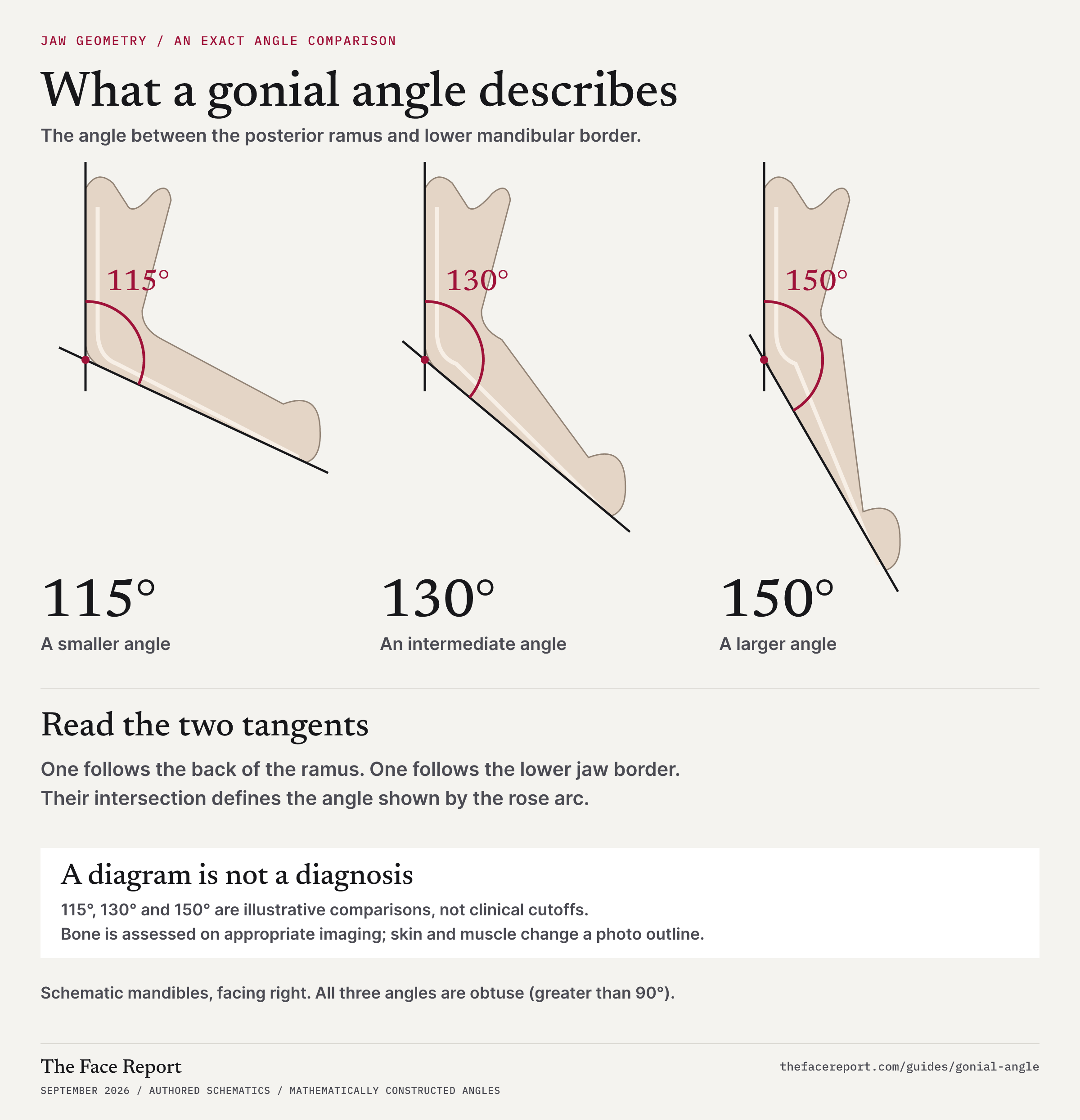
Compare the angle between the two tangents. All three examples are obtuse angles; the number increases as the corner opens. These constructed schematics explain geometry and do not predict a person’s appearance or define treatment thresholds.
Open the image above to inspect the details at full size.
What a gonial angle describes. The Face Report (2026). https://thefacereport.com/guides/gonial-angle#gonial-angle-comparison
How this was made & reuse permission
Authored vector mandible schematics with angles constructed mathematically and checked using the vectors’ dot product. The tangent definition follows published cephalometric methodology: posterior ramus border and inferior mandibular border. The drawings are schematic, not radiographs. Skin and muscle affect a photo outline, so a visible jaw-corner estimate is not the same measurement as the bony gonial angle.
You may reproduce this reference graphic in articles, teaching materials and social posts. A credit to The Face Report and a link to this source page are appreciated. If you adapt it, identify your changes and keep its illustrative context clear. This permission applies to this graphic.
Permanent source link · Published September 4, 2026 · Version 1
Measurement reference: Comparison of gonial angle determination from cephalograms and orthopantomogram.
What's a Normal Gonial Angle?
Published cephalometric norms vary by study, method, and population, but they cluster tightly enough for a practical picture:
| Group | Angle | What it means |
|---|---|---|
| Typical adult range | ≈ 120–130° | Most cephalometric references place adult means in the mid-120s; individual studies vary by method and population. |
| Lower (more acute) angle | below ≈ 120° | A sharper, squarer-looking jaw corner. Common in low-angle (hypodivergent) growth patterns. |
| Higher (more obtuse) angle | above ≈ 130° | A softer, more sloped corner, often with a steeper mandibular plane (high-angle / hyperdivergent patterns). |
| Children | larger, decreases with growth | The angle is more obtuse in childhood and closes through adolescent mandibular growth. |
| Older adults | can increase again | Tooth loss and bone remodeling can re-open the angle later in life. |
Looksmaxxing forums often quote a sharp "ideal" around 115–120° for men. Treat that as forum convention, not clinical guidance - norm studies describe what's typical, and neither they nor perception research crown one value as most attractive.
How to Measure Your Gonial Angle: Calculator vs Radiograph
The honest hierarchy: a radiograph is the only exact measurement, because the gonion and ramus are bone landmarks. A side-profile photo lets you approximate the angle with a protractor app, but soft tissue shifts the visible corner by several degrees. A front photo can't see the ramus at all - which is why our free jawline tool measures the visible front-photo jaw-corner angle from 478 landmarks and labels it exactly that - a photo-based estimate of your visible jaw geometry, not the clinical gonial angle. It's consistent photo-to-photo under the same conditions, which makes it useful as a private baseline even though it isn't a radiograph.
Measured examplesynthetic subject · 478 landmarks
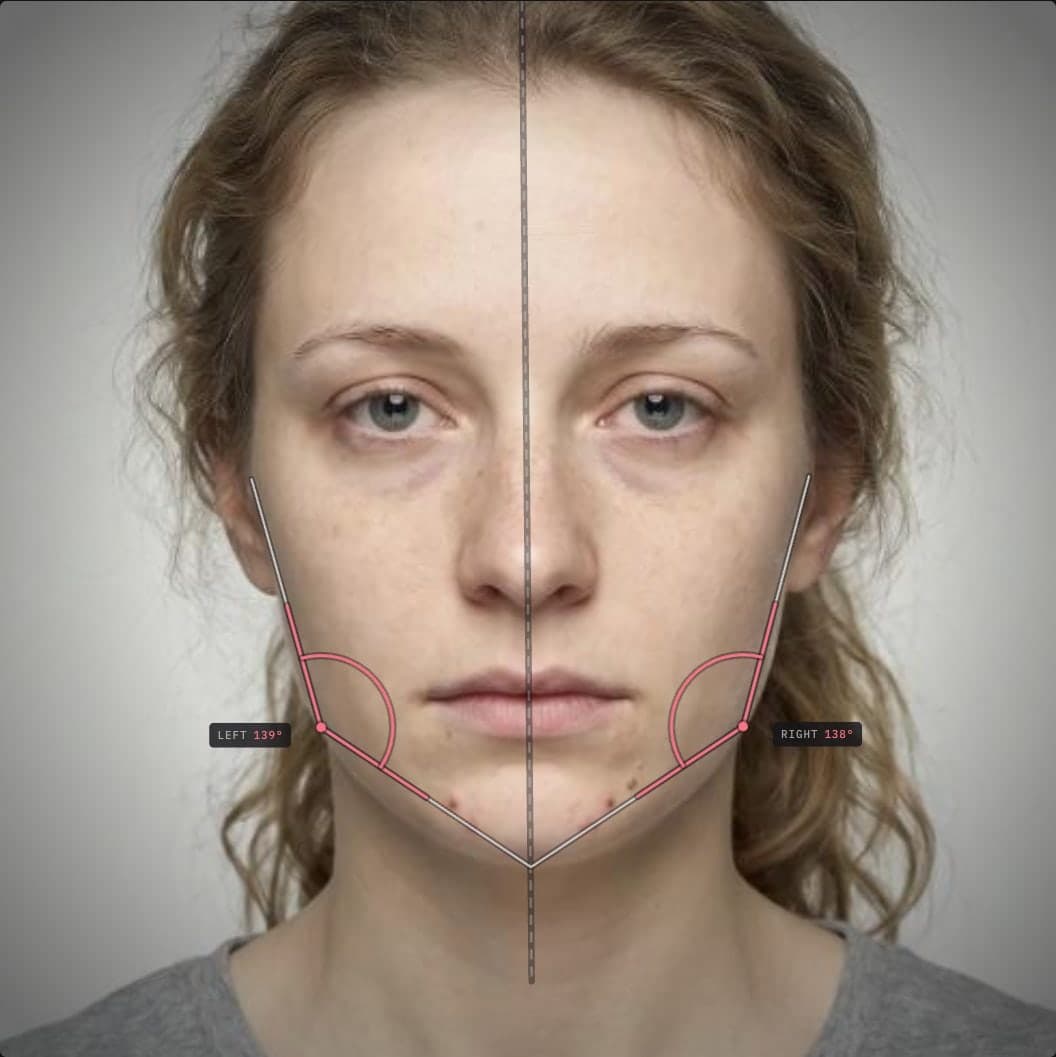
For where a photo-based reading sits against other faces, our facial measurement norms publish the percentile bands the tool uses, computed from one closed day of eye-level scans.
What Can (and Can't) Change Your Gonial Angle
In adults, the bone angle is fixed short of surgery. What most people actually want - a sharper-looking jaw corner - has non-surgical levers, because appearance is bone plus muscle plus fat:
Body-fat reduction
Appearance onlyDoes not change the bone angle, but lower facial fat makes the existing jaw corner visibly sharper. The highest-leverage non-surgical change for most people.
Masseter growth (chewing, clenching)
Appearance onlyA larger masseter muscle adds soft-tissue bulk over the jaw corner, which can read as a wider, squarer angle. The skeletal gonial angle itself does not change.
Masseter Botox
Appearance only (softens)Shrinks the masseter, slimming the lower face - the jaw corner reads softer and less square. Used deliberately for slimming, it moves appearance the opposite way from chewing.
Mewing / tongue posture
No evidenceNo peer-reviewed evidence that tongue posture changes the adult gonial angle or mandibular shape. See our mewing guide for the full evidence review.
Jaw implants / angle augmentation
SurgicalCustom mandibular-angle implants create a lower, squarer visual angle. Real risks (infection, asymmetry, revision) - specialist consultation territory.
Orthognathic surgery
Surgical (functional cases)Corrects skeletal discrepancies (severe high-angle or low-angle patterns) and changes the angle as a side effect. Planned on radiographs by a maxillofacial team, not for cosmetic tweaks.
For the broader jawline playbook - body-fat thresholds, posture, and the evidence behind each - see How to Improve Your Jawline.
Frequently Asked Questions
What is a normal gonial angle?
Most cephalometric references place the typical adult gonial angle around 120–130°, with study means commonly in the mid-120s. There is natural variation by individual, method, and population, and values outside that band are not automatically a problem - orthodontists read the angle alongside the rest of the facial skeleton, not in isolation.
Is a gonial angle of 130° bad?
No. Around 130° is at the obtuse end of the commonly cited adult range - the jaw corner reads softer and the mandibular plane steeper, which is simply one facial pattern. It is not a diagnosis, and no single angle value determines how a face looks or functions.
Do men and women have different gonial angles?
Studies report small average differences between the sexes - often a slightly larger (more obtuse) mean angle in women - but the distributions overlap heavily, and findings differ between populations and methods. The angle is not a reliable way to read sex or masculinity from a face.
Does mewing or chewing change your gonial angle?
There is no peer-reviewed evidence that mewing changes the adult gonial angle. Heavy chewing can enlarge the masseter muscle, which adds soft-tissue bulk over the jaw corner and can make it look squarer - but that is muscle, not a change in the bone angle a radiograph would measure.
How can I measure my gonial angle without an X-ray?
You can't measure the true clinical gonial angle at home - it is defined on a radiograph between the ramus and the lower border of the mandible, landmarks that skin and muscle hide in photos. What a photo can give you is an estimate of the visible jaw-corner geometry: our free jawline tool measures the front-photo corner angle from 478 landmarks and is explicit that this is a photo-based proxy, not the clinical angle.
Is there a gonial angle calculator?
Photo-based calculators exist, including ours, and they all estimate the same thing: the visible jaw-corner angle formed by the soft-tissue outline in a photograph, not the bony angle a radiograph measures. Our jawline tool draws the corner on your own photo, reports left and right in degrees, and places the average against a percentile band from 4,237 eye-level scans. Treat the number as a repeatable baseline under the same lighting and pose, not as a clinical reading.
What is the ideal gonial angle?
No study crowns one. Cephalometric norms describe what is typical - adult means in the mid-120s with wide overlap - and attractiveness research has not converged on a single preferred value, partly because the angle is read alongside chin projection, ramus length, and lower-face height. The looksmaxxing figure of 115-120° for men is forum convention. Use the typical range as context and no single angle value as a target.
What does a 180° gonial angle mean?
A 180° gonial angle would mean the ramus and the jaw body form a straight line - no jaw corner at all - which does not occur in a real mandible. When a photo app reports a value near 180°, it is almost always a landmark or pose problem: the jaw corner was hidden by hair, a turned head, a low camera, or soft tissue under the chin. Retake the photo at eye level with the ears visible before reading anything into it.
See Your Visible Jaw Angle in Seconds
One front-facing photo, 478 landmarks, and an honest photo-based estimate of your jaw-corner geometry with per-component scores. Free, private, processed in your browser.
Measure My Jaw Angle FreeMeasure it, then improve the visible part
The angle is one number - the jawline around it is what you can actually work with.
Jawline Rating Test
FreeThe measurement this guide is about - front-photo jaw-corner angle, width, and symmetry.
How to Improve Your Jawline
Body-fat thresholds, exercises, and clinical options - the evidence-ranked playbook.
Mewing Results: What Science Says
Why tongue posture won't move your gonial angle - the full evidence review.
Full Face Analysis
FreeJaw geometry in context - 40+ measurements with personalized recommendations.